



Last Tuesday, a retail owner named Sarah watched a 30% discount on bulk inventory vanish because her traditional bank application was still sitting on a loan officer’s desk after 22 days. It’s a painful reality when roughly 80% of small business loan applications at major banks end in a rejection letter. You shouldn’t have to miss a growth opportunity just because of slow paperwork. If you’re looking for Tips for Kredline success, the first step is understanding that speed and smart strategy go hand in hand.
You’ve probably felt the stress of managing payroll while waiting for a client to pay an invoice, or worried about falling into a debt trap by “stacking” the wrong types of loans. We’re here to change that. This guide will show you how to secure funding in as little as 24 hours and select a repayment structure that matches your specific revenue cycles. We’ll break down how to manage your capital effectively so you can scale your business through 2026 and build a clear path toward even larger lines of credit later.
Key Takeaways
- Discover the “Clean File” principle to streamline your application and secure funding approvals in as little as 24 hours.
- Learn how to leverage a marketplace to compare multiple offers and apply the “ROI Rule” to ensure your capital generates more value than it costs.
- Implement the essential tips for Kredline success by balancing funding speed with strategic growth to maintain a competitive edge in 2026.
- Understand the hidden risks of “stacking” multiple financial products and how to integrate repayments into your daily accounting without disrupting cash flow.
- Find out how consistent repayments can improve your profile and help you transition from bridge funding to more sustainable, long-term capital solutions.
Preparing for Kredline Success: The “Clean File” Strategy
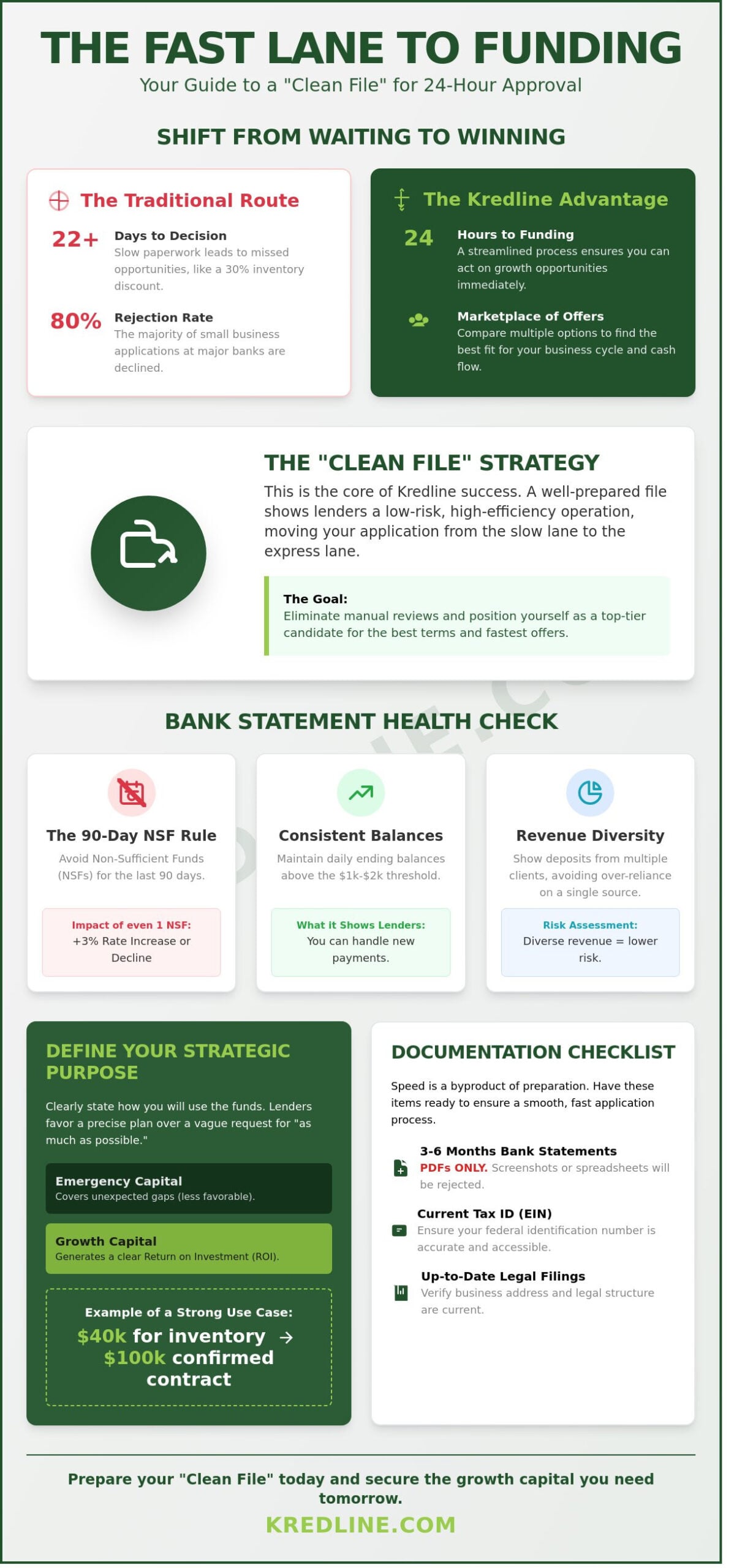
Securing capital shouldn’t feel like a second job. For most small business owners, Tips for Kredline success start with a shift in perspective. Success isn’t just getting an approval; it’s the balance of speed, cost, and strategic growth. You want the funds in your account within 24 hours, a rate that protects your margins, and a repayment structure that doesn’t stifle your cash flow. Achieving this requires a “Clean File” strategy. This principle ensures that when a lender looks at your data, they see a low-risk, high-efficiency operation.
A “Clean File” is the difference between a 48-hour waiting period and a same-day offer. Lenders prioritize clarity. If your documents are scattered or your bank statements show erratic patterns, you’re flagged for manual review, which slows everything down. By organizing your financial narrative before you prequalify for business funding, you position yourself as a top-tier candidate. This preparation allows you to leverage a business line of credit or short-term loan as a tool for precision growth rather than a desperate fix.
The Documentation Checklist for Fast Approval
Speed is a byproduct of preparation. To keep your application moving, you’ll need your last 3 to 6 months of business bank statements ready in PDF format. Screenshots or Excel exports won’t cut it; lenders need the official documents to verify your revenue health. You should also ensure your Tax ID (EIN) and legal filings are current. If you’ve recently changed your business address or legal structure, update these records before applying.
- The 90-Day NSF Rule: Avoiding Non-Sufficient Funds (NSFs) is the most effective way to lower your cost of capital. Even one NSF in a 90-day period can increase your offered rate by 3% or lead to an automatic decline.
- Consistent Ending Balances: Lenders look for daily balances that stay above $1,000 to $2,000. This shows you aren’t living “hand-to-mouth” and can handle a new payment.
- Revenue Variety: If 80% of your revenue comes from a single client, you’re seen as high risk. A diverse deposit history suggests stability.
Defining Your Strategic Funding Purpose
Your “Use of Funds” statement is often the most influential document you’ll provide. It tells the lender you aren’t just looking for a safety net; you’re looking for an engine. You must distinguish between “emergency” capital, which covers unexpected gaps, and “growth” capital, which generates a return. For example, using $40,000 to purchase inventory for a confirmed $100,000 contract is a clear ROI-generating activity.
When you match the funding amount to a specific activity, you reduce the lender’s perceived risk. This clarity often leads to improved terms and higher borrowing limits. Don’t just ask for “as much as possible.” Ask for the specific amount needed to hit your next milestone. This level of precision is one of the most overlooked Tips for Kredline success, as it builds the trust necessary for a long-term financial partnership.
Navigating the Marketplace: Matching Products to Your Business Cycle
Shopping for capital shouldn’t feel like a shot in the dark. While a single bank offers one set of rules, a marketplace gives you access to a broad spectrum of risk appetites. According to the Federal Reserve’s 2023 Small Business Credit Survey, 66% of firms faced financial challenges, yet many only applied to one source. One of the most practical Tips for Kredline success is to look beyond the total dollar amount. You need to see how the repayment structure aligns with your specific industry cash flow. Kredline allows you to compare multiple offers side by side, which prevents the “take it or leave it” pressure of traditional lending.
Before you dive into the numbers, it’s wise to establish business credit through official channels. This preparation makes you a more attractive candidate when our funding advisors step in. These advisors play a critical role; they help you interpret the “fine print” of different offers, ensuring you don’t get buried in fees that aren’t immediately obvious. They act as your navigator, translating complex financial structures into clear business outcomes.
Comparing Revenue-Based Options
For seasonal businesses, like a landscaping firm that sees a 40% revenue drop in January, Revenue-Based Financing is often the safest path. The payments scale with your sales, meaning you pay less when business is slow. If you run a high-volume retail shop or a restaurant, a Merchant Cash Advance (MCA) might fit better. It provides fast access to capital based on your daily credit card receipts. While the cost is sometimes higher than a bank loan, the flexibility in repayment is often worth the premium to protect your daily operating budget.
Lines of Credit and Short-Term Loans
If you’re managing recurring gaps, such as waiting 60 or 90 days for a $50,000 invoice to clear, a Business Line of Credit provides an on-demand safety net. You only pay interest on what you use. For a specific, one-time purchase like a new $20,000 industrial oven, a Short-Term Business Loan is usually more appropriate. It offers a fixed end date and predictable payments. You should also evaluate Equipment Funding if you want to take advantage of Section 179 tax deductions. This allows you to deduct the full purchase price of qualifying equipment in the year it’s placed in service, which is a major win for your tax strategy.
Following these Tips for Kredline success ensures you don’t just get funded, but get funded correctly. If you’re ready to see which of these structures matches your current business cycle, you can prequalify for business funding in just a few minutes.
Decoding the Cost of Capital: The ROI Rule
Business owners often hesitate when they see the price tag of fast capital. It’s a natural reaction. You’ve worked hard to build your margins, and you don’t want to see them eaten up by financing costs. However, one of the most vital Tips for Kredline success is shifting your focus from the “price” of the money to the “profit” that money enables. If a $10,000 fee allows you to secure a $100,000 profit you otherwise would have missed, the cost becomes a secondary detail. It’s about looking at capital as a tool, not just a debt.
Factor Rates vs. APR: What You Need to Know
Most traditional bank loans use an Annual Percentage Rate (APR), which includes interest that compounds over time. Revenue-based products and short-term options often use factor rates instead. A factor rate is expressed as a decimal, like 1.15 or 1.30. To find your total payback, you simply multiply the funding amount by this number. For example, if you receive $40,000 at a 1.2 factor rate, you’ll repay $48,000. There’s no compounding interest to track; the cost is fixed from day one.
Don’t fall into the trap of only looking at the daily or weekly payment amount. While cash flow management is important, the true cost of a short-term business loan is the total dollar amount you pay above the principal. When you understand this total cost, you can compare it directly against the projected revenue of your project. This clarity is what separates a strategic move from a desperate one.
Calculating Your Return on Investment
Let’s look at a real-world scenario. Imagine a retail owner who needs $50,000 to buy inventory for a peak season. Without the stock, they lose out on $150,000 in projected sales. If the funding costs them $8,000 in fees and factor costs, their total repayment is $58,000. After paying back the funding, the business is left with $92,000 in gross profit. Without the capital, that profit would be zero. In this context, the $8,000 isn’t an “expense” as much as it’s a small commission paid to unlock a massive revenue stream.
The ROI Rule states that if the net profit generated by the capital exceeds the total cost of the funding, the investment is a mathematical win for your business.
To find your breakeven point, divide the total cost of the funding by your profit margin. If your funding costs $5,000 and your margin is 20%, you need $25,000 in new sales to cover the cost of the capital. Anything above that is pure growth. While a comprehensive SBA loan guide might highlight lower rates, those products often take months to fund. In the fast-moving world of small business, the “cost” of waiting 90 days for a bank approval often far exceeds the cost of a factor rate. Using these Tips for Kredline success helps you prioritize speed and opportunity over the pursuit of the lowest possible interest rate.
Execution and Management: Avoiding Common Pitfalls
Securing capital is a milestone, but the way you handle those funds determines your long-term viability. One of the most vital Tips for Kredline success involves treating your new capital as a precision tool rather than a general safety net. If you mismanage the repayment phase, even a well-structured loan can create unnecessary friction. Success depends on proactive oversight and a clear understanding of how daily or weekly draws impact your liquid cash.
The Golden Rule: Never Stack
Stacking occurs when a business owner takes out a second or third funding product before the first one is fully repaid. This is the primary reason 62% of small business funding failures happen within the first year of over-leveraging. Lenders view multiple UCC filings as a major red flag, as it suggests your cash flow can’t support your existing obligations. If you already have multiple positions, don’t panic. You can often explore a revenue-based financing solution to consolidate those high-frequency payments into a single, more sustainable structure. This protects your credit and simplifies your daily accounting.
Post-Funding Cash Flow Management
The first 30 days after receiving funds are the most critical for your business. During this window, you must integrate the repayment schedule into your existing accounting software to avoid surprises. Many successful owners set up automated bank alerts that trigger 24 hours before a draw occurs. This ensures you never face a non-sufficient funds (NSF) fee. You should also adjust your operational budget by at least 8% to 12% to account for the cost of capital. This prevents you from “feeling” the repayment and keeps your focus on the growth projects you funded, like inventory or a short-term business loan for equipment.
Maintaining a “Clean File” status is your ticket to better terms in the future. A Clean File means you have zero missed payments and no history of blocked draws. When you reach the 50% mark of your repayment term with a perfect record, you often qualify for renewals or a business line of credit with lower rates. If your cash flow shifts because a major client is 15 days late on an invoice, call your funding advisor immediately. Transparency is always better than a bounced payment; most advisors can work with you if you reach out before the draw fails.
Want to see which funding options best fit your current cash flow? Prequalify for business funding today and speak with an advisor about your growth plan.
Long-Term Scaling: Building a Funding Relationship
Most business owners view capital as a one-time fix for a specific emergency. Real growth happens when you treat your funding source as a strategic partner instead of a safety net. Transitioning from a short-term bridge loan to a long-term capital solution requires a shift in how you manage your daily operations. One of the best Tips for Kredline success is to look past the initial deposit and focus on your long-term marketplace profile. When you repay your first facility on time, you aren’t just clearing a debt; you’re building a data-driven reputation that lenders value more than a simple credit score.
Consistent performance on the Kredline marketplace creates the “paper trail” that traditional institutions often demand. For instance, maintaining a 1.25x debt service coverage ratio over 12 months of alternative funding can position your business for an SBA 7(a) loan. These federal programs offer some of the lowest rates available, but they require the kind of disciplined financial history that successful Kredline users demonstrate through their repayment cycles. By using Kredline as a perpetual resource, you can plan your 24-month roadmap with the confidence that capital will be available when you hit your next milestone.
The Path to Lower Rates and Larger Amounts
Renewal terms differ significantly from your initial offer. In a study of 2023 funding trends, 74% of repeat borrowers qualified for lower interest rates or larger capital amounts during their second round of funding. This happens because the risk profile of your business drops once you’ve proven your reliability. You should ask your advisor about moving to longer-term products once you’ve completed 50% of your current repayment schedule. Building business credit through these timely repayments ensures that your next strategic move is funded at a lower cost of capital.
Your Next Strategic Move
Scaling requires a mindset shift from “surviving” to “investing.” Instead of using funds to cover a gap, you might use a $150,000 infusion to hire a general manager or acquire a local competitor’s assets. This move frees up your time to focus on high-level strategy rather than daily fires. When you have a reliable financial partner, you can make these decisions based on ROI rather than desperation. If you’re ready to stop reacting and start growing, you can prequalify for business funding today to see which long-term options fit your current trajectory. This is the final and most important of our Tips for Kredline success: always keep your next three moves in mind while managing the capital you have today.
Your Next Steps Toward Sustainable Growth
Securing growth capital shouldn’t feel like a gamble. It’s about preparation and knowing your numbers. When you focus on maintaining a clean financial file and apply the ROI rule to every dollar borrowed, you’re positioning your business for long-term stability. Following these tips for Kredline success helps you move past the stress of cash flow gaps and into a phase of proactive scaling. Using capital as a tool rather than a crutch is what separates businesses that struggle from those that thrive.
You don’t need to navigate the complexities of the financial world alone. Kredline provides access to a diverse marketplace of top-tier funding providers, often delivering decisions in as little as 24 hours. For most revenue-based products, you won’t even need to provide personal collateral. It’s a streamlined way to get the resources you need without the traditional banking hurdles that often slow down small business owners. This approach keeps your focus where it belongs: on your customers and your operations.
Ready to take the next step? You can see what your business qualifies for in minutes and start planning your next move with confidence. Your business has the potential; the right capital just helps you reach it faster.
Frequently Asked Questions
How long does the Kredline approval process actually take?
Most small business owners receive a funding decision within 24 hours of submitting their application. If you upload your 3 most recent bank statements by 10:00 AM on a Tuesday, you’ll often see an offer in your inbox by that afternoon. The entire process, from your initial click to seeing funds in your account, typically wraps up in 2 business days. This speed helps you handle urgent costs like a 48-hour inventory sale or an emergency equipment repair.
Will applying for funding through Kredline hurt my personal credit score?
Checking your funding options won’t impact your personal credit score because we use a soft credit pull during the initial review. This type of inquiry is invisible to other lenders and doesn’t take a single point off your FICO score. A hard inquiry only happens much later in the process if you choose to accept a specific offer. This allows you to compare 3 or 4 different funding scenarios without any risk to your personal credit standing.
What is the difference between a factor rate and an interest rate?
A factor rate is a fixed multiplier used to calculate the total payback amount, while interest rates accrue over time on a declining balance. If you receive $10,000 with a 1.2 factor rate, you’ll pay back exactly $12,000 regardless of how fast you move. Unlike a 12% APR loan where costs can shift if your timeline changes, a factor rate stays locked. It’s a transparent way to price short-term capital for 6-month or 9-month business projects.
Can I get funded if my business has a low credit score or bad credit?
Yes, you can still qualify because our review process prioritizes your business’s consistent cash flow over a single credit number. If your company generates at least $15,000 in monthly sales, a 580 credit score isn’t an automatic dealbreaker. We look at the health of your bank deposits to ensure you can manage the payments comfortably. Focusing on these revenue patterns is one of the best tips for Kredline success when traditional banks turn you away.
What does it mean to “prequalify” for business funding?
Prequalification is a non-binding estimate that shows you how much capital you can access based on 4 or 5 basic data points. It gives you a clear “yes” or “no” in about 5 minutes without requiring a stack of tax returns or 2 years of financial statements. Think of it as a roadmap for your next big move. Once you’re prequalified, you’ll know if you can afford that $25,000 expansion or if you should wait another quarter.
Is there a penalty for paying off my business funding early?
There are no hidden penalties or “exit fees” for paying off your balance ahead of schedule. In fact, many funding structures offer a 5% to 10% discount on the remaining cost if you settle the full amount early. This flexibility is a huge advantage for businesses that use the capital to flip inventory in 60 days instead of 180. If your project finishes early, you can save on costs and clear your books for the next opportunity.
What are the minimum requirements for Kredline success?
To see the best results, your business should be at least 6 months old and generate $10,000 in monthly revenue. You’ll also need a dedicated business bank account and a physical operating location within the United States. Meeting these 3 specific benchmarks is essential for Kredline success because it proves your business model is stable and predictable. Having your digital bank login or PDF statements ready before you start can shave 12 hours off your total wait time.
How much funding can my business realistically qualify for?
Most businesses qualify for an amount equal to 10% or 15% of their total annual gross sales. If your shop earns $500,000 a year, you can realistically expect funding offers between $50,000 and $75,000. We look at your average daily bank balance to make sure the daily or weekly payments won’t strain your operations. This approach ensures you get enough capital to hit your growth targets without overextending your monthly cash flow.

Article by
Billy Wagner Jr
Billy has 15 years of customer service experience and several years of experience in business loans and merchant services. His passion is helping business owners understand their options and assisting them in making confident decisions around funding and payment processing.
