



Last Tuesday, a founder named Marcus in Chicago realized his $14,200 invoice wouldn’t clear until next month, but his primary vendor payment was due in 48 hours. It’s a common stressor, as a 2024 U.S. Bank study found that 82% of small businesses fail specifically due to poor cash flow management. You’ve likely felt that same pressure when a big bank rejects your application because your company is less than two years old. Getting a startup business line of credit shouldn’t feel like an impossible hurdle just because you’re still in the early stages of your journey.
We believe you deserve flexibility, not a cold rejection letter based on outdated banking models. This guide explains how to secure and strategically use a business line of credit to bridge those invoice gaps and keep your operations moving. You’ll learn how to access revolving funds with lower interest costs than typical credit cards and see exactly what lenders are looking for in 2026. We’re going to cover everything from meeting payroll during seasonal dips to grabbing surprise growth opportunities without the stress of high-interest debt traps.
Key Takeaways
- Learn why a revolving credit facility offers the flexibility new businesses need to bridge cash flow gaps that traditional term loans often cannot handle.
- Identify the specific “time in business” milestones and revenue benchmarks you need to hit to qualify for the most competitive rates.
- Compare a startup business line of credit against alternative options like revenue-based financing to see which best supports your current growth phase.
- Discover strategic ways to draw funds for revenue-generating activities while avoiding common traps that lead to cycles of permanent debt.
- Understand how to use a marketplace to find startup-friendly lenders without damaging your credit score through multiple direct applications.
What Is a Startup Business Line of Credit?
In the early stages of a venture, cash flow rarely moves in a straight line. A startup business line of credit acts as a flexible financial tool designed specifically for companies with limited operating history. Unlike traditional bank products that often require three years of tax returns, these lines focus on your current performance and future potential. It’s a revolving facility, meaning you have access to a set amount of capital you can use whenever a need arises. You aren’t forced to take the full amount at once, which gives you total control over your debt levels.
You can think of this as a high-limit credit card with a professional upgrade. While a standard card might cap you at $10,000 with high interest rates, a business line of credit provides deeper liquidity and significantly lower rates. In early 2026, we’ve seen these lines offer the speed of a credit card but with the structural benefits of a bank loan. It’s there when you need it, and it stays out of the way when you don’t. This setup is perfect for the fast-moving, unpredictable nature of modern markets.
Revolving Credit vs. Fixed Term Loans
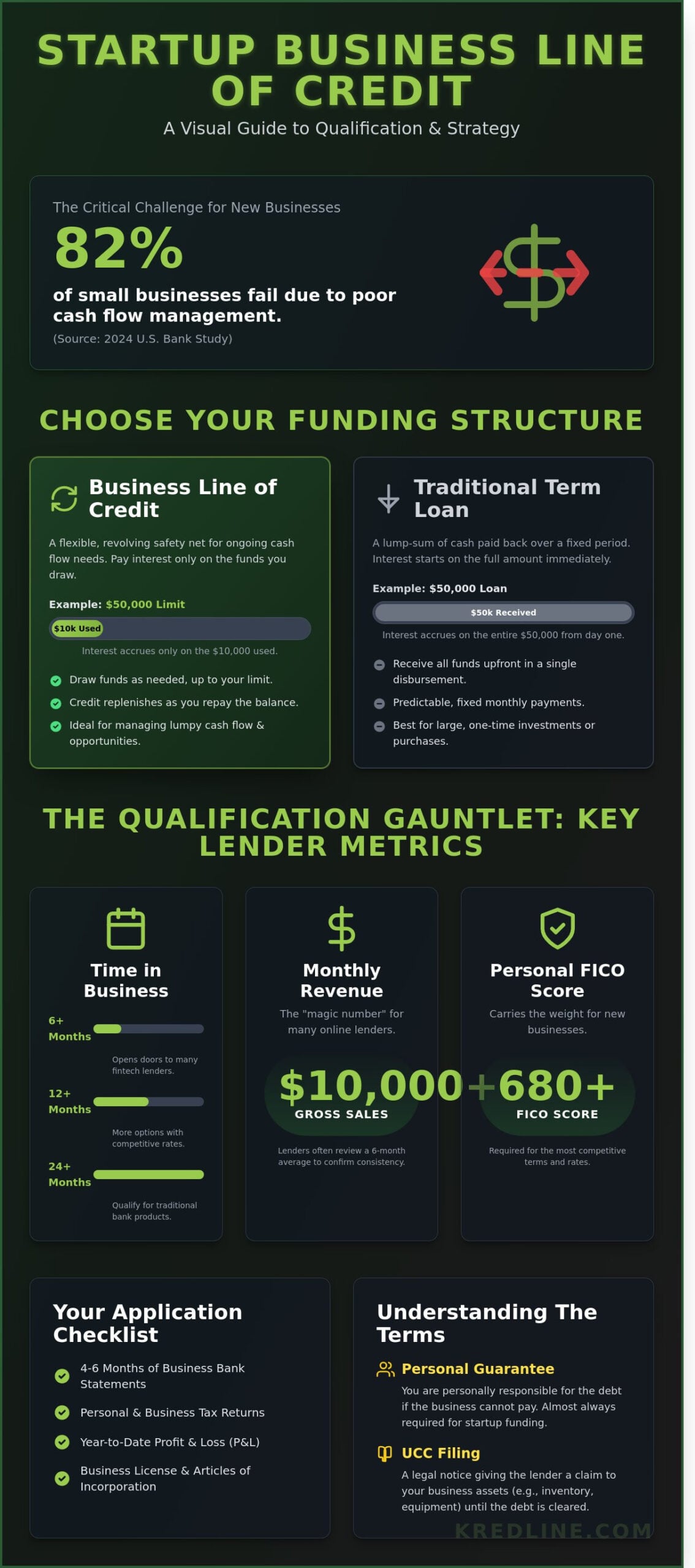
A term loan gives you a lump sum on day one; you pay interest on every penny immediately. With a line of credit, you only pay for what you actually draw. If you have a $50,000 limit but only use $10,000 to cover a vendor invoice, you only owe interest on that $10,000. As you pay the balance back, your available credit “recycles” back to the full $50,000. This cycle provides a permanent safety net during your first 24 months of operation.
Why Startups Prioritize Lines of Credit
New businesses often face “lumpy” cash flow. You might land a big contract today but wait 60 or 90 days for the payment to hit your account. Meanwhile, payroll is due every two weeks. A startup business line of credit bridges this gap perfectly. Data shows that roughly 65% of new ventures struggle due to cash flow timing rather than a lack of total profit. Having this buffer allows you to hire a key staff member or handle an emergency repair without waiting for a client’s check to clear. It’s about staying agile and keeping your momentum when unexpected shifts happen.
Managing a new company is stressful enough without worrying if you can afford a surprise expense. By securing a line of credit early, you’re essentially buying insurance for your cash flow. It’s a proactive step that ensures you’re never forced to pass up a growth opportunity just because your capital is tied up in accounts receivable.
Qualification Requirements for New Businesses
Securing a startup business line of credit isn’t about luck. It’s about meeting specific data points that lenders use to measure risk. Most startups fall into three buckets based on their age. At 0 months, you’re often looking at personal credit-based options or equipment financing. By 6 months, many fintech lenders open their doors if you show consistent growth. Once you hit 12 months, your options expand to include more traditional institutions with lower rates.
Revenue is the second major hurdle. For many online lenders in 2026, $10,000 in monthly gross sales is the magic number. This threshold proves your business model works and you have the cash flow to handle revolving debt. If your sales fluctuate, lenders look for a 6-month average to ensure you won’t default during a slow month. If you haven’t hit that $10,000 mark yet, some lenders might still consider you if your profit margins are exceptionally high.
Since your business likely lacks a deep credit history, your personal FICO score carries the weight. A score of 680 or higher is typically required for competitive terms. You’ll also need to gather specific documents to prove your claims:
- The last 4 to 6 months of business bank statements.
- Your most recent personal and business tax returns.
- A year-to-date Profit and Loss (P&L) statement.
- A valid business license and articles of incorporation.
The Personal Guarantee and Collateral
Most lines for new ventures are unsecured, meaning you don’t pledge a specific building or vehicle. However, they almost always require a personal guarantee. This means you’re personally responsible for the debt if the business can’t pay. Lenders also place a UCC filing on your business assets. It’s a legal notice that gives them a claim to business property until the debt is cleared. You can check your eligibility to see which structure fits your current asset base.
Alternative Metrics Lenders Use
Modern lenders care more about your daily bank balances than a long-winded business plan. They use API connections to analyze your real-time cash flow, looking for a healthy Daily Average Balance. Industry risk also plays a role. If you’re in a high-risk sector like construction or trucking, lenders might require higher revenue or a better credit score to offset the volatility of your field. They want to see that your cash stays in the account rather than being spent the moment it arrives.
Comparing Funding Options for Early-Stage Growth
Choosing the right capital source is about matching the tool to the specific task at hand. If you’re looking for a startup business line of credit, you’re likely prioritizing flexibility. However, a short-term business loan might serve you better if you have a single, fixed expense like a $50,000 office renovation or a bulk inventory purchase. Loans usually provide a lump sum with fixed monthly payments, whereas lines of credit only charge interest on the amount you actually draw.
The cost of capital varies significantly across the board. APRs for lines of credit in 2026 often range from 8% to 25%, depending on your personal credit score and business history. If your sales are steady at $15,000 per month but your credit score sits below 650, revenue-based financing offers a practical path forward. You’ll pay back a percentage of daily sales rather than a fixed interest rate, which protects your cash flow during slower weeks. For those needing cash in under 24 hours to bridge a gap, a Merchant Cash Advance provides speed, though it’s often the most expensive option with factor rates starting around 1.15.
Business Credit Cards vs. Lines of Credit
Many founders lean on business credit cards for the 0% introductory APR, which can last 12 to 21 months. It’s essentially free money if you pay it off before the window closes. But cards fail when you need to cover payroll or pay a vendor who only accepts ACH transfers. A line of credit allows for cash draws directly into your checking account without the heavy “cash advance” fees cards charge. It also builds a different type of credit depth that lenders look for during future expansion.
Financing for Specific Needs
Don’t use your line of credit for a $100,000 delivery van or heavy machinery. Instead, look into equipment funding. This uses the machinery itself as collateral, which often results in lower rates and longer repayment terms. Using a startup business line of credit responsibly for 12 months can also help you qualify for a $500,000 SBA 7(a) loan later. It proves to traditional banks that you can manage revolving debt. Speed matters too; while an SBA loan takes months, we’ve seen startups at Kredline get a line of credit approved in just three business days.
Strategic Use of Your Credit Line
Securing a startup business line of credit is a major milestone, but the real advantage comes from how you deploy those funds. The golden rule for any new venture is simple: only draw capital for activities that are revenue-generating or cost-saving. If a $10,000 draw doesn’t have a clear path to returning $11,500 or more through increased sales or operational efficiency, it’s probably not the right time to use it. You want your credit to be a springboard, not a weight.
It’s vital to avoid the “permanent debt” trap by treating the line as a short-term bridge rather than a long-term loan. If your balance stays maxed out for more than 90 days, you aren’t using a revolving tool; you’re carrying a high-interest burden that limits your flexibility. Use the funds, pay them back, and keep the limit available for the next opportunity. This liquidity also gives you incredible leverage with your own suppliers. Many vendors offer a 2% discount if you pay within 10 days instead of 30. On a $25,000 inventory order, that $500 saving often exceeds the interest cost of a two-week draw, putting money back into your pocket.
Success also depends on timing. Don’t let your repayment dates catch you off guard. Set up a schedule that mirrors your customer payment cycles. If your clients typically settle their invoices on the 15th of the month, schedule your credit line payments for the 17th. This ensures the cash is actually in your account before it needs to go back to the lender, keeping your cash flow smooth and predictable.
Managing Working Capital Effectively
Startups often struggle with “burn rate,” which is the amount of cash you spend each month before becoming profitable. If your monthly burn is $12,000 and you have $36,000 in cash, you have exactly 3 months of runway. A well-managed startup business line of credit can extend that runway to 5 or 6 months, giving you more time to hit key growth milestones. You can also use these funds to grab bulk inventory discounts. A 10% price break on a large order can significantly boost your profit margins. It’s also a perfect safety net for payroll. During a slow seasonal dip or a 45-day wait for a large invoice to clear, you can meet your team’s salaries without stressing your main operating account.
Building Your Business Credit Profile
Your behavior with a credit line today determines your borrowing power tomorrow. Responsible use is the fastest way to boost your business credit score. Lenders look closely at two factors: timely payments and low utilization. Aim to keep your credit utilization below 30% of your total limit. For instance, if you have a $50,000 line, try not to carry a balance higher than $15,000 for extended periods. After 6 months of perfect payment history, you’ll be in a strong position to request a limit increase. This builds a foundation of trust that makes future expansion projects much easier to fund.
If you’re looking for a partner to help you navigate these options, you can prequalify for business funding through Kredline to see what your startup qualifies for today.
How to Find the Best Startup Line of Credit
Applying to multiple lenders directly is a common trap for new founders. Every time you submit a formal application, the lender performs a hard credit pull. Doing this three or four times in a single month can lower your FICO score by as much as 35 to 50 points. This makes your business look high-risk to underwriters, even if you are simply trying to find the most competitive rate. It is much safer to use a filtered approach where your credit remains protected during the initial search.
The details in the loan agreement matter more than the headline interest rate. You must look for hidden costs that eat into your margins. Common expenses include:
- Draw Fees: A charge of 1% to 3% every time you move money from the line to your bank account.
- Maintenance Fees: Monthly or annual charges just for keeping the line active, regardless of whether you use it.
- Prepayment Penalties: Fees charged if you pay off your balance earlier than the scheduled term.
Positioning your business to be “Funding Ready” is about timing. Lenders in 2026 want to see that you don’t actually need the cash to survive the next week. They look for a healthy average daily balance, typically at least $5,000, over the last three months. By applying while your cash flow is steady, you secure better terms and higher limits than you would during a genuine financial crunch.
The Marketplace Advantage with Kredline
Kredline acts as a professional navigator by connecting startups with third-party providers who specifically fund new ventures. Instead of a hard inquiry that stays on your report for two years, Kredline utilizes a “Soft Pull” process. This lets you see your actual options and potential limits without any impact on your credit score. You get personalized guidance to ensure your startup business line of credit fits your specific 2026 growth targets, whether you are scaling inventory or hiring your first five employees.
Next Steps for Your Startup
Your first move should be gathering your documentation. Most lenders require your last 4 to 6 months of business bank statements to verify your revenue consistency. Having these PDFs organized and ready can reduce the approval time from several days to just a few hours. Once your paperwork is ready, define your objective clearly.
My primary funding goal for this quarter is to secure $40,000 in revolving credit to bridge the 30-day gap between inventory purchases and customer payments.
Ready to see what your business qualifies for? You can prequalify for business funding to see your available options today.
Securing Your Startup’s Financial Future in 2026
Navigating the early years of a business requires more than just a great idea; it demands consistent access to capital. By 2026, successful founders will prioritize flexibility by securing a startup business line of credit before they actually need it. This proactive approach ensures you can cover payroll during a slow month or jump on a bulk equipment discount without draining your cash reserves. It’s about having a safety net that grows alongside your revenue.
We’ve simplified the search by connecting you to a national network of 75+ third-party lenders through a no-obligation prequalification process that takes under 5 minutes. Our team offers specialized support to ensure your working capital aligns with your specific growth goals. You don’t have to handle the complexities of the credit market on your own or waste time with paperwork that leads nowhere.
Explore your startup funding options with Kredline and see what your venture qualifies for today. Building a resilient business is a long-term commitment, and the right funding partner makes the journey much smoother.
Frequently Asked Questions
Can I get a business line of credit with no revenue?
You can obtain a startup business line of credit with no revenue if you have a personal credit score above 700 or significant personal assets. While traditional banks usually demand 2 years of tax returns, many 2026 fintech lenders focus on your projected cash flow and personal financial health instead. If your business is still in the pre-revenue stage, you’ll likely need a personal guarantee to secure the funds.
What is the minimum credit score for a startup business line of credit?
You’ll generally need a personal credit score of 680 or higher to qualify for competitive rates. While some specialized lenders offer options for scores as low as 620, these often come with higher interest rates and smaller credit limits. Kredline helps you look at your full financial picture to see which lenders match your specific score and business stage without the guesswork.
How long does it take to get approved for a startup credit line?
Approval times vary, but you can expect a decision within 24 to 72 hours from most digital lenders. If you choose a traditional brick-and-mortar bank, the process often stretches to 20 or 30 days due to manual underwriting and heavy documentation requirements. Having your 2025 financial statements and recent bank records ready can shave 3 days off the total wait time.
Are startup business lines of credit secured or unsecured?
Most startup lines are unsecured, which means you won’t have to sign over your house or specific equipment as collateral. This doesn’t mean there’s no risk; 95% of these agreements include a personal guarantee. This legally binds you to repay the debt if the business can’t, so it’s a serious commitment for any founder regardless of the business structure.
What are the typical interest rates for startup lines of credit in 2026?
In 2026, interest rates for a startup business line of credit typically fall between 9% and 24% APR. Your specific rate depends on your credit history and how long you’ve been operating. Since the Federal Reserve adjusted benchmarks recently, a business with a 720 score might see rates closer to 10%, while a brand new venture might pay 18% or more.
Can I use a business line of credit for any business expense?
You’re free to use the funds for any legitimate business purpose, such as covering a $5,000 payroll gap or buying $10,000 in seasonal inventory. It’s a flexible tool designed for short-term working capital rather than buying heavy machinery or long-term real estate. Using it for personal expenses is a mistake that can trigger tax audits or immediate repayment demands from your lender.
Does a business line of credit affect my personal credit score?
Applying for a line usually triggers a hard inquiry, which can dip your personal score by 5 to 10 points temporarily. Most lenders don’t report your monthly business balance to personal bureaus unless you fall 30 days behind on your payments. Maintaining a low utilization rate on your business line is a smart way to protect your personal financial standing while you grow.

Article by
Billy Wagner Jr
Billy has 15 years of customer service experience and several years of experience in business loans and merchant services. His passion is helping business owners understand their options and assisting them in making confident decisions around funding and payment processing.
