



Why did a manufacturing firm with $1.2 million in annual revenue recently get offered a factor rate of 1.42 while their direct competitor secured a 1.18 for the same $100,000 line of credit? It isn’t just luck; it’s about the data story your business tells before you even hit submit. Most owners feel the sting of seeing lower than requested funding amounts or rates that eat into their margins. If you’re wondering how to improve Kredline results and secure better terms, you’re already ahead of the curve. It’s frustrating when you know your cash flow is strong, yet a lender sees a seasonal dip from last November and labels you high risk.
We believe your financing should work for you, not against you. That’s why we’ve put together this guide to help you understand exactly what lenders are looking for and how to strengthen your profile to your advantage. You’ll learn how to clean up your bank statements, manage debt-to-income ratios, and present a rock-solid case for the capital you need. We’ll show you the specific roadmap to lower your cost of capital and secure faster approvals so you can get back to growing your business without the constant stress of the application process.
Key Takeaways
- Focus on maintaining consistent monthly revenue rather than occasional sales peaks to prove to lenders that your business is stable and reliable.
- Learn how to improve Kredline approval odds by conducting a simple self-audit of your bank statements to identify and reduce non-essential expenses.
- Understand the “stacking trap” and why taking on too many funding positions at once can damage your debt-to-income ratio and limit your future options.
- Identify the critical time-in-business milestones that shift your profile from high-risk to a preferred candidate for higher limits and more flexible terms.
- Discover how a marketplace approach helps you navigate different products, like lines of credit or equipment financing, to find the best match for your current business health.
Understanding Your Funding Profile: What Does it Mean to “Improve” Your Standing?
Most business owners think their personal credit is the only thing that matters when they need capital. While understanding your credit score is a vital starting point, your funding profile is a much broader resume of your company’s financial health. It includes your daily bank balances, the consistency of your revenue, and even your industry’s specific risk level. When you focus on how to improve Kredline submissions, you aren’t just fixing a number; you’re proving to a network of lenders that your business is a safe bet.
Kredline acts as a professional bridge between your business and a diverse network of third-party lenders. Because we aren’t a single bank with a narrow set of rules, your profile needs to be versatile. A “good” profile to one lender might look different to another. Improving your standing means optimizing your data so that multiple lenders compete for your business, which naturally drives down your costs and opens up larger pools of capital.
The Shift from Personal Credit to Business Performance
Traditional banks often get stuck on a FICO score from 2022, but alternative lenders care more about what you did last month. They prioritize cash flow and real-time performance over static credit reports. Kredline uses your recent banking data to match you with lenders who specialize in your specific niche, whether you’re running a seasonal retail shop or a high-volume construction firm. A funding profile is the digital footprint of a business’s ability to repay capital.
- Cash Flow Consistency: Lenders look for steady daily or weekly deposits rather than erratic spikes.
- Industry Benchmarks: Your profile is measured against other businesses in your sector to determine risk.
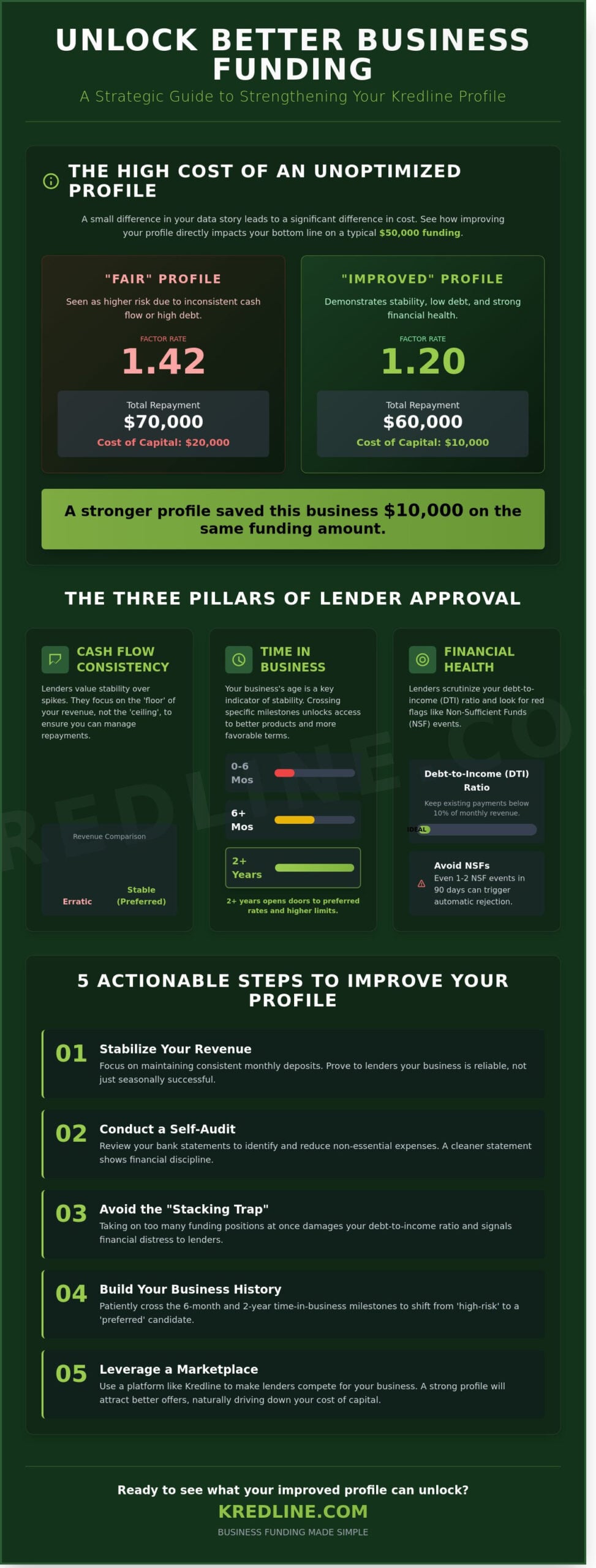
- Debt-to-Income Ratio: Keeping your existing loan payments below 10% of your monthly revenue makes you a prime candidate.
The Cost of Inaction: Why Waiting to Improve Costs You Money
Waiting to clean up your profile isn’t a neutral choice; it’s an expensive one. Lenders categorize businesses into risk tiers, and even a small move between these tiers changes your factor rate significantly. If you learn how to improve Kredline profile metrics now, you can qualify for more flexible products like a business line of credit instead of being stuck with high-interest, one-time advances.
Let’s look at the math on a $50,000 funding amount. A business with a “fair” profile might receive a 1.4 factor rate, meaning they pay back $70,000. However, a business that took six months to improve their cash flow and average daily balances might secure a 1.2 factor rate. That same $50,000 now costs only $60,000 to repay. That $10,000 difference is pure profit that stays in your pocket simply because your profile looked slightly more stable to the underwriting team. Short-term fixes like a quick cash injection can help in a pinch, but long-term financial health is what builds a sustainable ceiling for your growth.
The Three Pillars of Approval: What Lenders Look for in a Kredline Application
Underwriters don’t just look at a single number to decide your business’s worth. They’re looking for a story of stability. When you’re figuring out how to improve Kredline approval odds, you have to look at your business through the lens of a lender’s risk model. They focus on the “floor” of your monthly sales rather than the “ceiling.” A business that consistently brings in $20,000 every month is often more attractive than one that hits $100,000 in June but drops to $2,000 in July. Stability suggests you can handle a daily or weekly payment without breaking your cash flow.
Time in business acts as a psychological hurdle. Most alternative lenders require at least 6 months of active operations to consider an application. Once you hit the 2-year mark, you enter a different tier of financing with lower rates and longer terms. If you’re under that 6-month window, it’s often better to wait and build a solid deposit history. Automated underwriting systems also scan for Non-Sufficient Funds (NSF) events. Even one or two NSF marks in a 90-day period can trigger an automatic rejection. These are seen as “cardinal sins” of cash flow management, signaling that the business is living too close to the edge.
Your industry risk, defined by your SIC or NAICS code, also sets the baseline for your offers. A restaurant (SIC 5812) or a trucking company (SIC 4213) might face different scrutiny than a consulting firm. Lenders use these codes to predict how likely your specific sector is to face a downturn. Knowing your code helps you understand the “why” behind your initial offer terms.
Revenue: The Lifeblood of Alternative Financing
Lenders look for “vibrancy” in a bank account. This means they want to see 10 to 15 deposits per month. If you only have one or two large deposits, a lender worries that losing a single client will tank your ability to repay. For seasonal businesses, the key is to provide 12 months of bank statements instead of the standard three. This proves that your “slow months” are a predictable pattern rather than a sign of a failing business. This consistency is the direct link to securing better revenue-based financing terms, as it gives the lender confidence in your future sales.
The Documentation Trail: Making the Underwriter’s Job Easy
Speed is everything in business funding, and bad documentation is the biggest bottleneck. Always provide clean, digital PDF bank statements. Photos of printed statements often fail the automated verification checks used by 85% of modern lenders. While you work to establish business credit through official channels, keeping an updated Profit and Loss (P&L) statement makes you look like a pro. Transparency during the initial interview is just as vital. If you have a dip in revenue because of a one-time equipment repair, say so. Understanding these nuances is a big part of how to improve Kredline matches, as it allows brokers to place you with lenders who understand your specific situation.
If you’re ready to see where your business stands, you can prequalify for business funding in just a few minutes without affecting your credit score.
Strategic Cash Flow Management: The Key to Higher Funding Limits
Lenders don’t just look at your credit score; they look at your cash flow’s “breathing room.” Your debt-to-income ratio tells a story about whether you’re thriving or just keeping your head above water. To see a real difference in your offers, aim for a debt-service coverage ratio (DSCR) above 1.25. This means for every dollar of debt payment, your business generates $1.25 in net income. Learning how to improve Kredline eligibility starts with this fundamental metric. If your ratio is lower, it signals to underwriters that a new payment might break your budget.
Managing the Daily Balance
Your Average Daily Balance (ADB) is a vital sign for any funder. If your account hits zero or goes negative even once a month, it triggers automated risk alerts that can slash your potential funding limit by 50% or more. Try to maintain a floor of at least 10% of your monthly revenue. If you do $50,000 in monthly sales, don’t let that balance dip below $5,000. Timing is everything. Don’t take a draw the day before your largest vendor payment is due. Efficient merchant services also help by ensuring your revenue hits your account predictably, giving lenders a clear view of your total volume without the “noise” of delayed deposits.
Avoiding the Pitfalls of Multiple Advances
“Stacking” happens when a business takes out a second or third advance before paying off the first. It’s a trap that often leads to a 40% increase in daily payment pressure. Lenders see this as a sign of distress rather than growth. If you’re already in this cycle, Kredline can help you consolidate these high-frequency payments into a single, more manageable structure. Cleaning up your balance sheet is a prerequisite for larger capital. Taking a strategic short-term business loan to bridge a 30-day gap is smart, but using it for long-term survival is risky.
Consistent performance with smaller, short-term options builds the “repayment muscle” needed for larger traditional loans. You can use these smaller wins to establish and manage business credit effectively. This track record proves to banks that you can handle six or seven-figure SBA loans. When you know how to improve Kredline profiles through disciplined cash management, you’re not just getting a quick fix; you’re building a financial foundation that makes your business an attractive candidate for the most competitive rates on the market.
5 Actionable Steps to Improve Your Odds for Better Business Financing
Getting your business ready for funding isn’t just about having a high credit score. Lenders look at the health of your daily operations to determine how much risk they’re taking. If you’re wondering how to improve Kredline funding potential, start with these five practical steps to tighten up your financial profile.
- Perform a Self-Audit: Download your last three months of bank statements and look at them through a lender’s eyes. You’re looking for consistency in deposits and a lack of “red flag” transfers to personal accounts.
- Trim the Fat: Every dollar you save on non-essential business expenses directly boosts your net income. A 5% reduction in monthly overhead can significantly improve your debt-service coverage ratio.
- Formalize Your Credit: Don’t rely solely on your personal score. Set up a dedicated business credit file with bureaus like Experian Business or Dun & Bradstreet to build a track record for your EIN.
- Maintain a Cash Buffer: Non-sufficient funds (NSF) fees are deal-killers. Keeping a minimum “floor” of $1,000 to $2,000 in your account at all times helps you eliminate these fees and shows you can manage cash flow responsibly.
- Prequalify Early: You don’t need to wait until you’re in a cash crunch to see where you stand. Checking your options early allows you to identify gaps in your profile without a hard credit pull affecting your score.
The 90-Day Sprint: Cleaning Up Your Financials
Lenders typically focus on your most recent 90 days of activity. During this period, you should identify any “red flags” like erratic deposit patterns or high numbers of small, recurring withdrawals that don’t serve the business. If you had a one-time emergency expense, such as a $4,500 HVAC repair in June, be ready to explain it. Kredline advisors appreciate transparency; showing that a dip in cash was a calculated investment rather than a systemic problem builds trust. Categorize every transaction in your accounting software to ensure your ledger provides maximum clarity for any reviewer.
Building a Relationship with Your Broker
You shouldn’t only talk to your broker when you need money. Regular check-ins can lead to “early renewal” offers that feature lower rates or longer terms as your business matures. If your monthly revenue has grown by 15% since your last application, it’s a great time to update your prequalification status. When you land a major new contract or hit a growth milestone, share that data. This proactive approach helps you leverage your success to renegotiate current rates. Understanding how to improve Kredline terms often comes down to demonstrating that your business is on an upward trajectory.
Ready to see what your current financial profile can unlock for your business?
How Kredline Navigates the Marketplace to Find Your Best Match
Applying for capital can often feel like shouting into a void. If you apply to ten different lenders on your own, you risk ten hard credit pulls and a mountain of repetitive paperwork that slows you down. Kredline changes that dynamic. We act as your advocate, taking your profile and presenting it to a curated network of lenders who are already looking for businesses like yours. This is where the preparation pays off. When you understand how to improve Kredline‘s ability to represent you by providing clean bank statements and clear use-case plans, the offers that come back are significantly more competitive.
Our advisors don’t just blast your application to every name on a list. We match your specific needs with the right product. A retail shop with $50,000 in monthly credit card sales requires a different approach than a manufacturing firm looking to buy a $200,000 CNC machine. By narrowing the search to lenders that specialize in your industry, we reduce the time from application to “cash in bank” to as little as 24 to 48 hours in many cases.
Beyond the Application: The Human Element
Numbers are essential, but they don’t tell the whole story. A spreadsheet won’t explain that your revenue dip last October was due to a planned facility upgrade that eventually tripled your output. Kredline advisors take the time to learn these details so they can tell the story of your business to lenders. This human touch often makes the difference between a rejection and an approval.
Choosing the right funding options is about more than just the lowest interest rate. It’s about how the repayment structure fits your daily or weekly cash flow. Working with a broker is more effective than individual applications because we know which lenders are currently “hungry” for certain sectors. This insider knowledge saves you from the frustration of being rejected by a bank that simply doesn’t fund your specific industry.
Preparing for Your Next Growth Phase
Your first funding round is often a stepping stone. Data from 2023 shows that businesses that successfully manage and repay a short-term bridge loan are 40% more likely to secure prime rates on their second round. We help you use that initial capital to bridge immediate gaps while positioning you for long-term stability. As your profile strengthens, we can help you transition from higher-cost working capital to lower-cost equipment funding or traditional lines of credit.
Focusing on how to improve Kredline‘s view of your business over time ensures you aren’t just surviving the month; you’re building a financial foundation. Take the first step today by reviewing your current standing. Let’s find the capital you need to move your business forward without the usual stress of the lending world.
Secure the Funding Your Business Deserves
Getting your business ready for financing isn’t about luck; it’s about data. By focusing on your daily cash flow and maintaining a healthy bank balance, you show lenders you can handle growth. Many successful applicants aim to maintain at least 15% of their monthly revenue as a liquidity cushion. When you understand the three pillars of approval, you’re not just guessing. You’re building a profile that stands out to a network of over 50 third-party lenders.
When you focus on these pillars, you’ll discover how to improve Kredline approval chances while building a more resilient company. You don’t have to navigate the complexities of revenue-based financing on your own. Kredline provides the expert guidance you need to see where you stand. There’s no hard credit pull required to view your initial options, so you can explore your potential without any impact on your score.
Your next big project or essential equipment purchase shouldn’t have to wait. Take the insights you’ve gained here and put them into practice. You’ve built a solid foundation; now it’s time to leverage it for the growth your hard work deserves.
See what your business qualifies for today; prequalify with Kredline in minutes.
Frequently Asked Questions
How much does my credit score actually matter for a Merchant Cash Advance?
Your credit score matters significantly less than your daily sales volume for this type of funding. Most providers prioritize your last 3 to 6 months of bank statements to see if you have consistent revenue. You can often qualify with a score as low as 500 if your business generates at least $10,000 in monthly deposits. While a higher score might help you secure a better rate, your cash flow is the primary factor for approval.
Can I improve my funding odds if my business is seasonal?
You can improve your odds by applying during your peak revenue months when your bank statements look the strongest. Lenders typically evaluate the most recent 90 days of activity to determine your repayment capacity. If your retail shop earns $50,000 in December but only $10,000 in June, applying in January provides a much better snapshot of your potential. Providing a full 12 month profit and loss statement also helps show that your slow periods are predictable.
What is the fastest way to increase my business credit limit?
The fastest way to increase your limit is to request a formal review after 3 months of perfect payment history. Most lenders will consider a 20% increase in your limit once you’ve proven reliability over a 90 day period. Learning how to improve Kredline profiles often starts with keeping your credit utilization below 30% and ensuring no non-sufficient funds alerts appear on your bank records for 60 consecutive days.
Why was my application through Kredline for a business loan declined?
Applications are most frequently declined because of low average daily balances or having too many existing debt positions. If your account balance drops below $1,000 more than 3 times in a single month, lenders see a high risk of default. Other common reasons include being in business for less than 6 months or having more than 2 active advances already. Understanding how to improve Kredline data involves identifying these specific red flags, like recent tax liens, before you reapply.
How often should I update my financial information with Kredline?
You should update your financial data every 30 days to ensure your funding profile reflects your current growth. Lenders rely on fresh information, and a bank statement from 60 days ago won’t show a recent 15% jump in your revenue. Uploading your latest statements immediately can qualify you for larger amounts or lower rates as your numbers improve. Keeping this information current ensures you’re ready for a quick bridge loan if an unexpected equipment repair pops up.
Does having multiple bank accounts help or hurt my funding profile?
Having multiple accounts usually hurts your profile if it spreads your deposits too thin across different banks. Lenders prefer to see one primary operating account where at least 80% of your total revenue is deposited. If a lender sees $20,000 split between 4 different institutions, it makes it harder to calculate your true daily cash flow. Consolidating your income into one main account for 90 days creates a much clearer picture of your business’s financial health.
What is a “factor rate” and how can I get a lower one?
A factor rate is a multiplier used to calculate your total payback, and you can lower it by maintaining a higher average daily balance. Unlike an interest rate, a factor rate of 1.25 means you pay back $1.25 for every $1.00 you borrow. To get a lower rate, like 1.18, you should aim to keep your daily balance above $5,000 and show at least 2 years of business history. Lenders offer these better terms to businesses that demonstrate they aren’t living paycheck to paycheck.
How long do I need to be in business before I can get a line of credit?
Most lenders require a minimum of 6 months in business for a basic line of credit. If you want to access limits over $50,000 or more competitive rates, you’ll generally need at least 2 years of verifiable history. If you’ve hit the 12 month mark and show $15,000 in monthly sales, you’re in a strong position to qualify. Newer businesses should focus on building a clean 6 month track record of deposits to prove they can manage revolving debt safely.

Article by
Billy Wagner Jr
Billy has 15 years of customer service experience and several years of experience in business loans and merchant services. His passion is helping business owners understand their options and assisting them in making confident decisions around funding and payment processing.
