



Last Tuesday, Sarah, a small business owner in the logistics sector, spent four hours staring at a bank portal only to realize the lending criteria for 2026 had completely shifted. She needed $45,000 to bridge a gap between a major contract delivery and her next payroll; however, the maze of new digital requirements felt like a brick wall. It’s a common frustration that many entrepreneurs face when they start looking into how to get a business loan. You’ve likely felt that same knot in your stomach when checking your credit score or trying to decide which financing option won’t drain your monthly cash flow.
The good news is that the process doesn’t have to be a source of anxiety. We’ve built a clear, human-first roadmap to help you secure the capital you need without the usual bank-level headaches. This guide simplifies the 2026 lending landscape so you can focus on running your company instead of chasing paperwork. You’ll get a practical document checklist, an explanation of which loan types actually fit your current situation, and a look at how to prequalify for funding with partners like Kredline to keep your momentum high.
Key Takeaways
- Learn how to define your specific funding purpose and calculate the true cost of capital to avoid common borrowing pitfalls.
- Understand the “Big Three” pillars—credit, cash flow, and collateral—and how different lenders weigh them when reviewing your application.
- Follow a practical roadmap on how to get a business loan by organizing a “Digital Loan Folder” with the five essential documents every lender requires.
- Evaluate the trade-offs between traditional bank loans and alternative financing to find a solution that matches your need for speed or low rates.
- Discover how to use a marketplace to compare multiple funding options side-by-side without the risk of “shotgunning” applications and damaging your credit.
Identifying Your Funding Purpose and Amount
Every lender you talk to will start with the same question: What do you plan to do with the funds? This isn’t just a formality or a way to make conversation. The answer tells the lender exactly how much risk they’re taking. If you’re using the cash to buy inventory that you’ll sell in 60 days, that’s a very different risk profile than using it to cover three months of operating losses. Understanding your specific goal is the foundation of learning how to get a business loan that actually helps your bottom line instead of hurting it.
Calculating the true cost of capital requires looking beyond the interest rate. You need to factor in origination fees, closing costs, and the impact on your monthly cash flow. For example, a $50,000 loan with a 10% rate might seem affordable, but if it requires weekly payments that drain your cash before your clients pay their invoices, it can create a liquidity crisis. Common use cases include:
- Bridging payroll gaps: Ensuring your team is paid on time during a slow month or while waiting for a large 90-day invoice to clear.
- Inventory spikes: Purchasing stock ahead of a projected 20% increase in seasonal demand.
- Expansion: Funding a second location or hiring three new sales representatives to scale operations.
Avoid the trap of over-borrowing. It’s tempting to take an extra $25,000 just because a lender offers it, but that extra capital comes with a price tag. Every dollar you borrow that isn’t actively generating a return is a dollar that’s eating your profit margins through interest. Stick to the amount your data proves you need.
Matching Loan Types to Business Needs
You shouldn’t use a five-year loan to solve a two-month problem. Short-term needs, like a quick inventory purchase, are best handled by a short-term business loan. If you have recurring gaps in cash flow, a business line of credit provides the flexibility to draw only what you need, when you need it. When you’re looking to add a specific asset, equipment funding is often easier to secure because the machine or vehicle itself serves as collateral, reducing the lender’s risk compared to an unsecured working capital loan.
Determining Your Borrowing Capacity
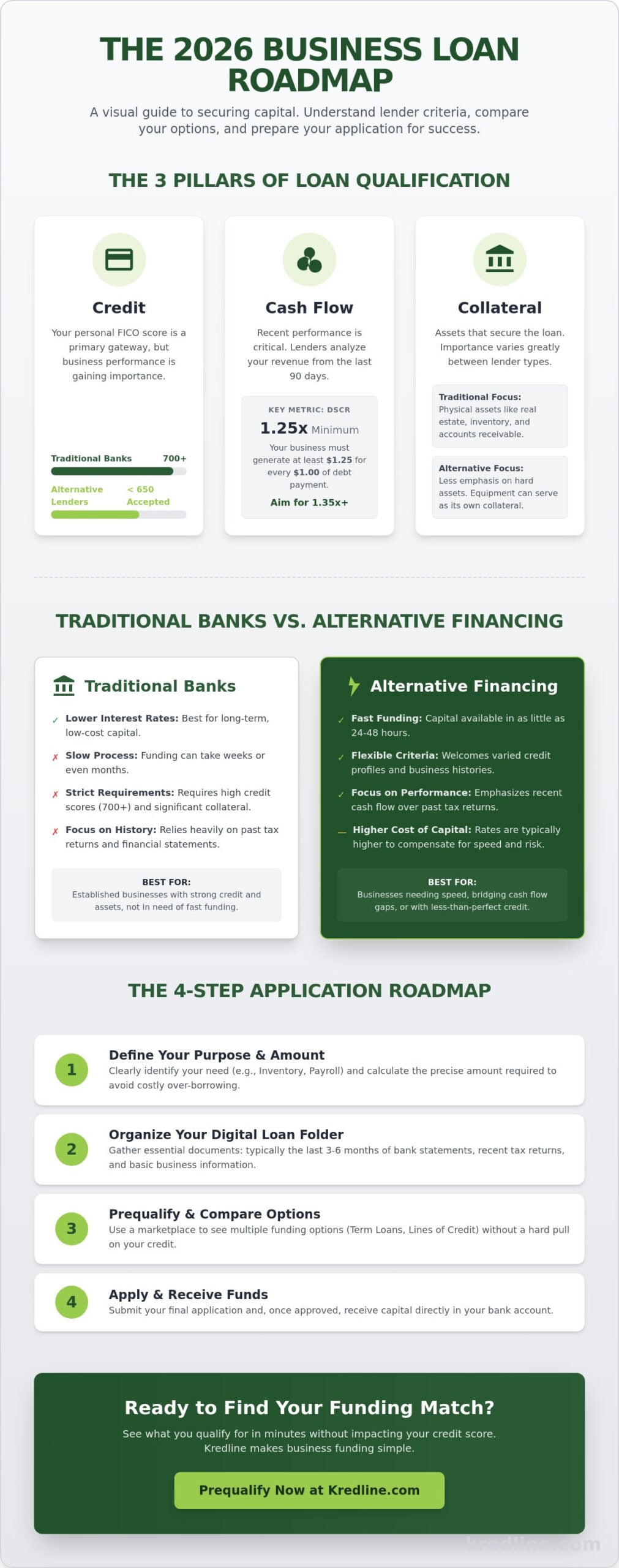
Before applying, analyze your Debt-to-Income (DTI) ratio. Most lenders in 2026 look for a debt-service coverage ratio of at least 1.25x, meaning your business generates $1.25 for every $1.00 of debt payment. Look at your daily and monthly revenue realistically. Can your cash flow support a new daily or weekly payment without stalling your operations? In 2026, your borrowing capacity is primarily defined by your ability to maintain a 1.35x debt-service coverage ratio while accounting for the 0.5% fluctuations typical of the current stabilized interest rate environment.
Understanding the 3 Pillars of Loan Qualification
Securing capital isn’t just about having a good idea. It’s about meeting specific criteria that lenders use to measure risk. While the fundamentals haven’t changed, the way lenders evaluate them in 2026 has evolved significantly. Knowing how to get a business loan today requires a firm grasp of the “Big Three”: credit, cash flow, and collateral.
Traditional banks still prioritize high credit scores and physical assets. However, modern alternative lenders often shift their focus toward real-time performance. They’re less interested in a tax return from two years ago and more interested in your revenue from the last 90 days. Your industry risk profile also plays a role; a retail shop might face different scrutiny than a software firm due to shifting consumer habits. Most lenders now look for at least 24 months of operation, though some specialized programs accept businesses with only six months of history if their revenue is strong.
Credit Scores: Personal vs. Business
Your personal FICO score remains the primary gatekeeper for most small business funding. Traditional institutions typically look for a score of 700 or higher. If your personal score sits below 650, you’ll likely find better luck with alternative lenders who prioritize business performance over personal history. It’s also vital to monitor your business credit report through bureaus like Dun & Bradstreet or Experian. Errors are common. A 2023 study found that 25% of small business owners discovered errors on their reports that could lead to higher interest rates. Correcting these mistakes is the fastest way to improve your eligibility without spending a dime.
Cash Flow: The Lifeblood of Your Application
Lenders don’t just want to see that you’re profitable; they want to see that you’re liquid. A Profit and Loss (P&L) statement can show a healthy year, but it doesn’t reveal the “dry spells” between large invoices. In 2026, most lenders use secure bank integrations to view your real-time transaction history. They look for consistent daily or weekly balances rather than a single large deposit at the end of the month. If you maintain a low average daily balance, it signals that you might struggle with new debt payments during a slow week.
This real-time data approach ensures that your current success carries more weight than your past tax filings. If you’re managing consistent revenue but need a boost to handle a large order or seasonal dip, you can explore specialized funding options that align with your specific cash flow patterns. This shift toward “live” data makes the application process faster, often providing a decision within 24 to 48 hours rather than weeks.
Traditional Loans vs. Alternative Financing: Which Fits?
Deciding how to get a business loan in 2026 often comes down to a single trade-off: speed versus cost. If your business has a healthy cash reserve and you’re planning a major expansion six months from now, a traditional bank is your best ally. However, if you’re trying to capitalize on a limited-time inventory discount or fix a broken delivery truck today, the cost of waiting for a bank can be higher than the interest on an alternative loan. You’ve got to weigh the “cost of capital” against the “cost of missed opportunity.”
When to Pursue a Bank or SBA Loan
The SBA 7(a) program remains the most popular path for business owners seeking long-term stability. It’s designed for working capital, debt refinancing, or purchasing furniture and fixtures. These loans offer some of the lowest rates available because the government guarantees a portion of the total. But that security comes with a high barrier to entry. Most traditional lenders expect you to have been in business for at least 24 months and show consistent profitability on your tax returns.
The reality of the 30 to 90 day waiting period is the biggest hurdle for many. Banks require an exhaustive list of documents, including personal financial statements, three years of tax returns, and detailed business plans. You’ll also likely need to pledge personal assets or business real estate as collateral. For a business owner who needs to meet payroll next week, this timeline just isn’t realistic. If you have the luxury of time and a pristine credit profile, the savings on interest make this the right choice.
The Case for Flexible Alternative Funding
Alternative financing has evolved to meet the needs of modern, fast-moving companies. A Merchant Cash Advance (MCA) has become a primary tool for businesses that need capital in 24 to 48 hours. It isn’t a loan in the traditional sense; it’s a purchase of your future credit card sales. This makes it an excellent fit for retail or service businesses that have high daily transaction volumes but might not meet the strict collateral requirements of a big bank.
If your revenue fluctuates throughout the year, Revenue-Based Financing provides a level of flexibility that banks can’t match. Instead of a fixed monthly bill, your repayments scale with your sales. When business is booming, you pay back more; when things slow down, your payment shrinks. This protects your cash flow during lean months. Similarly, Short-Term Business Loans are ideal for handling seasonal spikes, like a landscaping company needing to prep for the spring rush.
When you’re looking at these options, you’ll notice they use factor rates instead of a traditional APR. A factor rate is expressed as a decimal, like 1.15. If you’re borrowing $20,000 at a 1.15 factor rate, you’ll pay back a total of $23,000. While the total cost might be higher than an SBA loan, the speed of funding and the lack of compounding interest can make it a smarter move for short-term growth. If you aren’t sure which path fits your current numbers, you can visit Kredline to explore these options and see what your business qualifies for without the typical bank red tape.
The Application Roadmap: From Prep to Funding
Preparing your files before hitting submit saves days of back-and-forth. Create a Digital Loan Folder on your desktop to keep everything organized. This preparation is the most effective way to streamline the process of how to get a business loan without the usual stress. When your documents are ready, you can respond to lender requests in minutes rather than hours.
Every small business owner should have these five essentials ready:
- Bank Statements: The last 4 to 6 months of business account activity.
- Tax Returns: Your most recent two years of federal filings, both business and personal.
- Financial Statements: A year-to-date Profit and Loss (P&L) and a current Balance Sheet.
- Debt Schedule: A simple list of any current business loans, including monthly payments and remaining balances.
- Identification: A clear color copy of your driver’s license or passport.
Before you send these over, scan your bank statements for Non-Sufficient Funds (NSF) fees. Data from 2024 shows that more than three NSF occurrences in a 90-day period can lead to an automatic decline from 65% of alternative lenders. If you have them, be ready to explain the context. Finally, check that your business name, address, and EIN are identical across all documents. Inconsistencies often trigger fraud flags in automated systems, causing unnecessary delays.
Step-by-Step Submission Process
Accuracy beats speed every time during the initial application. Once you submit, the file moves into underwriting. This is where the lender’s team analyzes your cash flow and calculates your Debt Service Coverage Ratio (DSCR). Most lenders look for a ratio of 1.25 or higher. If you meet their criteria, you’ll receive a Letter of Intent (LOI). Treat this as a draft; it outlines the proposed terms and rates but isn’t a binding contract yet.
Closing and Receiving Funds
The final stage involves reviewing the fine print. Most business funding products include a UCC-1 filing, which is a public notice that the lender has a security interest in your business assets. You’ll also likely sign a personal guarantee. Before the wire hits, expect a quick verification call. The lender will confirm your identity and the intended use of the funds. A common mistake when learning how to get a business loan is assuming the process is over before this call; stay available to avoid delays.
Timelines vary by product. While short-term business loans can land in your account within 24 hours, traditional bank options still take 30 to 60 days on average as of 2025. Once you pass the verification call, the “money in bank” moment usually happens within one business day.
Ready to see which options your business qualifies for? Prequalify for business funding today and get a clear view of your roadmap.
Finding Your Best Match Through a Funding Marketplace
Applying for capital shouldn’t feel like a gamble. Many owners make the mistake of “shotgunning” applications to every lender they find online. This approach is risky. Each hard credit pull can ding your score; several in a short window can signal desperation to underwriters. When you’re researching how to get a business loan, your goal should be surgical precision, not a scattergun approach. You want to protect your credit profile while maximizing your options.
A funding marketplace simplifies this by acting as a single point of entry. Instead of filling out ten different forms and managing ten different conversations, you fill out one. This allows you to position your business to receive multiple competitive offers simultaneously. It forces lenders to compete for your business. This competition often leads to better rates and more flexible repayment terms than you would find walking into a local bank branch alone.
Why One Application is Better Than Ten
The primary advantage of a marketplace is the use of a single soft credit pull. This allows you to access dozens of vetted lenders without any impact on your credit score. It gives you the freedom to compare terms side-by-side. You aren’t just looking at the interest rate; you’re looking at the total cost of capital and how the daily or weekly payments will impact your actual cash flow.
Human advisors are essential in this phase. They act as your advocate, helping you navigate complex offers and explaining how different structures might affect your future borrowing power. They can spot hidden fees or restrictive covenants that an automated system might overlook. Having a partner who understands the nuances of the 2026 lending market ensures you don’t sign a contract that creates a bottleneck for your business later on.
Getting Started with Your Funding Search
If you’re ready to see what’s available for your company, the best move is to prequalify for business funding. This step provides a clear snapshot of your options without a hard credit hit. It’s important to set realistic expectations for your first round of funding. If your business is relatively new, you might start with a smaller short-term loan to build a solid repayment history.
Kredline connects businesses with third-party providers that specialize in various stages of growth and specific industry needs. Understanding how to get a business loan requires knowing that the best offer isn’t always the first one that lands in your inbox. It’s the one that aligns with your specific growth goals and keeps your day-to-day operations running smoothly. By using a marketplace, you gain the leverage needed to secure a deal that supports your business’s long-term health.
Securing Your Business Growth in 2026
Navigating the 2026 lending landscape requires more than just a good idea. It’s about having your financial story ready before you speak with a lender. You’ve learned that balancing the three pillars of qualification and choosing the right vehicle, whether it’s an SBA loan or alternative financing, makes all the difference for your bottom line. Understanding how to get a business loan isn’t just a one-time task; it’s a strategic move to protect your working capital and bridge seasonal gaps.
The market moves fast, and 2026 interest rates demand a precise approach. You don’t have to figure this out alone. Kredline provides access to a diverse network of SBA, term loan, and MCA providers. Our team focuses on an advisory-led approach that respects your cash flow and helps you find a match that actually fits your daily operations. You can skip the long queues and focus on what you do best: running your company.
See your business funding options and prequalify in minutes
Your next phase of growth is within reach, and with the right preparation, you’re already halfway there.
Frequently Asked Questions
How long does it typically take to get a business loan approved?
Approval times vary by lender, but online fintech platforms often provide a decision within 24 to 48 hours. Traditional banks usually take 3 to 6 weeks to process a full application. If you’re looking for how to get a business loan quickly, preparing your tax returns and bank statements in advance can shave 5 days off the process. This preparation ensures you aren’t stuck waiting on paperwork when opportunities arise.
What is the minimum credit score required for a small business loan in 2026?
Most traditional lenders require a minimum FICO score of 680 to qualify for competitive rates. However, alternative lenders often work with scores as low as 550 if your business shows strong monthly revenue. According to 2025 industry benchmarks, 72% of approved small business loans went to applicants with scores above 640. It’s often more about your consistent cash flow than just a single number on a report.
Can I get a business loan with no collateral or personal guarantee?
You can secure unsecured business loans that don’t require physical assets like real estate or equipment. These loans usually rely on your cash flow and credit history instead. Keep in mind that 90% of lenders still require a personal guarantee, which means you’re personally responsible for the debt if the business can’t pay. It’s a standard way for lenders to manage risk without seizing your property.
What documents do I need to prepare for a business loan application?
You’ll need at least 3 months of business bank statements, your most recent tax return, and a valid business license. Understanding how to get a business loan requires knowing exactly what lenders want to see on your desk. If you’re applying for more than $100,000, lenders often ask for a profit and loss statement and a balance sheet from the last fiscal year. Having these PDFs ready helps Kredline find the right fit faster.
What is the difference between a business loan and a merchant cash advance?
A business loan provides a lump sum with a fixed interest rate and monthly payments. A merchant cash advance (MCA) is technically a purchase of your future sales. Instead of a set interest rate, an MCA uses a factor rate, and payments fluctuate based on your daily credit card receipts. This makes an MCA more expensive, but it’s often easier to get if your credit isn’t perfect.
How do I know if I should choose a line of credit or a term loan?
Choose a term loan for one-time investments like a $50,000 kitchen renovation or a new delivery truck. A line of credit is better for ongoing needs, such as covering payroll during a 30 day gap in client payments. It works like a credit card where you only pay interest on the amount you actually use. This flexibility makes it a favorite for managing unpredictable monthly expenses.
Are there specific loans for businesses with seasonal revenue drops?
Seasonal businesses often use flexible lines of credit or short term working capital loans to bridge the gap. For example, a landscaping company might borrow in January to maintain equipment before the spring rush. Some lenders offer step-down payment structures where your monthly obligation decreases during your slowest 3 months of the year. This prevents the loan from becoming a burden when foot traffic is naturally lower.
How does a revenue-based financing repayment structure work?
Repayments are tied directly to your monthly sales volume rather than a fixed dollar amount. You might pay 5% of your total monthly revenue until the balance is cleared. This protects your cash flow because your payment drops automatically if you have a slow month with 20% lower sales than expected. It’s a supportive option for growing companies that want their debt to scale alongside their actual income.

Article by
Billy Wagner Jr
Billy has 15 years of customer service experience and several years of experience in business loans and merchant services. His passion is helping business owners understand their options and assisting them in making confident decisions around funding and payment processing.
