



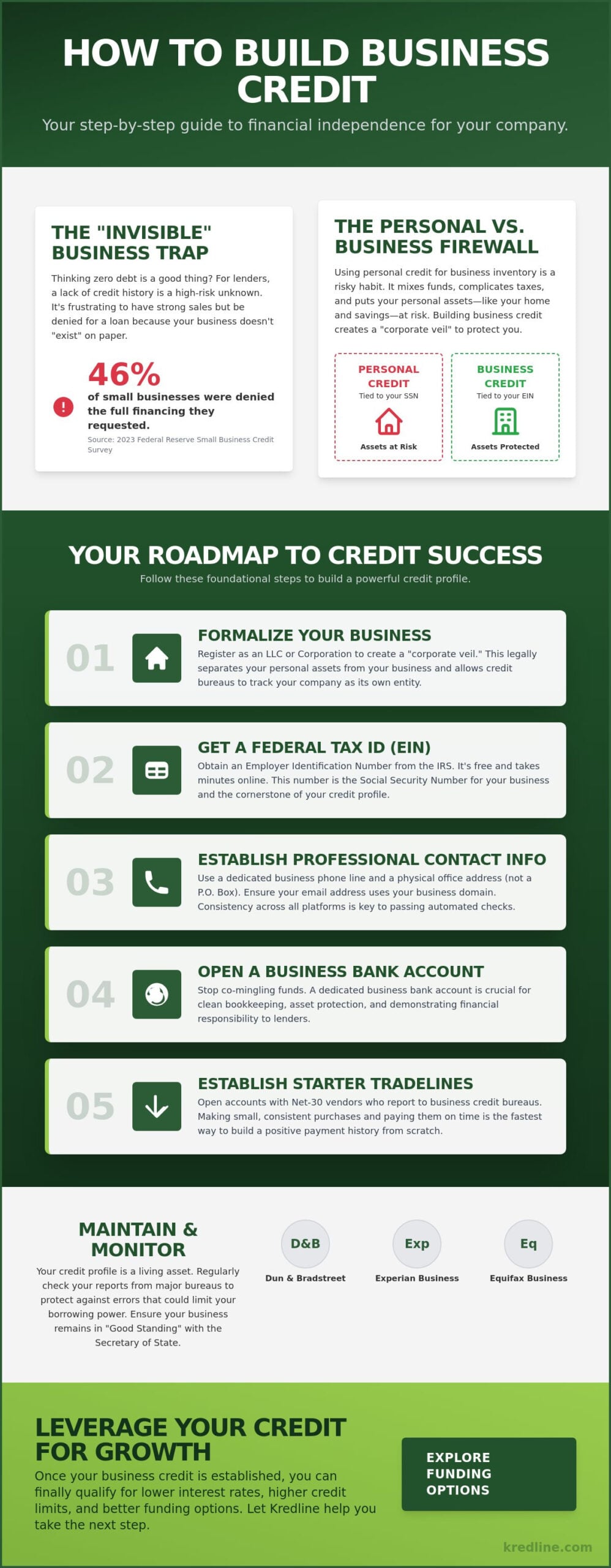
According to the 2023 Small Business Credit Survey by the Federal Reserve, nearly 46% of small businesses that applied for traditional financing were either denied or received less than they requested. Often, the culprit isn’t a lack of revenue, but a thin credit file that forces lenders to rely heavily on your personal history. Learning how to build business credit effectively is the only way to stop risking your family’s savings for a new piece of equipment or a bulk inventory order.
It’s exhausting to feel like you’re constantly mixing personal and business finances just to keep the daily operations running. We know that the confusion surrounding Paydex scores and Experian reports can make the whole process feel like an impossible puzzle. This guide provides the exact, step-by-step process to establish and grow your business credit profile so you can finally qualify for lower interest rates and higher credit limits. We’ll walk through the specific milestones you need to hit to ensure your business stands on its own two feet and stays ready for growth.
Key Takeaways
- Understand why separating your personal identity from your business EIN is the essential foundation for long-term financial security and asset protection.
- Follow a practical, step-by-step roadmap on how to build business credit through proper legal registration and strategic tax ID setup.
- Learn how to use Net-30 vendors and starter tradelines to build a positive payment history even if your company is relatively new.
- Discover how to monitor the major credit bureaus to protect your profile from errors that could limit your future borrowing power.
- Find out how to leverage your established credit to access better funding options and use Kredline as a resource for your next growth phase.
The Foundation: Why Business Credit is Your Most Valuable Asset
Business credit isn’t just a number on a screen. It’s a trackable measure of your company’s specific financial reliability, separate from your own habits as a consumer. If you’re wondering how to build business credit, you have to start by seeing your company as a separate entity. While your personal credit relies on your Social Security Number (SSN), your business credit attaches to your Employer Identification Number (EIN). This distinction is vital for growth. By 2026, the lending market has moved toward high-speed automation. Traditional banks and modern funders now prioritize real-time, verifiable data over a simple “gut feeling” or a quick look at a personal score. They want to see how your business handles its own obligations through Business credit reports. These documents aggregate data from vendors and lenders to build a profile that stands independently from your private life.
The “Invisible” Business Trap
Many owners think that having zero debt means their business is in good shape. It’s actually the opposite. A “thin file” business often faces more rejections than one with a few past challenges. According to a 2023 study by the Federal Reserve, roughly 45% of small businesses that didn’t apply for credit cited a lack of established history as a primary hurdle. Lenders see a lack of history as a high-risk unknown. It’s frustrating to have $60,000 in monthly sales but get denied for a growth loan because your business doesn’t “exist” on paper. This emotional toll can stall your momentum just when you’re ready to scale your operations or hire new staff.
Personal vs. Business Credit: The Firewall
You should stop using your personal credit card for business inventory immediately. It’s a common habit for new owners, but it creates a messy trail for both taxes and credit building. Co-mingling funds puts your personal assets, like your home or savings, at risk if the business faces a legal challenge or debt collection. The corporate veil is the legal separation that protects business owners from being personally liable for the company’s debts; building dedicated business credit is the strongest pillar of this protection. When you separate these worlds, you’re not just organizing your books. You’re building a scalable entity. If you’re looking to bridge a cash flow gap or invest in new equipment, checking your prequalification options for business-specific funding is a smarter move than leaning on your personal savings. Knowing how to build business credit correctly ensures your company can stand on its own two feet when the right opportunity arrives.
Step-by-Step: Setting Up Your Business for Credit Success
Building business credit is not just about paying bills on time. It starts with creating a legal identity that is entirely separate from your personal life. If your business is still operating as a sole proprietorship, you are essentially the business. To fix this, you must register as a formal legal entity, such as an LLC or a Corporation. This creates a “corporate veil” that protects your personal assets and allows credit bureaus to track your company as its own person. Once registered, you need to obtain a Federal Tax ID (EIN) from the IRS. It’s a free process that takes about 15 minutes online, but it is the cornerstone of your credit profile.
Lenders look for stability and permanence. If you use your personal cell phone number or a residential address, you might be flagged during the automated underwriting process. A dedicated business phone line and a physical office address (not a P.O. Box) are essential. You also need to apply for a D-U-N-S number through Dun & Bradstreet. This nine-digit identifier is used globally to track the financial health of businesses. Without it, many vendors and lenders won’t even see your credit history. Understanding how to build business credit starts with these administrative foundations that prove your company is a legitimate, professional operation.
The Compliance Checklist
Lenders use data-scrubbing software to verify your information in seconds. If your business name is “Green Valley Landscaping” on your bank account but “Green Valley LLC” on your tax returns, you might face an immediate rejection. Consistency is everything. Your business email should use your own domain name rather than a generic @gmail.com or @yahoo.com address. These small details signal that you aren’t a “fly-by-night” operation. Additionally, you must keep your status with the Secretary of State as “In Good Standing.” Missing a single annual report filing can freeze your ability to access capital until the state updates your record.
Opening the Right Bank Account
Your choice of bank can dictate your future access to business lines of credit. Most commercial lenders look at your “bank rating,” which is a score based on your average daily balance over the last 90 days. For example, a “Low-5” rating means you consistently maintain at least $10,000 in your account. Keeping a healthy balance proves you can manage the cash flow required for different types of small business funding. Use this account for every single dollar of revenue and every business expense. This clean paper trail makes it much easier to verify your income when you decide to check your eligibility for funding later on.
The “Starter” Strategy: Using Tradelines and Net-30 Vendors
Net-30 vendors are the most accessible entry point for most entrepreneurs. These suppliers allow you to buy goods now and pay the full invoice within 30 days. It’s a simple arrangement that creates a paper trail of your reliability. For a new business, this is often the fastest way to get data onto your credit profile because these accounts don’t usually require a long business history or a high personal credit score. You’re essentially using your overhead expenses to prove you can handle credit.
You need to find vendors that report to major bureaus like Experian Business or Dun & Bradstreet. Not all of them do. If a vendor doesn’t report, your on-time payments are invisible to future lenders. Most business owners think paying on the due date is enough, but it isn’t if you want a top-tier score. Dun & Bradstreet’s Paydex score rewards early payments. Paying 10 to 15 days before the deadline can push your score into the 80s or 90s. A “perfect” score of 100 often requires paying 30 days in advance of the terms.
Don’t fall into the trap of vendors that take your money but offer no credit benefit. Some companies charge a “membership fee” just to report your history; others won’t report unless you spend a specific amount, like $50 or $100 per month. Always confirm their reporting policy before placing an order. It’s also smart to check if they report monthly or quarterly, as quarterly reporting can slow down your progress significantly.
Building Your First Tradelines
Start with industries that naturally offer credit. Office supply companies like Uline or Quill, shipping services, and fuel providers are common entry points. You typically need three to five reporting tradelines to generate a visible business credit score. If you already have a relationship with a local supplier, ask them to start reporting your history. According to this guide on how to build business credit, establishing these trade references is a critical step in moving away from personal guarantees. It shifts the financial responsibility from you as an individual to the business entity itself.
Gas and Store Credit Cards
Retail cards from places like Staples, Lowe’s, or Home Depot are often easier to get than traditional bank cards. Use these for small, recurring expenses you’d pay for anyway. You should keep your credit utilization below 30% to avoid looking overextended to the bureaus. High utilization suggests a cash flow struggle, even if you pay the balance in full every month. Once you’ve maintained these accounts for six to twelve months, you’ll be in a much stronger position to transition toward more flexible capital, such as an unsecured short-term business loan. This progression shows lenders you can handle larger credit limits responsibly without relying solely on vendor terms.
Maintenance and Monitoring: Keeping Your Profile Healthy
Building a solid profile is only half the battle. You have to keep it that way. Unlike personal credit, business credit isn’t a static number. It’s a living record of your company’s reliability. To understand how to build business credit effectively, you must monitor the three major players: Dun & Bradstreet, Experian Business, and Equifax Small Business. Each bureau uses different data points, so a high score on one doesn’t guarantee a clean slate on the others. You should check these reports at least once a quarter to ensure your growth isn’t being stifled by outdated information.
One often overlooked factor is the Uniform Commercial Code (UCC) filing. When you take out a secured loan, the lender files a UCC-1 statement to announce their interest in your assets. If these stay on your report after a debt is paid, they look like active liabilities to future lenders. Keeping your debt-to-income ratio healthy is equally vital. Most traditional lenders look for a ratio below 35% to ensure your cash flow can handle new obligations as you scale. If your debt starts to outpace your revenue, lenders see it as a red flag, regardless of your payment history.
The Art of the On-Time Payment
A single 30-day late payment can be devastating. While personal credit might dip slightly, a business score like the Dun & Bradstreet PAYDEX can drop from an 80 (very good) to a 50 (high risk) after one missed window. It’s best to set up autopay for every recurring expense. If a cash flow gap hits, don’t just go silent. Call your vendor. Many suppliers will grant a 10-day extension without reporting it if you’re proactive. This protects the progress you’ve made while learning how to build business credit and keeps your reputation intact.
Disputing Errors and Inaccuracies
Errors are surprisingly common. A 2022 survey by the Wall Street Journal noted that roughly 25% of business owners found mistakes on their reports. These often include outdated addresses or incorrect NAICS codes. If your business is listed under a high-risk industry code by mistake, your interest rates will skyrocket. To fix this, gather your documentation and file a formal dispute through the specific bureau’s online portal. It usually takes 30 to 45 days for a correction to reflect. Remember that a clean report is just as important as a high-score report; lenders look for consistency and accuracy across all filings.
If you’ve spent time cleaning up your profile and want to see where your business stands, you can prequalify for business funding to explore your current options without a hard credit pull.
Leveraging Your Credit for Growth Capital
Building credit isn’t a goal in itself; it’s the preparation for a larger move. Once you’ve mastered the basics of how to build business credit, you reach a tipping point where your profile starts working for you. This transition usually occurs when your Paydex score hits the 75 to 80 range. At this level, you’re no longer just proving your business exists. You’re proving you’re a reliable partner for larger capital injections.
Kredline helps you evaluate various funding options through the lens of your specific business health. While a traditional bank might look solely at your personal FICO, many modern lenders prioritize your consistent cash flow. For instance, revenue-based financing relies heavily on your monthly deposits. Even here, a strong business credit profile acts as a safety net. It can help you secure more favorable terms or higher funding caps because it reduces the lender’s perceived risk.
According to the 2024 Small Business Credit Survey, 43% of firms sought financing specifically to expand operations or pursue new opportunities. Preparing for your first major loan means having your documentation and credit profile ready before that opportunity arrives. When your credit foundation is solid, you can focus on the ROI of the capital rather than just the stress of getting approved.
Choosing the Right Funding for Your Stage
Matching the right capital to the right problem is a vital skill for any owner. You might choose a Merchant Cash Advance (MCA) to cover a sudden 20% spike in inventory costs during a seasonal peak. It’s fast and adapts to your daily sales. However, a business line of credit is often better for ongoing growth because it stays open as you pay it down, providing a permanent safety net.
If you’re looking to upgrade machinery or vehicles, equipment funding is a smart move. Since the equipment itself serves as collateral, the lender’s risk is lower. This often makes it easier to qualify for even if you’re still learning how to build business credit to its full potential. By choosing the right tool, you position your company as a low-risk partner for long-term lenders.
Prequalifying Without the Stress
One of the biggest fears for business owners is the “hard pull.” This is a deep inquiry into your credit that can temporarily lower your score. It’s frustrating to lose points just for asking what’s available. Kredline uses a marketplace model that focuses on “soft pulls” initially. This allows you to see potential offers without any impact on your credit score.
This approach protects the hard work you’ve put into your credit profile. Instead of applying blindly and hoping for the best, you’re matched with providers who already have an appetite for your industry and profile. It’s a more efficient way to shop that keeps your scores intact for when you truly need them.
Ready to see where your business stands? Prequalify for funding today with no obligation.
Turning Your Credit Profile into a Growth Tool
Mastering how to build business credit is a long game that pays off when you need to bridge a cash flow gap or buy new equipment. It starts with a clean legal setup and grows through consistent reporting from Net-30 vendors. You should check your reports at least once every 30 days to catch errors early. This discipline transforms your business into a credible entity that lenders trust without looking at your personal bank account. It’s about creating a safety net today so you can seize opportunities tomorrow.
You don’t have to navigate the complex world of commercial lending alone. Our team provides expert guidance for businesses at every stage of the credit journey, helping you understand which levers to pull next. We offer access to a nationwide network of 3rd-party providers to match you with the right capital for your specific situation. There is no personal loan pressure here because we focus strictly on business-focused capital that respects your personal boundaries. Explore your funding options at Kredline to see what your business qualifies for right now. Your hard work deserves the financial backing to match your ambition.
Frequently Asked Questions
How long does it take to build business credit from scratch?
You can expect to see a baseline business credit score within 6 to 12 months of opening your first reporting tradelines. Most major bureaus like Dun & Bradstreet require at least 3 reported trade references before they generate a Paydex score. If you pay your vendors 10 days early, you will likely see a faster improvement in your rating. It is a steady process that requires consistent on-time payments to at least 5 reporting creditors to reach a prime tier.
Can I build business credit with a bad personal credit score?
You can absolutely build business credit even if your personal FICO score is below 600. Business credit is tied to your Employer Identification Number (EIN) rather than your Social Security Number. While some lenders still look at personal history for loans requiring a personal guarantee, vendor credit accounts often don’t require a hard pull on your personal report. Net-30 accounts from suppliers like Uline or Grainger are great starting points for decoupling your business finances from your personal history.
Do I need an LLC to have business credit?
You don’t strictly need an LLC, but operating as a registered legal entity like a C-Corp or S-Corp makes the process much smoother. Sole proprietors can build credit using an EIN, but 90 percent of traditional lenders prefer the clear separation of liability that an LLC provides. Registering your business with the Secretary of State is often the first step bureaus look for when verifying your company’s legitimacy. This structure ensures your business’s financial identity stands on its own.
What is a good business credit score for a small business?
A Paydex score of 80 or higher is considered excellent and indicates that you pay your bills on or before the due date. For Experian Business, a score above 76 puts you in the low-risk category. If your score sits in the 50 to 70 range, you might face higher interest rates or stricter terms. Keeping your score in the top 20 percent of businesses in your specific industry code is key for securing the best funding options.
Does a Merchant Cash Advance (MCA) help build my business credit?
Most Merchant Cash Advances don’t help you build business credit because providers rarely report your payment history to the major bureaus. Since an MCA is technically a purchase of future sales rather than a loan, it doesn’t function like a traditional tradeline. If your goal is specifically how to build business credit, you’re better off using a business credit card or a term loan from a lender that reports to Equifax or Experian. Kredline can help you identify which funding types actually contribute to your credit profile.
Why is my business credit score different across the three bureaus?
Your scores vary because Dun & Bradstreet, Experian, and Equifax use different scoring models and don’t always share data. One vendor might report your 30 day payment history to Experian but not to D&B. Additionally, D&B focuses heavily on trade references, while Equifax includes more banking and lease data. It’s common for a business to have an 80 Paydex score but a 65 Experian score simply because of these reporting gaps.
How many tradelines do I need to get a Paydex score?
You need a minimum of 3 reporting tradelines to generate a Dun & Bradstreet Paydex score. These accounts must be from different suppliers who report your payment behavior to the bureau. Simply having the accounts isn’t enough; you must use them and pay the invoices. Once those 3 reports are processed, D&B typically generates your score within 45 days. Adding 5 or more tradelines provides a more robust profile that lenders find more attractive.
What happens to my business credit if I close my company?
When you close your company and dissolve your legal entity, your business credit profile becomes inactive, but the history doesn’t disappear immediately. Credit bureaus typically maintain these records for 7 to 10 years. If you have outstanding debts, they’ll continue to reflect poorly on the business’s record. It’s vital to settle 100 percent of your vendor balances before filing dissolution papers to ensure no debts haunt your future entrepreneurial ventures.

Article by
Billy Wagner Jr
Billy has 15 years of customer service experience and several years of experience in business loans and merchant services. His passion is helping business owners understand their options and assisting them in making confident decisions around funding and payment processing.
