



The wrong financing partner can cost your business more in hidden balloon payments than the interest rate itself. You’ve probably felt that pang of anxiety when looking at a 15 page contract, wondering if a single hard credit pull will tank your score or if you’re accidentally signing away your seasonal cash flow. It’s frustrating when you just need a new excavator or a fleet of delivery vans to keep up with a 22% increase in client demand. Choosing between different equipment financing companies shouldn’t feel like a gamble with your company’s future.
We understand that you want a partner who speaks your language, not just bank jargon. This guide provides a transparent look at the top lenders for 2026, stripping away the fluff to show you exactly how to vet a provider without the stress. You’ll learn the real costs of leases versus loans, why 4 out of 5 brokers might not be the right fit for your specific industry, and how to secure a payment plan that actually matches your revenue cycles. At Kredline, we believe getting the right tools for growth should be as simple as using them.
Key Takeaways
- Learn the practical differences between working with direct lenders and leveraging a marketplace to find the right funding fit.
- Discover how to effectively compare equipment financing companies by focusing on approval speed and initial credit requirements.
- Identify hidden costs like “interim rent” and the reality behind 0% interest offers to ensure your agreement is truly transparent.
- Understand why equipment-backed loans are often easier to secure than traditional term loans in the current economic landscape.
- Find out how a human-first approach to your search can provide more tailored solutions than relying solely on automated algorithms.
Understanding the Landscape of Equipment Financing Companies
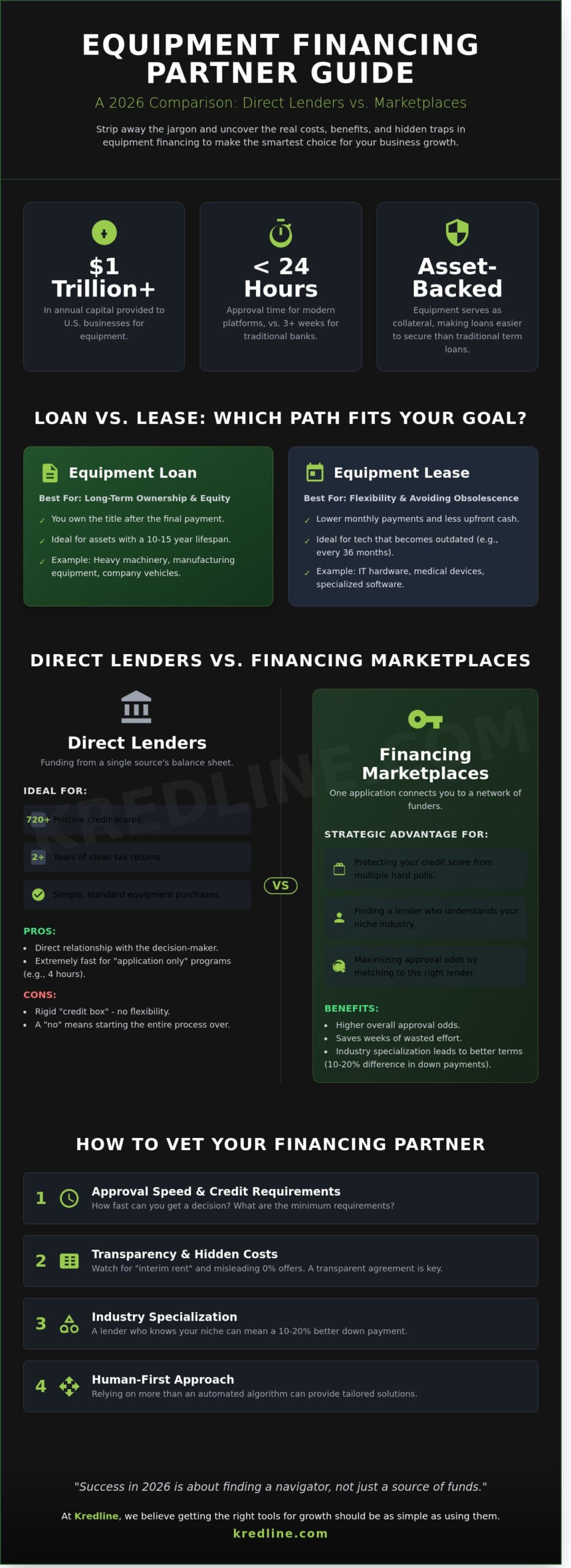
The 2026 economy demands speed and adaptability. Modern equipment financing companies have stepped in where traditional banks often hesitate, providing over $1 trillion in annual capital to U.S. businesses. You’ll find that securing these funds is often simpler than chasing a standard term loan. The reason is straightforward: the equipment itself serves as the security. If you’re buying a $150,000 CNC machine or a fleet of delivery vans, that asset backs the debt. This structure reduces the lender’s risk and often spares you from putting up personal assets like your home as collateral.
The shift toward fintech and marketplace solutions has accelerated since 2024. While a local bank might take three weeks to review your tax returns, modern platforms use real-time data to provide approvals in under 24 hours. This speed allows you to grab a vital piece of inventory or a specialized vehicle before a competitor does. These companies use proprietary algorithms to look at your actual cash flow rather than just a static credit score from three years ago.
Equipment Loans vs. Equipment Leasing
Choosing between a loan and a lease depends on how long you plan to keep the asset. An equipment loan is best for heavy machinery with a 10 or 15 year lifespan, as you’ll own the title once the final payment is made. Leasing is often smarter for medical devices or IT hardware that becomes obsolete every 36 months. Many businesses opt for a finance lease, which offers the tax benefits of leasing while providing an option to purchase the equipment at a bargain price when the term ends. It’s a flexible middle ground for growing firms.
Why Your Choice of Company Affects Your ROI
The right lender does more than just hand over cash. Different equipment financing companies calculate risk based on their own comfort levels with certain industries. A lender that specializes in construction will understand the resale value of a Caterpillar excavator better than a generalist. This expertise can lead to a 10% to 20% difference in your required down payment.
Industry specialization also impacts your approval odds. When a lender knows your niche, they’re less likely to be spooked by seasonal dips in your revenue. Working with a partner like Kredline allows you to explore equipment funding options that fit your specific business cycle. A company that understands your daily operations is always more valuable than one offering a slightly lower rate but restrictive terms that choke your monthly cash flow. Success in 2026 is about finding a navigator, not just a source of funds.
Direct Lenders vs. Financing Marketplaces: Which is Right for You?
Choosing between a direct lender and a marketplace is the first real hurdle for any business owner. Direct lenders, like Pathward or Crest Capital, use their own balance sheets to fund your equipment. They set the rules, they hold the risk, and they make the final call. Marketplaces like Kredline take a different approach by connecting you with a network of specialized funders. Data from 2024 shows that nearly 80% of small businesses seek external funding; knowing where to apply saves weeks of wasted effort and unnecessary stress.
The Case for Direct Lenders
Going straight to the source makes sense if your credit is pristine and your business has been profitable for at least three years. Companies like Crest Capital offer “application only” programs up to $250,000 for high-credit borrowers, often providing a decision in as little as four hours. You build a direct relationship with the decision-maker, which can be useful for future financing needs. However, these institutions usually have a rigid “credit box.” If you fall outside their specific risk profile, the answer is a hard no. This leaves you starting from scratch with a new application elsewhere.
Direct lenders are ideal for:
- Borrowers with credit scores above 720.
- Businesses with 2+ years of clean tax returns.
- Simple equipment purchases that don’t require specialized industry knowledge.
The Strategic Advantage of Marketplaces
Marketplaces offer a strategic buffer. Instead of guessing which equipment financing companies will approve you, you submit one application to reach dozens of potential funders. This is vital because multiple hard credit pulls can drop your score by 5 to 10 points in a single month. A marketplace matches your specific industry, credit score, and equipment type to the right lender’s appetite. Before you commit to a specific path, reviewing SBA tips on equipment financing can help you identify whether leasing or a loan fits your current tax strategy.
This “credit box” matching is especially helpful for B-rated or C-rated credit profiles where traditional banks often hesitate. By using a marketplace, you gain access to alternative equipment financing companies that specialize in “story credit,” looking at your business’s potential rather than just a FICO score. You can explore our diverse funding options to see how this variety works for different business stages. If you’re unsure which path fits your current cash flow, you can prequalify for business funding to see your options without the typical bank pressure.
5 Key Criteria to Use When Comparing Equipment Loan Providers
Choosing between different equipment financing companies requires looking past the monthly payment. You need to evaluate the total cost and the speed of execution. In 2026, the gap between a tech-forward lender and a traditional bank has widened significantly. A modern lender can often fund a $150,000 CNC machine in 24 hours, while a local bank might still require a 15-day approval window.
Credit checks are another major differentiator. Many top-tier providers now use “soft pulls” for the initial qualification phase. This lets you see your potential rate without a hard inquiry hitting your credit report. You should also weigh the down payment requirements. While a 20% down payment was the standard a few years ago, many 2026 programs offer 0% down for businesses with at least 24 months of history and a 680+ FICO score.
Industry expertise matters because it impacts how a lender views the asset’s resale value. A lender who understands specialized medical imaging equipment will offer better terms than one who treats every asset like a standard delivery truck. As noted by the Equipment Leasing and Finance Association, specialized knowledge allows lenders to structure deals that reflect the actual lifecycle of the hardware. Finally, demand total transparency. If a lender can’t clearly state the total interest and fees in a single dollar amount, they aren’t the right partner for you.
Evaluating the Application Friction
The “No Tax Return” threshold is a critical benchmark to watch. For many equipment financing companies, $250,000 is the magic number. If you’re borrowing less than this, you can often secure funding with just a one-page application and three months of bank statements. For larger fleet upgrades, have your last two years of tax returns and a current P&L statement ready to go. Watch for red flags like “upfront processing fees” charged before you even see a loan offer. Legitimate partners don’t charge you just to look at your file.
Analyzing Repayment Structures
In the 2026 market, fixed rates provide the most stability, but variable rates might be attractive if you anticipate a downward shift in interest rates. If your business is seasonal, like a construction firm or a landscaping company, ask about “skip payment” options. This allows you to reduce or pause payments during your slowest months. Sometimes, short-term business loans can bridge the gap if you need to buy a smaller, used piece of gear immediately while waiting for a larger equipment lease to be finalized.
Avoiding Hidden Traps in Equipment Finance Agreements
Don’t let a “0% interest” headline fool you. In the commercial lending world, money is never free. Most equipment financing companies that offer zero-interest deals simply hide the cost elsewhere. You might find the equipment price is inflated by 10% compared to what a cash buyer pays, or the lender tacks on a $2,500 “documentation fee.” It’s a shell game. You’re still paying for the capital; it’s just labeled differently on your invoice to make the deal look more attractive than it actually is.
Another common trap is “interim rent.” This happens when a lender charges you daily interest for the time between the equipment delivery and the official start of your first billing cycle. If your machinery arrives on the 12th of the month but your contract cycle doesn’t start until the 1st of the next month, you could be billed for 18 days of extra rent. This money doesn’t reduce your principal balance. Over a 60-month term, these small “administrative” additions can drain thousands of dollars from your bottom line.
The buyout clause is the most important part of your contract. You must know if you’re signing a $1 Buyout, which grants you ownership for a buck at the end, or a Fair Market Value (FMV) lease. An FMV lease often features lower monthly payments, but you could face a surprise 15% or 20% balloon payment at the end of the term just to keep the gear you’ve already spent years paying for. Kredline acts as your transparent advisor here. We help you look past the monthly payment to see the total cost of ownership so you aren’t blindsided by a five-figure bill in three years.
The Section 179 Tax Advantage
Section 179 allows businesses to deduct the full cost of qualifying equipment up to a specific limit, even if it is financed. For the 2026 tax year, this remains a vital strategy for maintaining cash flow. Financing is often a better tax move than paying cash because you can claim the entire deduction in year one while only having paid a fraction of the cost in monthly installments. You’re essentially using a tax break to fund your growth. It’s a way to keep your liquid capital available for emergencies while the equipment pays for itself through new revenue.
The Soft Pull vs. Hard Pull Debate
You should never let a company perform a hard credit pull just to give you a quote. A hard inquiry can drop your credit score by 5 to 10 points instantly. If you approach four different equipment financing companies and they all run hard pulls, your score could drop by 40 points in a single week. This makes your business look desperate to other lenders and can lead to higher interest rates later. Kredline protects your score during the prequalification phase by using soft pulls, ensuring your credit remains healthy while you compare your actual funding options.
Want to see what you qualify for without the hidden fees or credit damage? Prequalify for equipment funding now and get a clear, honest look at your numbers.
Finding Your Best Fit Through a Tailored Financing Search
Securing the right tools for your business shouldn’t feel like a second job. You have already done the heavy lifting by identifying the machinery or technology that will drive your next phase of growth. Now, the focus shifts to protecting your cash flow while acquiring those assets. Many equipment financing companies rely heavily on automated scoring models, but a spreadsheet rarely tells the full story of a business’s potential. Data from the Equipment Leasing and Finance Association shows that nearly 80% of U.S. businesses use some form of financing to acquire equipment, yet many owners still struggle to find terms that align with their specific revenue cycles.
A human-first strategy bridges the gap between cold data and your actual business needs. Instead of letting a computer reject an application because of a minor credit dip from two years ago, a human advocate looks at your current trajectory and the ROI of the equipment itself. This perspective is vital when you’re trying to scale quickly without overextending your bank account. Your immediate next steps should include finalizing your equipment quotes from vendors and performing a quick internal audit of your debt-to-income ratio. This preparation ensures that when you speak to a consultant, you have the numbers ready to move fast.
Getting Started with a Strategic Partner
Working with a broker provides a strategic navigator in a crowded market. They understand which equipment financing companies are currently favoring your specific industry and which ones have tightened their lending criteria. This advocacy saves you hours of repetitive paperwork and prevents multiple hard credit pulls that can damage your score. You can typically expect a preliminary assessment of your file within 24 hours of your first inquiry. You can learn about equipment funding specifics to see which structures, like fair market value leases or $1 buyout options, make the most sense for your 2026 tax strategy.
The Kredline Difference
We operate differently because we aren’t a traditional bank. Kredline serves as your direct link to the right financial institutions, removing the guesswork and the typical “gatekeeper” mentality from the application process. Our team focuses on your operational health, ensuring that any funding you take on serves as a ladder for growth rather than a weight on your balance sheet. We don’t believe in high-pressure sales tactics or hiding fees in fine print. If you want a clear view of your current options, you can prequalify for business funding today. It’s a simple way to see where you stand without the hurdles of a conventional bank loan.
Build Your Future with Smarter Equipment Choices
Choosing the right partner from the sea of equipment financing companies isn’t just about finding the lowest interest rate. It’s about protecting your cash flow and ensuring your new machinery starts generating ROI on day one. Remember to prioritize transparency by checking for hidden 5% processing fees and always compare at least three different lending structures before signing. In 2026, the difference between a direct lender and a marketplace can mean the difference between waiting 48 hours or three weeks for your funding.
You don’t have to navigate these complex financial waters alone. At Kredline, we’ve simplified the process by providing access to a network of 50+ specialized lenders who understand small business needs. You can get initial quotes with no hard credit pull, meaning your score stays protected while you explore your options. Our advisors speak your language, not bank-speak; they focus on helping you find a tailored fit for your specific industry goals.
Ready to upgrade your operations? Prequalify for equipment financing in minutes with Kredline and get the tools you need to grow. Your next big milestone is closer than you think.
Frequently Asked Questions
What is the average interest rate for equipment financing in 2026?
Rates for equipment financing companies in 2026 currently range from 6.5% for prime borrowers to 18% for those with challenged credit. These figures stabilized in early 2026 following shifts in central bank policies. A construction firm with a 740 credit score purchasing a $120,000 loader can expect a rate near 7.2% for a five-year term.
Your specific rate depends on your business vintage and the type of asset you’re buying. Newer businesses often see rates 3% higher than established companies with three years of clean tax returns. Kredline can help you compare these moving targets to find a rate that fits your monthly cash flow.
Can I get equipment financing with a credit score below 600?
You can secure funding with a score below 600, but most lenders will require a 20% down payment to offset the risk. Since the equipment itself serves as collateral, lenders focus more on the asset’s resale value than your personal credit history. A shop owner with a 580 score can typically finance a $35,000 CNC machine by proving 12 months of consistent revenue.
Expect shorter repayment windows and higher documentation requirements in this credit bracket. You’ll likely need to provide the last six months of business bank statements to demonstrate you can handle the new debt. It’s a practical way to build business credit while getting the tools you need to grow.
How long are the typical repayment terms for business equipment?
Most equipment loans carry terms between 3 and 7 years, which usually aligns with the expected useful life of the machinery. If you’re financing a delivery van, a 48-month or 60-month term is standard. This ensures you aren’t still paying for the vehicle after it’s reached its 150,000-mile limit and requires heavy maintenance.
Longer terms of 10 years are sometimes available for heavy industrial plant equipment or aircraft that retain value for decades. Shorter 24-month terms are better for technology like laptops or software that becomes obsolete quickly. Matching the loan length to the asset’s life keeps your balance sheet healthy and prevents “upside-down” loans.
Is it better to lease or finance heavy machinery?
Leasing is the better choice if you plan to upgrade your fleet every 36 months, while financing is superior if you want to own the asset for 10 years or more. Many equipment financing companies offer “fair market value” leases that keep monthly payments low because you’re only paying for the portion of the machine’s life that you use.
Financing allows you to claim depreciation and interest deductions, which builds equity in your business over time. If a paving company buys a $250,000 roller, financing it means they own a valuable asset outright once the final check clears. Leasing that same roller would result in lower payments but no ownership at the end of the term.
What equipment qualifies for the Section 179 tax deduction?
For the 2026 tax year, almost all tangible business property qualifies, including heavy machinery, office furniture, and “off-the-shelf” software. You can deduct the full $1,160,000 purchase price of qualifying equipment from your gross income as long as it’s put into service by December 31st. This applies whether you paid cash or used a loan.
There are specific rules for vehicles, where “heavy” SUVs over 6,000 pounds have different deduction limits than standard sedans. It’s a powerful tool for reducing your tax bill while modernizing your operations. Always verify the current year’s exact limits with a CPA before making a large year-end purchase.
Does equipment financing require a personal guarantee?
Almost all small business equipment loans require a personal guarantee from any owner with a 20% stake or more. Even though the machinery acts as collateral, lenders want an extra layer of security to ensure the loan is repaid. In 92% of small business lending contracts, this clause is a non-negotiable standard.
A personal guarantee means you’re personally responsible for the debt if the business can’t pay. While it sounds intimidating, it’s the primary reason lenders can offer lower interest rates compared to unsecured loans. It shows the lender you’re fully committed to the success of the equipment’s integration into your workflow.
How fast can I get funds to buy a new commercial vehicle?
You can often receive an approval for a commercial vehicle in 4 hours and have the funds wired to the dealer within 48 hours. Digital lending platforms have replaced the weeks of waiting typical of traditional banks. If you submit your dealer invoice and last three bank statements by 9:00 AM, you’ll often have a signed contract by the afternoon.
Speed is critical when a specific truck is sitting on a lot and other buyers are circling. Kredline streamlines this by connecting you with lenders who specialize in rapid vehicle closings. This efficiency prevents you from losing out on a deal while waiting for a loan committee to meet.
What is the difference between an equipment loan and a merchant cash advance?
An equipment loan is a term loan secured by the asset with a fixed interest rate, while a merchant cash advance is a sale of future revenue at a steep discount. Equipment loans are significantly cheaper, with APRs often 30% lower than an average advance. An advance doesn’t have a fixed term, meaning the lender takes a daily cut of your sales until you’ve paid back a set “factor” amount.
Using an advance for equipment is generally a bad move for cash flow because the daily withdrawals can starve your working capital. An equipment loan’s predictable monthly payment makes it much easier to budget for the long term. Stick to asset-backed loans when you’re buying something physical that has a serial number.

Article by
Billy Wagner Jr
Billy has 15 years of customer service experience and several years of experience in business loans and merchant services. His passion is helping business owners understand their options and assisting them in making confident decisions around funding and payment processing.
