



The most common myth in small business finance is that an sba loan is a bureaucratic nightmare reserved only for the desperate. It’s true that interest rates on traditional commercial loans have remained significantly higher than their 2021 lows, making growth feel like an expensive gamble. You’ve likely looked at your 2026 expansion plans and wondered if high monthly payments would eventually choke your cash flow during a seasonal dip.
Securing government-backed funding is actually the most reliable way to lock in low-interest, long-term capital that protects your profit margins. This guide will show you how to navigate the application process to secure the funding you need for equipment, real estate, or working capital. We’ll walk through the specific eligibility criteria and the exact steps to take so you can stop worrying about high-cost debt and focus on scaling your operations with confidence.
Key Takeaways
- Understand how the government’s guarantee works to lower your borrowing costs without the SBA lending you money directly.
- Discover why the 7(a) program remains the most versatile sba loan for long-term growth and working capital in 2026.
- Learn how to balance the trade-offs between lower interest rates and the speed of alternative funding to find your business’s ideal pace.
- Check your business against the updated 2026 size standards and equity requirements to ensure you’re ready for approval.
- Find out how to bypass traditional bank hurdles by using a marketplace like Kredline to connect with lenders who specialize in your specific industry.
What is an SBA Loan? Demystifying Government-Backed Financing
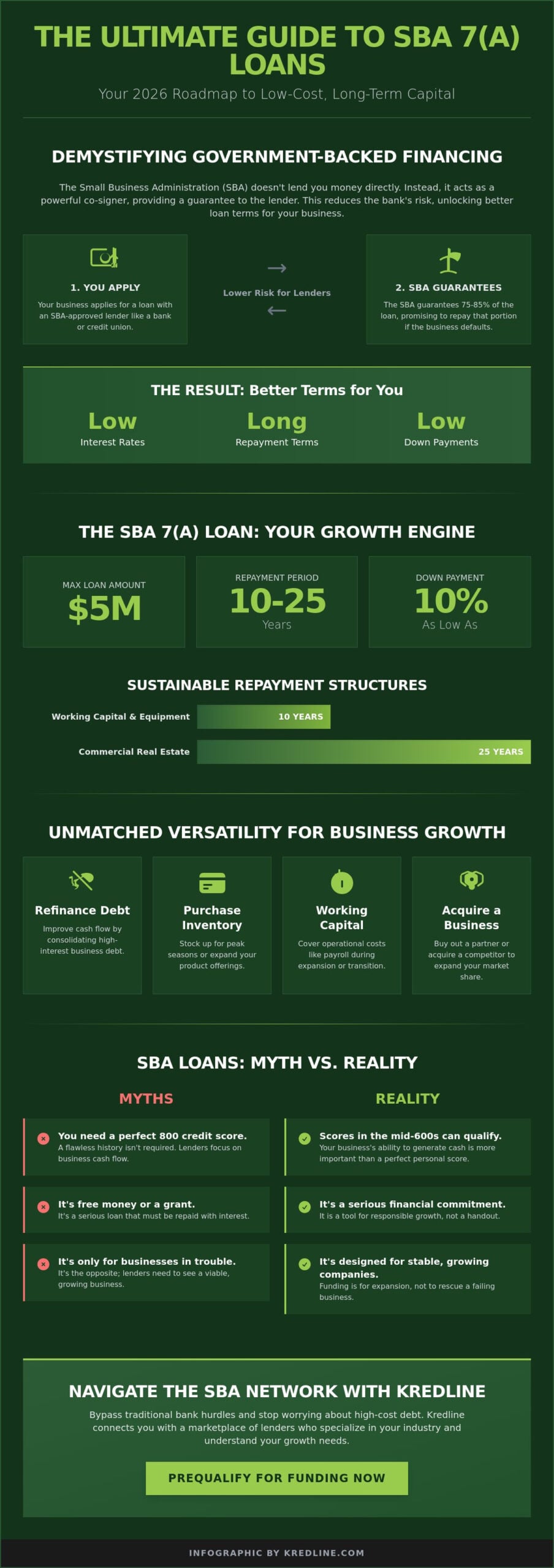
The first thing to understand about an sba loan is that the Small Business Administration doesn’t actually hand you a check. Instead, they act as a powerful co-signer for your business. This government agency partners with banks and credit unions to provide a safety net. If a borrower can’t repay the debt, the government covers a significant portion of the loss. This setup makes lenders much more comfortable offering capital to entrepreneurs who might not meet the strict criteria of a traditional commercial mortgage or term loan.
In 2026, this program is more relevant than ever. Business owners are facing tighter credit markets, and the SBA’s ability to stretch repayment terms out to 25 years for real estate or 10 years for working capital is a lifesaver for monthly cash flow. You’ll often find lower down payments, sometimes as low as 10%, which keeps more cash in your operating account for day-to-day needs. It’s a tool designed to bridge the gap between where your business is now and where it needs to be.
How the SBA Guarantee Works for You
The government typically guarantees between 75% and 85% of the loan amount. This protection is the engine behind the SBA 7(a) Loan program, which is the most popular path for general business needs. Because the bank’s risk is capped, they can offer you interest rates that are often lower than standard commercial products. This isn’t just about saving money on interest; it’s about making sure local businesses stay resilient during economic shifts. When banks feel safe lending, the whole community grows.
Common Myths About SBA Funding
- You need a perfect 800 credit score: This isn’t true. While you need decent credit, most lenders look for a score in the mid-600s or higher. They care more about your business’s ability to generate cash than a flawless personal history.
- It’s free money: An sba loan is a serious financial commitment. It isn’t a grant or a “forgivable” payout. You’re expected to pay it back with interest, just like any other professional financing.
- It’s only for businesses in trouble: Actually, it’s the opposite. Lenders want to see that your business is viable and has a clear plan for growth. If your company is already failing, you’ll likely struggle to get approved.
At Kredline, we believe that understanding these options shouldn’t feel like a chore. We focus on taking the complexity out of the equation so you can focus on running your shop or clinic. If you’re wondering where your business stands, you can prequalify for business funding to see which programs fit your 2026 growth strategy without the typical bank-related stress.
The SBA 7(a) Loan: The Workhorse of Business Growth
The 7(a) program stands as the most versatile tool in the Small Business Administration’s arsenal. It’s often the first choice for owners who need a significant capital injection but don’t want the high costs associated with some forms of private lending. In 2026, the maximum amount for an sba loan under the 7(a) umbrella remains at $5 million. This cap provides enough room for most small-to-mid-sized companies to execute major shifts, whether that’s a total digital overhaul or a physical move.
Repayment terms are designed to be sustainable. For typical working capital, machinery, or equipment, you’re looking at a 10-year maturity. If you’re using the funds for real estate, that term extends to 25 years. This long-term structure keeps monthly payments manageable, which is a breath of fresh air for businesses used to the aggressive daily or weekly draws of high-interest products. However, the SBA isn’t a lender of first resort. They strictly enforce the “credit elsewhere” rule. This means your lender must certify that you couldn’t obtain a conventional loan on reasonable terms without the SBA’s guarantee. It’s a safeguard to ensure government-backed funds support those who truly need the help to grow.
The versatility of these funds is unmatched. You can use a 7(a) loan for:
- Purchasing inventory to prepare for peak seasons.
- Meeting payroll during a transition or expansion phase.
- Refinancing high-interest business debt to improve monthly cash flow.
- Buying out a partner or acquiring a competitor.
While exploring Alternative Financing can sometimes offer faster approval times, the 7(a) program’s low interest rates and long terms often make it the most cost-effective path for sustainable growth.
SBA 7(a) Working Capital Loans Explained
The 7(a) loan is the primary vehicle for general business purposes. These funds act as a bridge, filling the gap when your accounts receivable haven’t quite caught up with your daily operating expenses. Seasonal businesses benefit most from this. If your company experiences a 40 percent dip in revenue during the winter, working capital ensures you don’t have to cut staff or stall production. It provides the liquidity needed to handle inventory surges before your busiest sales months, keeping your operations steady regardless of the calendar.
Using 7(a) Funds for Business Expansion
Expansion is more than just a goal; it’s a complex logistical challenge that requires cash. Whether you’re hiring a new management team, launching a regional marketing campaign, or opening a second location, the 7(a) program provides the necessary runway. Lenders will expect a detailed business plan that proves the expansion is viable. They’ll look for three years of financial projections and a clear explanation of how the new revenue will cover the debt. If you aren’t sure if your financials are ready, Kredline can help you prequalify for business funding to see if you fit the 7(a) profile. This step helps you understand your standing before you commit to the lengthy application process.
SBA Loans vs. Alternative Financing: Finding the Right Speed
Choosing between an sba loan and alternative financing isn’t about finding the “best” product. It’s about matching the funding to your business’s current velocity. Think of it as choosing between a freight train and a delivery van. Both move cargo, but they do it at different speeds and costs. If you’re planning a major expansion or buying real estate, the “slow and steady” path of SBA loan programs is almost always the right move. These loans offer the lowest APRs and longest repayment terms, often stretching out over 10 to 25 years.
The trade-off for those low rates is time. It’s common for an sba loan to take 60 to 90 days to fund. In the fast-moving world of small business, three months can feel like an eternity. If you’re facing a sudden equipment failure or a surprise tax bill, you don’t have 90 days. This is where “fast and flexible” alternatives come in. While the cost of capital is higher, the speed of delivery can be the difference between staying open or closing your doors. A 2023 Federal Reserve report highlighted that 40% of small businesses sought funding to cover immediate operating expenses, where speed was the primary factor in their decision.
Many smart owners now use “bridge funding” to get the best of both worlds. They secure a fast, short-term solution to handle immediate needs while their SBA application moves through the pipeline. Once the SBA funding arrives, they use a portion of it to retire the more expensive short-term debt. This mix of products ensures the business never loses momentum while waiting for government-backed approval. At Kredline, we often help owners look at their total capital needs to see if a combination of products serves them better than a single, large loan.
When to Choose a Short-Term Business Loan
There are specific scenarios where speed is far more valuable than the lowest possible interest rate. Imagine a supplier offers you a 25% discount on bulk inventory, but the deal expires in 72 hours. The interest you’d pay on a short-term business loan is a fraction of the 25% you’ll save on COGS. These loans are designed for quick wins and immediate gaps. They provide a lump sum of cash that you typically repay within 6 to 18 months, making them perfect for projects with a rapid return on investment.
The Role of Merchant Cash Advances (MCA)
For businesses that lack traditional collateral but have strong daily sales, a merchant cash advance (MCA) offers a unique path. An MCA isn’t a loan in the legal sense; it’s a purchase of your future credit card receipts. This makes it highly accessible for retail and hospitality businesses. Unlike the fixed monthly payments of an SBA loan, an MCA is repaid through daily or weekly percentages of your sales. If your business has a slow week, your payment automatically scales down, providing a built-in safety net for your cash flow.
Qualifying for an SBA Loan: A 2026 Eligibility Checklist
Securing an sba loan in 2026 requires more than just a solid business plan. You need to meet several non-negotiable criteria before a lender will even open your file. First, your business must operate for profit and be physically located and operating within the United States. You also need to demonstrate that you’ve invested your own time or money into the business, known as the “equity injection.” This ensures you have skin in the game.
Size standards are another critical factor. The SBA defines a “small” business based on your industry’s NAICS code. For many service industries, this means staying under $8 million to $40 million in average annual receipts. For manufacturing, the cap is often 500 employees. If your business has grown rapidly, you’ll need to verify you haven’t outgrown these specific thresholds before applying.
Transparency is the foundation of the application. You’ll be asked to provide a Statement of Personal History (SBA Form 912). Lenders use this to assess your character and financial reliability. If you have past tax liens or legal issues, it’s better to disclose them early. Regarding collateral, the SBA doesn’t necessarily decline a loan if you lack sufficient assets, but they will require a lien on whatever business assets are available. If those don’t cover the loan amount, the lender might require a lien on personal real estate as additional security.
Financial Documentation You Will Need
Lenders expect a high level of organization. You’ll need to provide three years of federal income tax returns for both the business and its owners, along with current year-to-date profit and loss statements and balance sheets. A major factor for approval is your debt-to-income ratio. Lenders want to see that your cash flow can comfortably cover new loan payments alongside existing obligations. To speed things up, organize these documents into a digital “loan package” folder before your first meeting. This simple step can shave weeks off the underwriting process.
The Personal Credit Score Factor
Your personal financial health remains a primary benchmark. Most lenders require a FICO Small Business Scoring Service (SBSS) score of at least 155 to move forward. If your score is currently a hurdle, focus on reducing credit card utilization or resolving any errors on your report. If you need capital immediately and can’t wait for a credit rebuild, revenue-based financing is a viable alternative that focuses on your daily sales rather than just your credit history. This can bridge the gap while you prepare for an sba loan in the future.
How to Apply: Navigating the SBA Network via Kredline
Applying for an sba loan through a traditional local bank often feels like a one-way conversation. You submit a mountain of paperwork and wait weeks for a simple status update. If that specific bank isn’t currently looking to fund your industry, you’re forced to start the entire process over with a new lender. Kredline changes this dynamic by acting as your navigator through a complex financial landscape.
We move away from the rigid, “one-size-fits-all” bank model. Our team works with a curated network of third-party SBA lenders who have different risk appetites. This is vital because credit availability fluctuates. By mid-2026, data shows that while some national banks tightened their requirements, non-bank SBA lenders increased their approval rates by 12%. We know which lenders are actively looking for deals in your specific sector, whether you’re running a boutique hotel or a regional distribution center.
Our advisor-led approach helps you avoid the common pitfalls that stall 40% of independent applications. We don’t just pass your file along; we review your debt-to-income ratios and cash flow statements to ensure they meet the 2026 “SBA Standard” before a lender ever sees them. This preparation cuts down the traditional 90-day waiting period to a more manageable 30 to 45 days for most well-prepared businesses.
The Advantage of a Financing Marketplace
A marketplace offers a “one-to-many” advantage that a single bank cannot match. When you work with Kredline, your single inquiry reaches multiple lenders who are actually hungry for your specific deal. This creates a competitive environment where lenders work harder to win your business.
- Human Connection: We prioritize real conversations over robotic, automated “denied” emails.
- Industry Matching: We find lenders who understand the nuances of your business model, not just your balance sheet.
- Efficiency: You fill out one set of core documents instead of repeating the process for every bank in town.
Next Steps: Prequalifying Without the Stress
You don’t need to have every tax return from the last three years ready just to see where you stand. We recommend that business owners explore their funding options broadly first. This helps you understand if an sba loan is the right tool or if a faster bridge loan might better serve your immediate growth needs.
We protect your credit score during the initial discovery phase. Kredline uses a soft credit pull for prequalification, which means your score won’t take a hit while you’re shopping for the best terms. It’s a low-risk way to get a clear picture of your borrowing power. Once you’re ready to move forward, we’ll guide you through the final steps with a dedicated advisor by your side. Prequalify with Kredline today to see which SBA or growth capital programs fit your 2026 goals.
Your Roadmap to Business Expansion in 2026
Securing capital shouldn’t feel like a second full-time job. By now, you know that the sba loan remains one of the most reliable tools for long-term growth, especially with the SBA 7(a) program still offering up to $5 million for eligible small businesses. The 2026 lending landscape favors owners who come prepared with clear financial statements and a solid understanding of their debt-service coverage ratio. You don’t have to navigate these complex government requirements alone.
Our team at Kredline acts as your financial navigator. We provide access to a diverse network of SBA 7(a) lenders and offer flexible funding options that often go beyond what traditional local banks can provide. You’ll get personalized guidance from knowledgeable advisors who understand that every business has a unique story. Instead of guessing which lender fits your industry, you can focus on running your daily operations while we handle the heavy lifting of the search.
See if you prequalify for SBA or growth funding with Kredline
Your business deserves a partner that values your time as much as you do. Let’s get your growth plan moving forward today.
Frequently Asked Questions
How long does it typically take to get an SBA loan in 2026?
You can expect the process to take between 30 and 90 days from the moment you submit your application until the funds hit your account. While SBA Express options can close in under 30 days, standard programs involve over 20 specific documents that require patience. Kredline helps you organize these files early to avoid the common 14 day delays caused by missing tax returns or financial statements.
What is the minimum credit score required for an SBA 7(a) loan?
Most lenders require a personal credit score of at least 680 to qualify for an sba loan in 2026. Additionally, the SBA uses a FICO SBSS score, where a minimum of 155 is typically necessary for approval. If your score is lower, focusing on strong cash flow or higher collateral can sometimes bridge the gap, though 680 remains the standard benchmark for most traditional banks.
Can I get an SBA loan if I have no collateral?
You can obtain financing without collateral for amounts under $50,000 under current agency guidelines. For loans exceeding this threshold, the government requires lenders to take a lien on available business assets to secure the debt. However, the agency explicitly states that a lender cannot reject your application solely due to a lack of collateral if you meet all other credit and cash flow requirements for the program.
What are the current SBA loan interest rates?
Interest rates for an sba loan are currently tied to the Wall Street Journal Prime Rate plus a negotiated spread, often ranging from 2.25% to 4.75%. In 2026, most 7(a) programs feature variable rates that adjust quarterly based on market shifts. You’ll find these rates are often 15% lower than traditional merchant cash advances, which carry double-digit equivalent APRs that can drain your daily cash flow.
Can I use an SBA loan to pay off existing high-interest business debt?
You can use these funds to refinance existing debt if the new terms improve your monthly cash flow by at least 10%. This is a common strategy for business owners stuck with high-interest daily or weekly payment loans that hamper growth. Kredline can help you determine if your current debt structure meets the specific refinancing criteria to ensure the transition is smooth and actually saves you money.
Is an SBA loan better than a business line of credit?
This financing is generally better for long-term investments like real estate or major equipment, while a line of credit suits short-term operational gaps. Government-backed terms can extend to 25 years for real estate, providing much lower monthly payments than a standard line. If you need to bridge a 30 day gap between an invoice and payroll, a line of credit is faster and more efficient for your business.
Do I need a business plan to apply for an SBA loan?
You definitely need a comprehensive business plan if you’re a startup or using the capital for an expansion exceeding 20% of current revenue. Lenders look for a three year financial projection and a clear explanation of how the money will generate growth. A well-structured plan proves to the bank that you’ve accounted for market risks and have a solid strategy for repayment, which builds the trust needed for approval.
What happens if I cannot repay my SBA loan?
If you default, the government pays the lender the guaranteed portion of the debt, which typically covers 50% to 85% of the loss. You remain responsible for the remaining balance and any personal guarantees signed during the application process. This often involves the liquidation of pledged business assets to recover as much of the outstanding debt as possible before the agency steps in to settle the remaining claim.

Article by
Billy Wagner Jr
Billy has 15 years of customer service experience and several years of experience in business loans and merchant services. His passion is helping business owners understand their options and assisting them in making confident decisions around funding and payment processing.
