



Last Tuesday, a boutique owner in Austin tried to open a commercial checking account for her new brand, “Velvet & Vine,” only to be told she couldn’t because her legal paperwork listed her as a sole proprietor under her own name. It’s a common roadblock. It stops many entrepreneurs before they even process their first sale. You’ve likely felt that same frustration when legal requirements seem to complicate your vision rather than support it. We believe your focus should stay on your customers, not on deciphering confusing administrative hurdles.
In this guide, we’ll explain exactly what does d/b/a mean for your specific business structure and why it’s a vital tool for your professional identity. You’ll learn how this simple filing impacts your ability to secure merchant services and clear the way for future business funding. We’ll walk through the registration steps and show you how to align your brand name with your legal entity. At Kredline, we’ve seen how a proper setup makes it much easier to explore funding options later, so you can get back to growing your business without the stress of compliance worries.
Key Takeaways
- Understand exactly what does d/b/a mean and how it distinguishes your public brand identity from your business’s registered legal entity.
- Identify whether your current setup—as either a sole proprietor or an existing LLC—requires a trade name to launch new products or services legally.
- Clarify the critical difference between a naming convention and a legal structure to ensure your business has the right level of liability protection.
- Learn the practical steps for conducting a name search and filing the necessary paperwork to keep your business finances organized and compliant.
- Discover how a registered trade name helps you establish a professional history, which simplifies securing business funding and merchant services.
What Does D/B/A Mean? Understanding Trade Names
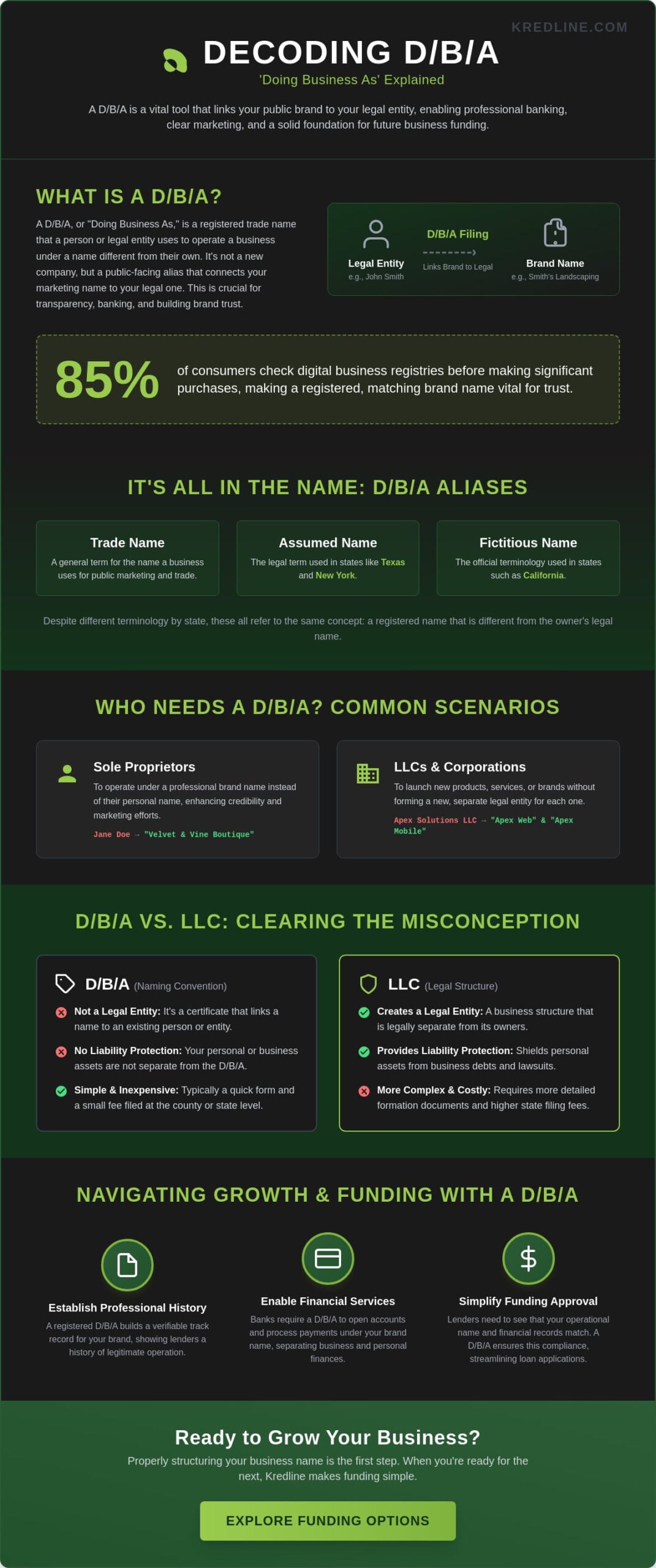
When you start a business, your legal name is often determined by your own name or the name on your formation documents. For a sole proprietor, that name is simply their personal name. For a corporation or LLC, it’s the name registered with the Secretary of State. However, many owners choose to operate under a different title that better reflects their services. This is where a DBA comes in. The term d/b/a mean “doing business as,” and it acts as a formal notification that a person or entity is conducting business under a name other than their legal one.
In 2026, clear brand identification is more than just a legal hurdle; it’s a foundation for consumer trust. With 85% of consumers now checking digital business registries before making significant purchases, having a registered name that matches your marketing materials is vital. A DBA allows you to create a professional image and build a distinct brand without the administrative overhead of forming an entirely new legal entity for every project or product line.
Trade Names vs. Assumed Names vs. Fictitious Names
You might hear your accountant call it a fictitious name while your lawyer refers to it as an assumed name. Don’t let the jargon confuse you. These terms are largely interchangeable and refer to the same concept: a trade name that differs from the owner’s legal name. The specific terminology usually depends on your geography. For instance, in states like Texas or New York, “assumed name” is the standard legal phrase, while California officials typically use “fictitious business name.”
Your local county clerk might use one term because it’s what’s written in the state statutes, while your bank might use another on their internal forms. Regardless of the label, the function remains the same. It’s a way to link your public-facing brand to your underlying legal structure so that everyone knows exactly who they are dealing with.
The Core Purpose of a DBA Filing
The primary reason for filing a DBA is consumer protection. It prevents business owners from hiding behind anonymous storefronts. By filing this paperwork, you’re making it public record that you are the individual or entity responsible for the business’s actions. This transparency is a legal requirement in most jurisdictions to ensure that if a legal or financial issue arises, the public knows who to hold accountable.
Beyond legalities, a DBA is a practical necessity for financial logistics. Most banks won’t allow you to open a business account or cash checks made out to a brand name unless you have a certified DBA certificate on file. If you’re looking to secure a business line of credit to manage your cash flow, lenders will require your DBA documentation to ensure your operational name matches your financial records. A DBA serves as the functional bridge that connects your formal legal identity to the public brand identity your customers recognize.
- Accepting Payments: You can legally accept checks and credit card payments under your brand name.
- Marketing Flexibility: You can launch multiple brands under one LLC.
- Professionalism: It moves your business away from “John Smith” to a more credible “Smith’s Industrial Solutions.”
Who Needs a DBA? Common Scenarios for Business Owners
Most business owners encounter the term when they want to market themselves more effectively. While the legal definition of DBA refers to a trade name used by a person or entity that differs from their registered legal name, the practical applications vary by business structure. Understanding what does d/b/a mean in a daily operational context helps you decide if it’s the right move for your current growth stage.
A DBA is essential for four primary groups of entrepreneurs. Sole proprietors use them to look more professional. Existing LLCs or Corporations use them to launch new products without the cost of forming a new entity. Franchisees use them to operate under a national brand name. Finally, businesses shifting into a new industry use DBAs to rebrand without changing their underlying legal structure. It’s a tool for flexibility and brand clarity.
The Sole Proprietor Dilemma
If your name is John Smith and you start a landscaping company, your legal business name is “John Smith.” This works for taxes, but it’s not great for marketing. To operate as “Smith’s Professional Landscaping,” you need a DBA. This registration allows you to open a business bank account and accept checks made out to the business name rather than your personal name. It creates a necessary boundary in the eyes of your customers, making your operation feel established and trustworthy.
It’s vital to remember that a DBA doesn’t change your legal status. For a sole proprietor, there’s no separation of liability. If your business faces a legal issue, your personal assets are still on the line. A DBA is a “mask” for your business name, not a shield for your bank account. If you’re looking to protect personal assets, you’ll eventually need to look beyond a trade name toward formal incorporation.
Expanding with Multiple DBAs
Established companies often use DBAs to manage different revenue streams under one roof. This is a common strategy for a restaurant group, for example. A single LLC, like “Main Street Hospitality Group,” might operate a “Green Leaf Cafe” and a “Midnight Catering” service. Each brand has its own logo and customer base, but the cash flow is managed through the same parent company. This setup simplifies your accounting and reduces the administrative burden of filing separate tax returns for every branch.
Managing multiple brands requires careful attention to your working capital. When one brand is in a seasonal slowdown, the other might be peaking. If you find that your expansion is moving faster than your current cash flow allows, you can prequalify for business funding to see which options might help bridge the gap between your different trade names. Using a DBA allows you to test new markets or service lines with minimal risk to your existing corporate structure. It’s an efficient way to grow while keeping your legal foundations simple and organized.
DBA vs. LLC: Clearing Up the Misconceptions
Many entrepreneurs mistakenly think a DBA is a legal entity. It isn’t. Understanding what d/b/a mean helps you avoid significant legal traps. A DBA is simply a “Doing Business As” name, acting as a trade name for an existing person or company. An LLC, however, is a separate legal person created by the state. While an LLC provides a protective barrier between your personal life and your business, a DBA offers no such shield.
Most owners start with a DBA because it’s the fastest way to open a business bank account or brand a product. As the business grows, they often transition to an LLC to mitigate risk. In 2026, filing a DBA remains affordable, usually costing between $10 and $100 depending on the county. Forming an LLC is more intensive, requiring articles of organization and filing fees that typically range from $50 to $500 plus annual maintenance costs. For those starting out, looking up How to Register a DBA provides a clear picture of the administrative steps required at the local level.
Liability and Asset Protection
If you run a sole proprietorship under a DBA, you and the business are one and the same in the eyes of the law. If a customer slips in your store or a vendor sues for breach of contract, your personal bank account, car, and home are vulnerable. An LLC is often preferred for businesses with high physical equipment or inventory because it creates a corporate veil. This separation ensures that business debts stay with the business. When you reach the stage where you need to scale or protect what you’ve built, Kredline helps businesses with various structures prequalify for funding to manage these transitions and growth phases safely.
Tax Implications of a DBA
Registering a DBA doesn’t change how you file your federal income taxes. If you’re a sole proprietor, you’ll still report business income and expenses on a Schedule C attached to your personal 1040 return. You can usually use your Social Security Number for these filings. However, if you hire employees or want to keep your personal data more private, you should apply for an Employer Identification Number (EIN). Understanding what d/b/a mean in a tax context is simple; it is a label for your income, not a new tax category. The IRS sees through the trade name to the person or entity behind it, ensuring that your tax obligations remain tied to your primary legal identity.
How to Register a DBA and Set Up Your Business Finances
Registering a trade name is a practical step that moves your business from a concept to a functional entity. While the process is straightforward, skipping a step can lead to legal headaches or delays in accessing capital. Understanding what d/b/a mean in a regulatory context helps you realize that this name is your public identity, while your legal name remains the foundation for your taxes and liabilities.
- Step 1: Conduct a thorough name search. Before filing, check your state and county databases to ensure the name is available. Using a name already in use can result in cease-and-desist letters or trademark disputes.
- Step 2: File the appropriate paperwork. Depending on your location, you’ll submit a “Fictitious Business Name” statement to the County Clerk or the Secretary of State.
- Step 3: Pay the registration fee. Filing costs are generally low, typically ranging from $10 to $100. For example, some jurisdictions charge a flat $50 fee that covers the first five years of use.
- Step 4: Meet public notice requirements. Several states require you to publish your new trade name in a local newspaper once a week for four consecutive weeks. This provides public record of who is actually operating the business.
- Step 5: Secure your DBA certificate. Once approved, the government issues a certificate. This document is essential for every financial interaction your business has moving forward.
Opening a Business Bank Account with a DBA
You can’t simply walk into a bank and deposit a check made out to a trade name without the proper paperwork. Banks require your DBA certificate to comply with federal “Know Your Customer” laws. Keeping your personal and business finances in separate buckets is the only way to maintain clean accounting. If you ever need to apply for short-term business loans to cover a seasonal dip or an unexpected repair, lenders will look for these organized records. Clear separation proves your business is a distinct, professional operation rather than a hobby.
Merchant Services and Payment Processing
When a customer swipes their card at your shop, they expect to see a name they recognize on their bank statement. If your legal name is “J&M Holdings LLC” but your storefront is “The Daily Grind,” an unrecognized charge often leads to a dispute. Using your DBA for merchant services ensures the trade name appears on credit card statements, which significantly reduces chargebacks. It also allows you to set up merchant accounts that track daily cash flow accurately. This level of transparency makes it much easier to manage your working capital and plan for future growth.
Navigating Business Funding and Growth with a DBA
You don’t need a complex corporate structure to access capital. Many entrepreneurs wonder if they can secure a business loan without being a formal LLC or Corporation. The short answer is yes. When you apply for funding, what a d/b/a mean to a lender is that you’ve taken the first step toward professionalizing your operations. It shows you aren’t just a hobbyist; you’re operating a brand with a specific market identity.
A DBA helps you build a paper trail that’s vital for future credit applications. By opening a business bank account under your trade name, you separate your personal grocery trips from your professional supply runs. This separation is exactly what underwriters look for when they review your bank statements. It creates a clear history of revenue and expenses tied to your brand. Beyond credit, a DBA lets you test new markets. If your landscaping company wants to try out pool cleaning, you can register a new trade name to see if the market bites before you commit to a full corporate expansion.
Funding Options for DBA Holders
Lenders prioritize your cash flow and consistency over your legal filing status. If your trade name has a steady stream of credit card sales, a Merchant Cash Advance (MCA) can be a fast way to get capital. This option uses your DBA’s daily sales data to determine how much you can borrow. It’s built for speed, which is helpful when you need to grab inventory for a sudden rush.
For businesses with seasonal peaks, Revenue-Based Financing offers a flexible way to support growth. Since payments fluctuate based on your monthly income, it won’t crush your cash flow during slow months. However, if you’re looking at large equipment financing, be prepared for more scrutiny. Lenders might require personal tax returns or additional collateral because the DBA doesn’t provide the same legal “shield” as a corporation. They want to ensure the person behind the name is just as reliable as the brand itself.
Bridging the Gap Between Invoices and Expenses
Operating under a DBA allows you to bill clients professionally. When a customer sees a “Doing Business As” name on an invoice rather than a personal name, it builds trust. This professional image is crucial when you’re waiting 30 or 60 days for a payment to arrive. To manage your daily operations during these gaps, a Business Line of Credit provides a safety net. You can draw funds to cover payroll or utilities and only pay interest on what you actually use.
At Kredline, we see a DBA as a sign of professional intent. It tells us you’re serious about your brand’s future. We act as a partner to help you find the right capital for your specific structure, ensuring your funding matches your growth pace. Whether you’re a solo contractor or a growing retail shop, your trade name is the foundation for your business credit journey. Understanding what a d/b/a mean for your financial health is the first step toward long term stability.
Take the Next Step for Your Brand Identity
Managing a business name is about more than just paperwork; it’s about how your customers perceive your value. You now understand that knowing what does d/b/a mean allows you to market different product lines or services under a single legal entity. This flexibility is vital in a market where the SBA reports over 33 million small businesses are competing for attention. Remember that while a trade name helps with branding and banking, it doesn’t replace the liability protection of an LLC structure. Getting these details right sets a solid foundation for your 2026 growth strategy.
Once your business identity is clear, securing the right capital becomes the next priority. We provide expert guidance on Merchant Cash Advances and Revenue-Based Financing to help you cover payroll or bridge gaps between invoices. You don’t have to navigate the complex world of business credit alone. Our network of third-party providers offers flexible capital through a simple, transparent process designed for busy owners. Prequalify for business funding with Kredline today and focus on building the brand you’ve envisioned. You’ve got the tools to succeed, and the right support makes all the difference.
Frequently Asked Questions
Does a DBA give me exclusive rights to a name?
A DBA doesn’t give you exclusive legal rights or ownership over a business name. It’s simply a public registration that links your personal name or LLC to a specific trade name. For example, if you register “Main Street Cafe” as a DBA in your county, another business owner could potentially use that same name in a different state or even a neighboring city. To get true brand protection and prevent others from using your name, you’d need to file for a federal trademark.
Do I need a DBA if I have an LLC?
You only need a DBA if you plan to conduct business using a name that’s different from the official name on your LLC formation documents. Many owners use them when they want to launch a specific product line without the cost of forming a new legal entity. If your LLC is “Green Valley Holdings” but you want to open a shop called “The Flower Post,” you’ll need a DBA to legally sign contracts and open a bank account under that trade name.
Can I have more than one DBA for my business?
You can register as many DBAs as you need under a single business entity. This is a practical strategy for small business owners who manage different service lines or brands under one roof. For instance, a single construction LLC could hold three separate DBAs for a roofing business, a painting service, and a tool rental shop. This keeps your administrative work centralized while allowing each brand to have its own unique identity and marketing presence.
How much does it cost to get a DBA in 2026?
Filing fees for a DBA in 2026 typically range from $10 to $100 depending on your specific state and county requirements. Some jurisdictions also require you to pay for a public notice in a local newspaper for four consecutive weeks, which can add another $40 to $150 to your total costs. You should check your local county clerk’s website for their current fee schedule to ensure you include the correct payment with your application.
Does a DBA need its own EIN (Tax ID)?
A DBA doesn’t need its own EIN because it isn’t a separate legal entity from your primary business. You’ll continue to use the EIN assigned to your main LLC or your Social Security number if you operate as a sole proprietor. This simplifies your bookkeeping since all income earned under the DBA name is reported on your primary tax return. It’s one less piece of paperwork to manage during the busy tax season.
What happens if I forget to renew my DBA registration?
If you forget to renew your DBA, you lose the legal right to use that name for business transactions and official contracts. Most registrations expire every 5 or 10 years depending on local laws. If the registration lapses, another entrepreneur could legally claim the name for their own business. This could also cause immediate issues with your business bank account, as banks often require proof of an active registration to keep your accounts in good standing.
Is a DBA the same as a Trademark?
A DBA is a local or state requirement for transparency, while a trademark provides federal legal protection for your brand. Understanding what “d/b/a mean” helps you realize it’s about public notice rather than ownership. A trademark prevents others nationwide from using similar names in your specific industry. If you’ve spent years building a unique brand, a DBA alone won’t stop a competitor from copying your name and confusing your customers.
Can I apply for a Merchant Cash Advance with a DBA?
You can definitely apply for a Merchant Cash Advance or other funding options while operating under a DBA. Lenders like Kredline focus on your overall business performance and daily cash flow rather than just your trade name. You’ll simply need to provide your official formation documents and proof of your current DBA filing during the application. This ensures the funding is correctly linked to your primary legal entity and your business bank account.

Article by
Billy Wagner Jr
Billy has 15 years of customer service experience and several years of experience in business loans and merchant services. His passion is helping business owners understand their options and assisting them in making confident decisions around funding and payment processing.
