



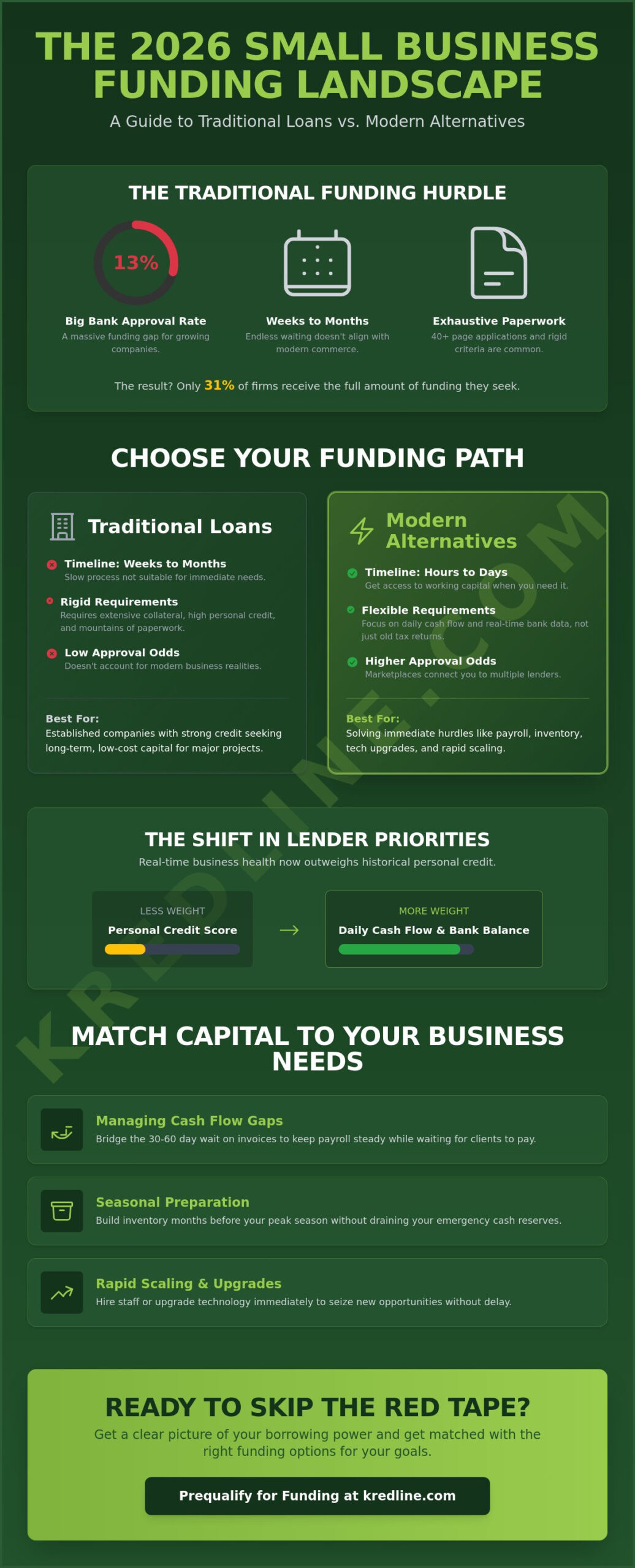
What if the biggest obstacle to your 2026 growth isn’t your business model, but a 40 page application that sits on a loan officer’s desk for three weeks? Data from the 2023 Small Business Credit Survey shows that only 31% of firms received the full amount of funding they sought, often due to rigid criteria that don’t account for modern business reality. You likely know the frustration of staring at a stack of paperwork or worrying about personal collateral while trying to manage a 15% increase in seasonal inventory costs. It’s a common hurdle. You need a small business loan to scale, but the traditional process often feels designed to slow you down with confusing jargon and endless waiting periods.
We believe that securing capital shouldn’t feel like a second full time job. This guide provides a clear roadmap through traditional and alternative funding options to help you find the right capital for your specific needs. We’ll break down how to get fast access to working capital with transparent terms and explain how a resource like Kredline helps you skip the red tape so you can focus on your next big project.
Key Takeaways
- Understand why traditional banks are tightening their criteria and how to identify the specific funding structure that fits your current business stage.
- Learn how to choose between traditional options and modern alternatives like revenue-based financing to secure the ideal small business loan for your growth goals.
- Discover why your daily cash flow and bank balance now carry more weight with lenders than a simple personal credit score.
- See how to strategically use equipment financing or revolving lines of credit to solve immediate operational hurdles like payroll or tech upgrades.
- Explore how using a marketplace approach can increase your odds of approval by connecting you with a curated network of providers instead of relying on a single bank.
Navigating the Small Business Loan Landscape in 2026
The financial environment for entrepreneurs has shifted significantly as we enter 2026. While the economy shows signs of steady growth, traditional banks have continued to tighten their lending criteria. Data from late 2025 indicates that big bank approval rates for small firms remain near 13%, leaving a massive gap for growing companies that don’t fit a rigid corporate mold. Securing a small business loan through a local branch now often requires exhaustive collateral and months of waiting, which doesn’t align with the fast pace of modern commerce.
A business loan is no longer just a simple lump sum of cash meant to sit in a savings account. It’s a strategic tool designed to solve specific operational hurdles. Modern owners now look toward financial marketplaces to find the right fit. These platforms, like the resources found at Kredline, connect you with a variety of capital sources ranging from private investors to fintech lenders. In this new era, the speed of funding and the flexibility of repayment terms have become just as vital as the interest rate itself. If you can’t buy inventory today, a low-interest loan that arrives in three months won’t help you.
Why Traditional Banks Aren’t the Only Choice
Technology has democratized access to capital by allowing lenders to look at real-time data instead of just a two-year-old tax return. You’ll likely encounter two types of partners: direct lenders, who provide the funds themselves, and financial brokers, who shop your profile to multiple sources. This distinction matters because a broker can often find a home for “non-bankable” businesses, those with strong revenue but perhaps shorter credit histories. Choosing the right small business loan depends on whether you value a single direct relationship or the broad reach of a marketplace that forces lenders to compete for your business.
Common Funding Goals for Small Businesses
Most owners aren’t looking for money just to have it; they’re solving a specific puzzle. We see three primary drivers for seeking capital in 2026:
- Managing Cash Flow Gaps: Bridging the 30 to 60 day wait between accounts receivable and accounts payable is the most common use of funds. It keeps payroll steady while you wait for clients to pay.
- Seasonal Preparation: About 40% of retail and service businesses need to build inventory months before their peak season. Funding allows you to stock up without draining your emergency cash reserves.
- Rapid Scaling: When a new contract arrives or a competitor closes, you need to hire staff or upgrade technology immediately.
If you’re ready to see what options fit your current goals, you can prequalify for business funding to get a clear picture of your borrowing power without the typical bank runaround.
Traditional Loans vs. Alternative Financing: A 2026 Comparison
Choosing the right small business loan in 2026 requires a shift in perspective. It’s no longer just about which lender has the lowest interest rate. It’s about matching the speed and structure of the capital to your specific business need. Traditional bank products and modern alternative options serve different masters; one prioritizes low cost over time, while the other prioritizes agility and accessibility.
Traditional SBA loan programs remain the most cost-effective path for established companies with strong credit profiles. These are ideal for long-term stability. However, the application process can still take weeks or months. For businesses that need to move faster, revenue-based financing offers a modern workaround. Instead of a fixed monthly payment, your repayment fluctuates based on your daily or weekly sales volume. This ensures your debt service never outpaces your actual income during a slow month.
Comparing a term loan to a revolving line of credit is equally vital. A term loan provides a lump sum for a specific purpose, like a $75,000 equipment upgrade. A line of credit is better for managing the valleys in your cash flow, such as paying vendors while you wait for a large client to settle a 60-day invoice. If your credit is less than perfect, a Merchant Cash Advance (MCA) provides capital by purchasing a portion of your future sales. It’s one of the fastest ways to get cash, though it carries a higher cost than a standard bank loan.
Understanding cost is where many owners get tripped up. Banks talk in APR, while alternative lenders often use factor rates. A factor rate of 1.15 on a $20,000 advance means you’ll pay back $23,000. It’s simple math, but the shorter repayment term means the effective cost is higher. Transparency matters more than ever in 2026. You should always ask for the total cost of capital in dollars to avoid surprises. If you’re unsure which path fits your current growth stage, you can prequalify for business funding to see your actual options without a hard credit pull.
When to Choose Traditional Term Loans
These are best for long-term projects with a predictable ROI. If you’re buying real estate or planning a major expansion that will take years to pay off, the lower rates of a bank loan are worth the effort. Expect to provide three years of tax returns, profit and loss statements, and likely some form of collateral. The trade-off for the lower interest rate is a longer approval time and stricter requirements.
The Rise of Revenue-Based Financing
This has become a go-to for businesses with fluctuating revenue. Because repayment adjusts based on your actual sales, it’s a stress-free option that won’t choke your cash flow during a seasonal dip. Qualification is based on your recent performance and bank data rather than just a FICO score. It’s a practical choice for companies that have strong sales but lack the collateral or credit history required by traditional banks.
Qualifying for Funding: What Lenders Look for Beyond Credit
By 2026, the traditional credit score has lost its status as the sole gatekeeper for capital. Lenders now prioritize the “Three Cs”: Cash flow, Character, and Capacity. Cash flow is the heartbeat of the evaluation. It shows if your business generates enough liquidity to cover a new small business loan payment without choking your daily operations. Character refers to your professional track record and how you handle previous obligations, while capacity measures your financial headroom for growth. Most modern lenders care more about your average daily bank balance than a three-digit number from a credit bureau. They want to see that you aren’t ending every month at zero.
Time in business remains a critical filter for most providers. While some startup programs exist, the majority of non-bank lenders require at least 6 months of active operations. They also look for consistent monthly revenue, typically starting at $15,000. To make the process smoother, keep your Profit and Loss (P&L) statements updated every thirty days. Clean books don’t just look professional; they prove you understand your margins and can spot trouble before it starts. If you’re unsure where to start, learning how to apply for a business loan through reputable guides can help you organize these financials before you hit the submit button.
Can You Get a Business Loan with Bad Credit?
A low personal credit score doesn’t mean your business is a failure. Many owners with scores below 620 secure funding by leaning on their business health. Alternative funding options focus on your sales volume rather than your past credit mistakes. By using these shorter-term tools, you can build a repayment history that eventually makes you “bankable” for traditional institutions. It’s vital to avoid predatory lenders who hide high fees in confusing contracts. Working with a transparent broker network ensures you’re seeing legitimate offers that fit your actual cash flow.
The Documentation Checklist for Fast Approval
Speed is often the goal when you’re trying to bridge a gap between invoices or meet a sudden payroll demand. To get an answer in as little as 24 hours, you should have these items ready:
- Bank statements: Provide the last 4 to 6 months of your business bank statements. These are the gold standard for verifying your actual revenue.
- Legal documents: Have your tax returns and business formation papers, like your Articles of Incorporation, in a digital folder.
- Use of Funds: Be specific about why you need the small business loan. Telling a lender you need money for “growth” is too vague. Instead, specify that you’re purchasing a $20,000 piece of equipment or hiring two seasonal employees.
If you have these documents prepared, you can often prequalify for business funding without a hard pull on your credit. This allows you to see what you’re eligible for before committing to a specific path.
Strategic Funding: Matching Capital to Your Business Needs
Choosing the right funding isn’t about just getting cash into your bank account. It’s about matching the specific financial tool to the problem you’re trying to solve. Think of a small business loan as a specialized piece of equipment; you wouldn’t use a sledgehammer for a finishing nail, and you shouldn’t use long-term debt to cover a two-week payroll gap.
Equipment and Asset-Based Funding
When you need to upgrade your tech or replace a delivery van, equipment financing is often the most logical path. Because the equipment itself serves as the collateral, lenders often have a lower barrier to entry for credit scores or time in business. This setup protects your other business assets from being tied up in the deal.
The tax benefits are a major driver here. Under Section 179 of the tax code, the deduction limit for 2024 reached $1,220,000, allowing many owners to deduct the full purchase price of qualifying equipment in the year they buy it. Deciding between financing and leasing usually comes down to your long-term plans. Financing builds equity and offers those tax breaks, while leasing keeps your monthly payments lower and makes it easier to swap for newer models in three to five years.
Managing Working Capital Gaps
Growth is often the “silent killer” of small businesses. If you land a massive contract that requires a $50,000 inventory buy-in today, but you won’t see a dime of profit for 90 days, you face a liquidity crisis. This is where a business line of credit becomes your best friend. It stays in the background as a safety net; you don’t pay for it until you draw funds, and you only pay interest on the amount you actually use.
- Payroll Protection: Use a line of credit to keep your best staff during a seasonal dip, like a landscaping company in January or a retail shop in the post-holiday lull.
- Inventory Spikes: If a supplier offers a 15% discount for a bulk purchase, using a short-term business loan to grab that deal can actually save you more money than the interest costs.
- Emergency Repairs: When a walk-in freezer dies on a Friday night, immediate access to working capital prevents thousands of dollars in lost product.
The Cost of Inaction
Many owners focus entirely on the interest rate of a small business loan without calculating what it costs to do nothing. To find your “Cost of Inaction,” look at the revenue you’re missing by waiting. If a new CNC machine generates $8,000 in monthly profit but costs $1,200 in monthly loan payments, waiting six months to “save up” doesn’t save you money. It actually costs you $40,800 in lost net profit. When the return on the capital is significantly higher than the cost of the debt, borrowing becomes a strategic investment rather than a burden.
Ready to see which funding tool fits your current goals? Prequalify for funding options in minutes without impacting your credit score.
The Marketplace Advantage: Securing Capital Without the Stress
Walking into a single bank to request a small business loan is often a gamble. If that specific institution has reached its lending limit for your industry or prefers different collateral, you’re left with a rejection and a wasted week. In 2023, the Federal Reserve’s Small Business Credit Survey found that only 43% of applicants received the full amount they sought. Relying on one door to open is a risk; using a marketplace is a strategy. Kredline functions as your navigator through a complex network of third-party providers, ensuring your application lands in front of lenders actually looking for businesses like yours.
This approach shifts the power back to the owner. Instead of “seeking a loan” with uncertainty, you’re executing a financial plan with data. The process begins with a prequalification step that uses a soft credit pull. This means you can view real offers and terms without the 5 to 10-point drop in credit score typically associated with hard inquiries. It’s a transparent way to shop for capital while keeping your financial profile intact for future needs.
The Human Side of Financial Brokerage
Algorithms can’t understand why a restaurant needs a new walk-in freezer or how a seasonal dip in a retail shop’s revenue is temporary. Kredline advisors bridge the gap between cold data and the reality of the daily grind. They look closely at your debt-to-income ratio to make sure any funding package you accept is sustainable. The goal isn’t just to get you cash today. It’s to build a path. Many clients start with a short-term bridge loan to solve an immediate inventory gap and work with their advisor to improve their profile for an SBA-ready small business loan within 12 to 18 months.
Your Next Steps to Funding
Securing the capital you need shouldn’t feel like a second full-time job. You can start the prequalification process in under 10 minutes. Once you submit your basic information, here is what you can expect:
- The First 24 Hours: A dedicated advisor reviews your submission and reaches out to discuss your specific goals, whether that’s meeting payroll or purchasing equipment.
- Reviewing Options: You’ll receive a curated list of funding paths tailored to your current cash flow and credit profile.
- Finalizing the Plan: After choosing an option, the documentation process is streamlined to get funds into your account as quickly as possible, often within a few business days.
To keep your business ready for future growth, maintain a clean set of digital books and monitor your business credit score monthly. Having your last four months of bank statements ready at all times ensures that when a growth opportunity appears, you’re ready to move before the competition does.
Securing Your Business Future in 2026
Success in the coming year depends on how quickly you can adapt to shifting market demands. Choosing the right small business loan requires a clear look at your specific goals, whether you’re covering a seasonal dip or scaling up operations. Traditional banks aren’t the only path anymore. Modern alternative financing offers the speed and flexibility that small firms need to stay competitive in a fast-moving economy.
Navigating this complex landscape doesn’t have to be a solo mission. Kredline acts as your professional navigator by providing access to a wide network of third-party lenders, giving you more choices without the typical stress of a bank visit. You can explore flexible revenue-based repayment options that align with your actual monthly income. Best of all, you can get started with a no-cost prequalification that involves no hard credit pull. It’s about getting the information you need to make a smart decision for your team and your customers. It’s worth taking a few minutes to see what’s actually available for your specific situation.
See your funding options and prequalify in minutes
Your business has the potential to reach new heights this year. Let’s find the capital to make it happen.
Frequently Asked Questions
How much can a small business realistically borrow in 2026?
Most small businesses can realistically borrow between 10% and 30% of their annual gross revenue. For example, if your company generates $500,000 yearly, you might qualify for a $50,000 to $150,000 small business loan. SBA 7(a) programs maintain a maximum cap of $5 million as of early 2026, though lenders focus heavily on your debt-to-income ratio. Most banks look for a coverage ratio of 1.25 or higher to ensure your cash flow can handle the new monthly payments.
What is the difference between an SBA loan and a Merchant Cash Advance?
An SBA loan is a long term, lower interest debt partially guaranteed by the government, which often takes 60 to 90 days to fund. In contrast, a Merchant Cash Advance isn’t technically a loan; it’s a purchase of your future credit card sales. While an MCA provides cash in 24 hours, the costs are significantly higher than traditional bank products. You’ll pay back an MCA through a percentage of daily sales rather than a fixed monthly amount, which helps during slow weeks.
Do I need to provide personal collateral for a small business loan?
You don’t always need physical collateral like real estate or equipment, but most lenders require a personal guarantee for amounts over $50,000. This means you’re personally responsible for the debt if the business can’t pay. Unsecured options exist for smaller amounts, though these usually come with higher interest rates to offset the lender’s risk. Kredline helps you compare which lenders require specific assets and which rely primarily on your business’s consistent cash flow history.
How quickly can I get funds into my business bank account?
Funding speeds vary from 24 hours to several months depending on the product you choose. Online alternative lenders often deposit funds within 1 to 3 business days after approval because they use automated underwriting. Traditional bank loans or SBA products typically require 30 to 90 days for full processing and document verification. If you’re facing an immediate payroll gap or an urgent equipment repair, fintech platforms are your fastest route to capital.
Will applying for a business loan affect my personal credit score?
Initial pre-qualification usually involves a soft credit pull, which doesn’t impact your score at all. However, once you move forward with a formal application, the lender will likely perform a hard inquiry. According to FICO data, a single hard inquiry typically drops a score by fewer than 5 points. It’s smart to check if a lender uses soft pulls first to protect your credit while you’re shopping for different small business loan options.
What are the typical interest rates for alternative business funding?
Interest rates for alternative funding in 2026 generally range from 8% to over 30% depending on your risk profile and time in business. While these are higher than the 6% to 10% rates often seen at traditional banks, the approval criteria are much more flexible. You’re paying a premium for speed and the lack of strict collateral requirements. Always look at the Total Cost of Capital to understand the full dollar amount you’ll repay over the life of the funding.
Can a new business with less than a year of history get a loan?
It’s difficult to get a standard term loan with less than 12 months of history, but you still have viable options. Equipment financing and invoice factoring are accessible if you have at least 6 months of operations and steady revenue. Most lenders look for at least $10,000 in monthly sales for these specific products. If you’re a true startup, you might need to look toward personal loans for business or specialized microloans from non-profit lenders.
What happens if my business revenue fluctuates after taking a loan?
If you have a fixed-payment loan, your monthly obligation stays the same regardless of your sales volume. This can be stressful during slow months, so it’s vital to maintain a cash reserve of at least two months of expenses. If you choose a revenue-based financing model, your payments naturally decrease when your sales drop. If you’re struggling, contact your lender immediately; many will offer a temporary payment deferral rather than risking a total default on the debt.

Article by
Billy Wagner Jr
Billy has 15 years of customer service experience and several years of experience in business loans and merchant services. His passion is helping business owners understand their options and assisting them in making confident decisions around funding and payment processing.
