



Last Tuesday, a wholesale distributor realized they had $45,000 in outstanding invoices but only $2,000 in the bank with payroll due on Friday. This isn’t a sign of a failing business; it’s the reality for the 60% of entrepreneurs who struggle with timing gaps in their working capital. You likely know the feeling of being rejected by a traditional bank just because your collateral doesn’t meet their outdated standards or because you need the money in days, not months. Finding a reliable funding company shouldn’t feel like a gamble where the lender wins through opaque pricing and hidden factor rates.
We’re here to change that by showing you how to find a financial partner that values your cash flow as much as you do. At Kredline, we believe clarity is just as important as the capital itself. You’ll learn how to evaluate the current finance market to find a structure that matches your specific growth goals while keeping your daily operations smooth. We will break down the steps to secure transparent, flexible capital that aligns with your revenue, ensuring you never have to turn down a big contract because of a temporary dip in the bank balance.
Key Takeaways
- Learn how a modern funding company prioritizes your business’s real-time cash flow and speed over the exhaustive collateral requirements found at traditional banks.
- Discover how to align your specific growth goals with the right financial structure to avoid the common pitfalls of rigid, one-size-fits-all lending.
- Explore why a marketplace approach often provides better results than a direct lender by connecting you with a wider variety of underwriting styles in one place.
- Master the 2026 qualification standards by understanding the shift from credit-only decisions to revenue-based analysis.
- Learn to spot industry red flags and hidden costs to ensure your financial partner values transparency as much as your business’s success.
What is a Funding Company and How Does it Differ from a Bank?
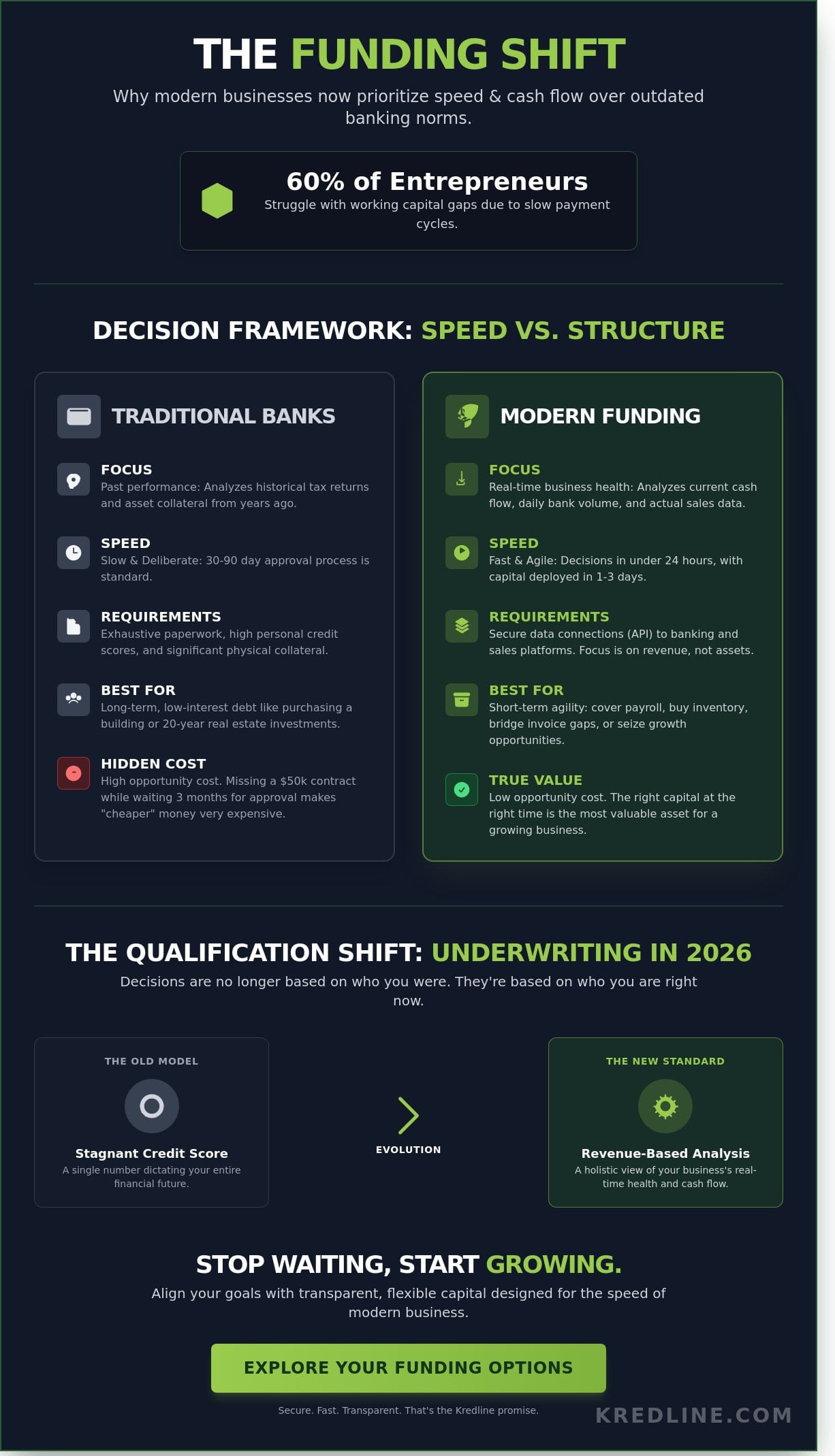
A funding company is a specialized financial partner that provides capital to businesses outside the traditional banking infrastructure. While a bank uses customer deposits to issue loans, a funding company typically uses private capital or credit facilities to support entrepreneurs. The primary difference lies in the philosophy of risk. Banks often focus on what happened three years ago. A modern funding company focuses on what’s happening in your business right now.
By 2026, the shift toward these alternative partners has accelerated significantly. Recent industry reports indicate that nearly 45% of small businesses now seek capital from non-bank lenders first. Traditional banks often require exhaustive collateral and tax returns that don’t reflect the real-time agility of a modern company. This evolution is a core part of the SME finance ecosystem, where the goal is to bridge the gap between opportunity and capital without the bureaucratic weight of a legacy institution.
The Evolution of Alternative Business Finance
Technology has completely rewritten the rules of borrowing. In 2018, a typical business loan application took weeks to process and required stacks of physical paperwork. Today, data-driven underwriting allows providers to analyze your revenue through secure API connections in under 24 hours. This isn’t a “last resort” for struggling shops anymore. Instead, successful companies use these tools to move faster than their competitors. Decisions are now based on actual sales data and daily bank volume rather than just a stagnant personal credit score.
Banks vs. Private Funding: When to Choose Which
Deciding where to source capital depends on your specific needs. Banks are excellent for long-term, low-interest debt like buying a warehouse or a 20-year real estate investment. However, they’re often too slow for day-to-day operational needs. You should consider a private funding company when you need to:
- Purchase inventory for a sudden seasonal surge.
- Bridge a 30-day gap while waiting for a major client to pay an invoice.
- Cover payroll during a brief transition period.
- Act on a growth opportunity that won’t wait for a 60-day bank approval.
The real cost of a bank loan isn’t just the interest rate; it’s the opportunity cost of waiting. If a three-month delay causes you to miss a contract worth $50,000, the “cheaper” bank loan actually becomes the more expensive option. At Kredline, we help you weigh these factors to find the path that keeps your momentum high and your stress low. We believe that getting the right capital at the right time is the most important factor for success in the current market.
Choosing the Right Funding Structure for Your Business Goals
Business owners often treat capital like a fire extinguisher. You grab it when there’s a flame. That’s a mistake that can lead to expensive debt. Modern entrepreneurs use funding as a lever for growth. A professional funding company won’t just hand you a check and walk away. They’ll help you pick a structure that doesn’t choke your daily operations. One-size-fits-all lending died years ago because every business has a different heartbeat. A retail shop’s cash flow looks nothing like a construction firm’s ledger.
Matching your specific challenge to the right product is the difference between scaling and stalling. When you’re exploring the market, you’ll see a vast landscape of SBA funding programs and private alternatives. The key is understanding how the repayment schedule hits your daily balance. If you take a monthly payment loan but your revenue fluctuates by 40% every week, you’re inviting unnecessary stress. You need a structure that breathes with your business.
Short-Term Agility: MCA and Revenue-Based Financing
If you need to stock up for a holiday rush or fix a broken walk-in freezer, speed matters more than long-term interest rates. A Merchant Cash Advance (MCA) isn’t a traditional loan. It’s a purchase of your future sales. This works well for restaurants or retailers with high credit card volume. Similarly, Revenue-Based Financing scales with your actual performance. If you have a slow week, your payment stays proportional to what you actually earned. It’s built for businesses that deal with 20% to 30% seasonal swings.
Flexible Growth: Lines of Credit and Term Loans
Sometimes you don’t need all the cash at once. A Business Line of Credit acts as a revolving reserve. You only pay for what you use. This is perfect for bridging the 60-day gap between invoicing a client and getting paid. If you’re buying a piece of machinery that will last five years, a Short-Term Business Loan for fixed-cost investments is usually the better move.
You’ll need to know the difference between interest rates and factor rates. Interest accrues over time on the remaining balance. A factor rate is a fixed multiplier applied to the total amount upfront. It’s a common tool used by a funding company to keep costs transparent for short-term products. Knowing these details helps you calculate the true cost of capital before you sign any paperwork. If you aren’t sure which path fits your current numbers, you can see what you qualify for to get a clearer picture of your options.
The Marketplace Advantage: Why a Broker Often Beats a Direct Lender
Many business owners assume that going straight to a funding company will save them money on commissions. It’s a logical thought, but it often ignores how the lending market actually functions. A direct lender only has one set of rules. If you don’t fit their specific appetite for risk, they’ll either decline you or offer high rates because they aren’t worried about competition. A broker flips this script. They act as a marketplace, forcing lenders to bid for your business while you focus on running your shop or restaurant. This creates a buffer between you and predatory terms that often hide in the shadows of “fast cash” offers.
One Application, Multiple Possibilities
Applying for capital can be a full-time job. If you approach five different lenders, you’re filling out five forms and potentially authorized five hard credit inquiries. According to FICO data, multiple hard inquiries within a short window can drop your credit score by 5 to 10 points. A marketplace model avoids this damage. You submit one set of documents, and a professional navigator uses a single soft pull to see which partners are currently hungry for your specific industry.
- Efficiency: You have one point of contact instead of managing five different email threads.
- Competition: When lenders know they’re competing in a marketplace, they’re more likely to trim their margins to win your business.
- Diverse Products: One application might reveal that a business line of credit is a better fit for your cash flow than the term loan you originally planned for.
Expert Guidance Through the Fine Print
Comparing two different funding offers is rarely straightforward. One lender might quote a factor rate, while another uses a traditional APR. Without a translator, you might choose an offer that looks cheaper on the surface but costs 15% more over the life of the deal. Brokers help you compare these “apples to apples” by calculating the total cost of capital, including origination fees which typically range from 1% to 5% in the private market.
A broker also acts as your advocate during underwriting. If a funding company has questions about a specific dip in your revenue from two months ago, your broker can explain the context, such as a seasonal slowdown or a one-time equipment repair, before a computer algorithm simply hits “decline.” This human element is often the difference between a rejection and a customized approval. If you want to see what your business qualifies for without the stress of a hard credit check, you can prequalify for business funding through a marketplace that prioritizes your long-term stability over a quick transaction.
Qualifying for Funding: What Companies Look for in 2026
By 2026, the criteria for securing capital have shifted significantly. Most traditional banks still lean on static credit scores, but a modern funding company now prioritizes real-time cash flow analysis. This shift means your daily bank balances and transaction volumes carry more weight than a FICO score from three years ago. Lenders want to see that your business generates consistent revenue to support a new payment schedule without straining your operations.
Expect to meet a few baseline benchmarks before you apply. Most top-tier providers require at least 6 months of active operations and a minimum monthly revenue of $15,000. If your industry is considered volatile, such as construction or seasonal retail, these requirements might be slightly higher. Preparing your profile involves more than just having a good idea; it requires proving your business is a stable machine capable of handling debt service.
The Essential Documentation Checklist
The documentation process is faster than it used to be, but it’s more data-intensive. You’ll need to provide the last 3 to 6 months of business bank statements to serve as the primary indicator of your financial health. While you might not need a full audit, a clean P&L statement shows that you understand your overhead and profit margins. A UCC filing is a public notice that a lender has a legal interest in certain assets of your business to secure a loan.
Overcoming Common Qualification Hurdles
Don’t let a “bruised” credit score stop you from seeking capital. In 2026, strong daily sales can often offset a lower credit score, especially if your business maintains a daily balance above $2,000. If you have existing debt, a funding company will look at your total debt-to-income ratio to ensure you aren’t over-leveraged. They want to be a partner in your growth, not a burden on your weekly cash flow.
- Maintain a consistent daily balance to show liquidity and resilience.
- Keep your business and personal expenses strictly separate to simplify the underwriting process.
- Be transparent about existing liens or other merchant cash advances you’ve taken.
Industry risk codes also play a major role in your funding limit. If your NAICS code flags your business as high-risk, you might start with a smaller bridge amount to prove your reliability. Once you’ve made 50% of your payments on time, many providers will increase your limits or offer more favorable terms for your next round of capital.
Ready to see where your business stands? You can prequalify for business funding in minutes to explore your current options without a hard credit pull.
Spotting a Trustworthy Funding Partner
Finding the right funding company shouldn’t feel like a gamble. In 2026, the market is crowded, and identifying a reliable partner requires looking past flashy marketing. A legitimate lender will never ask for “application fees” or “processing fees” before you’ve even seen an offer. If a provider guarantees approval regardless of your business health, it’s a sign they might be predatory or simply untruthful. Always verify a physical office address; a company that exists only as a website is a significant risk for a small business owner.
Transparency is the foundation of a good relationship. You need to know the total cost of capital, not just a monthly payment. For example, if a factor rate is 1.2 on a $50,000 advance, you’ll repay $60,000. Choosing a funding company that hides these numbers or uses “black box” algorithms is a mistake. These automated systems often ignore the nuances of your industry, like seasonal dips in a retail business. A human-first advisor will explain why a specific structure works for your cash flow, whether you’re covering payroll or buying inventory for a busy season. They’ll help you see the ROI of the capital rather than just the debt.
Evaluating Transparency and Communication
Ask direct questions about the repayment schedule. A trustworthy partner will tell you if a product has downsides, like how daily draws might impact your daily operations during a slow month. Look for real-world customer stories from 2024 or 2025 that highlight how the company handled challenges, not just the easy wins. If they’re unwilling to discuss the “what-ifs,” they aren’t looking out for your long-term success.
Next Steps: Taking the Stress Out of Prequalification
Taking the first step doesn’t have to be intimidating or hurt your credit score. You can prequalify for business funding through Kredline without a hard credit pull, which keeps your options open while you gather information. A no-obligation consultation allows you to discuss your specific goals, like bridging a 60-day gap in receivables or expanding a restaurant location. This conversation is about finding a fit, not a sales pitch. Once you understand the structure and the costs, you can move forward with the confidence that your funding partner is actually on your side.
Taking the Next Step for Your Cash Flow
Running a business in 2026 requires more than just hard work; it demands a clear strategy for managing capital. You’ve seen how the right funding company can bridge the gap between paying your team today and waiting for that big invoice to clear next month. Success often comes down to choosing between a rigid bank structure and the flexibility of a modern marketplace. By looking at your specific goals, whether it’s an SBA 7(a) loan for long-term stability or a quick MCA for immediate equipment needs, you position your company for sustainable growth.
Navigating these choices doesn’t have to be a lonely process. At Kredline, we focus on providing transparent, human-led advice that cuts through the noise of corporate jargon. We act as an expert brokerage, connecting you to a national network of providers to find the exact fit for your situation. You get the benefit of multiple options, from working capital to SBA programs with terms up to 25 years, without the stress of managing dozens of applications yourself. It’s about finding a partner who values your time as much as you do. See which funding options your business qualifies for today. Your next phase of growth is closer than you think.
Frequently Asked Questions
What exactly is a merchant cash advance and how is it different from a loan?
A merchant cash advance isn’t a loan; it’s a purchase of your future credit card sales at a discounted rate. Unlike a traditional loan with fixed monthly installments, a funding company collects a set percentage of your daily sales until the balance is paid. If your sales drop on a particular Tuesday, the amount you pay that day decreases accordingly. This structure makes it a flexible tool for businesses with fluctuating seasonal revenue.
Can I get funding for my business if I have a low personal credit score?
You can still secure capital with a personal credit score as low as 500, as alternative lenders prioritize your business’s monthly revenue over your credit history. In 2024, data from the Small Business Credit Survey showed that alternative providers approved 58% of applicants with fair or poor credit. These lenders typically analyze your last 6 months of bank statements to ensure your cash flow is strong enough to support the repayment schedule.
How fast can a funding company actually get capital into my bank account?
Most modern funding companies can deposit capital into your business account within 24 to 48 hours of your application’s approval. The process is efficient because they use automated underwriting systems to analyze your digital bank records in real time. If you submit your application and required documents before 10:00 AM, it’s common to receive a same-day wire transfer by the end of the business day.
What are the typical requirements for a small business line of credit in 2026?
To qualify for a line of credit in 2026, you generally need at least 6 months of operational history and $10,000 in consistent monthly revenue. Lenders will ask for your most recent 3 months of business bank statements to verify these figures and check for a healthy ending daily balance. While traditional banks often require physical collateral, most fintech options are unsecured and rely on your real-time cash flow data instead.
Is it better to work with a direct lender or a business loan broker?
Working with a broker is often better if you want to compare 10 different offers simultaneously, whereas a direct lender provides a faster, one-on-one relationship. Brokers act as a bridge, helping you navigate complex terms across multiple platforms to find the lowest cost of capital for your specific situation. Kredline serves as a helpful resource in this space, guiding you through these choices to find a fit that matches your growth goals.
What are the common ‘hidden costs’ I should look for in a funding agreement?
Look specifically for origination fees, which can range from 1% to 5% of the total amount, and draw fees that apply every time you pull funds from a line of credit. Some agreements also include documentation fees or early prepayment penalties that aren’t always highlighted in the initial quote. Always ask for the Total Cost of Capital in a specific dollar amount to see exactly what you’ll pay back by the end of the term.
How do I know if my business is ready for revenue-based financing?
Your business is ready for revenue-based financing if you maintain gross margins above 20% and have a predictable monthly sales cycle. This model works best when you use the capital for activities with a clear ROI, like buying inventory for a peak season or hiring a new sales representative. If your monthly revenue fluctuates by more than 30%, the flexible payment structure of this funding style provides a necessary safety net for your cash flow.
Can I use alternative funding to pay off existing high-interest business debt?
You can use alternative funding to consolidate high-interest debt into a single payment with a more manageable structure. Business owners often use a term loan or a line of credit to pay off multiple daily-payment advances that are stifling their daily operations. If the new funding has a longer term or a lower total cost, it can free up 15% to 25% of your monthly cash flow, allowing you to focus on growth.

Article by
Billy Wagner Jr
Billy has 15 years of customer service experience and several years of experience in business loans and merchant services. His passion is helping business owners understand their options and assisting them in making confident decisions around funding and payment processing.
