




On October 14, 2025, Sarah, a retail owner in Ohio, sat at her desk staring at a stack of invoices and a payroll deadline just 48 hours away. It’s a scene played out in thousands of offices every week. When your cash flow is tied up in inventory or unpaid client bills, growth feels impossible. This is why the sba 7(a) working capital loan remains a cornerstone of American business; in 2023 alone, the SBA backed over $25 billion in these loans to help owners bridge those exact gaps.
You likely already know that high-interest credit cards or predatory short-term lenders aren’t the answer to long-term stability. You want lower monthly payments and a repayment schedule that doesn’t suffocate your daily operations. This guide shows you how to meet the 2026 SBA requirements to secure the funding you need without the usual headache. We’ll break down the eligibility criteria, the updated application timeline, and the specific steps to get your paperwork through the system faster.
Key Takeaways
- Discover how the 2026 Working Capital Pilot program offers new levels of flexibility to help your business maintain liquidity through operational shifts.
- Learn how an sba 7(a) working capital loan can bridge the gap between sending invoices and receiving payments, ensuring you never miss payroll or inventory needs.
- Weigh the long-term benefits of SBA funding against high-cost alternatives like merchant cash advances to protect your bottom line.
- Find out what it takes to pass the “Credit Elsewhere” test and how your SBSS score impacts your eligibility for federal backing.
- See why working with a financial marketplace like Kredline can help you bypass “big bank” rejections and connect with lenders who specialize in small business growth.
Understanding the SBA 7(a) Working Capital Loan in 2026
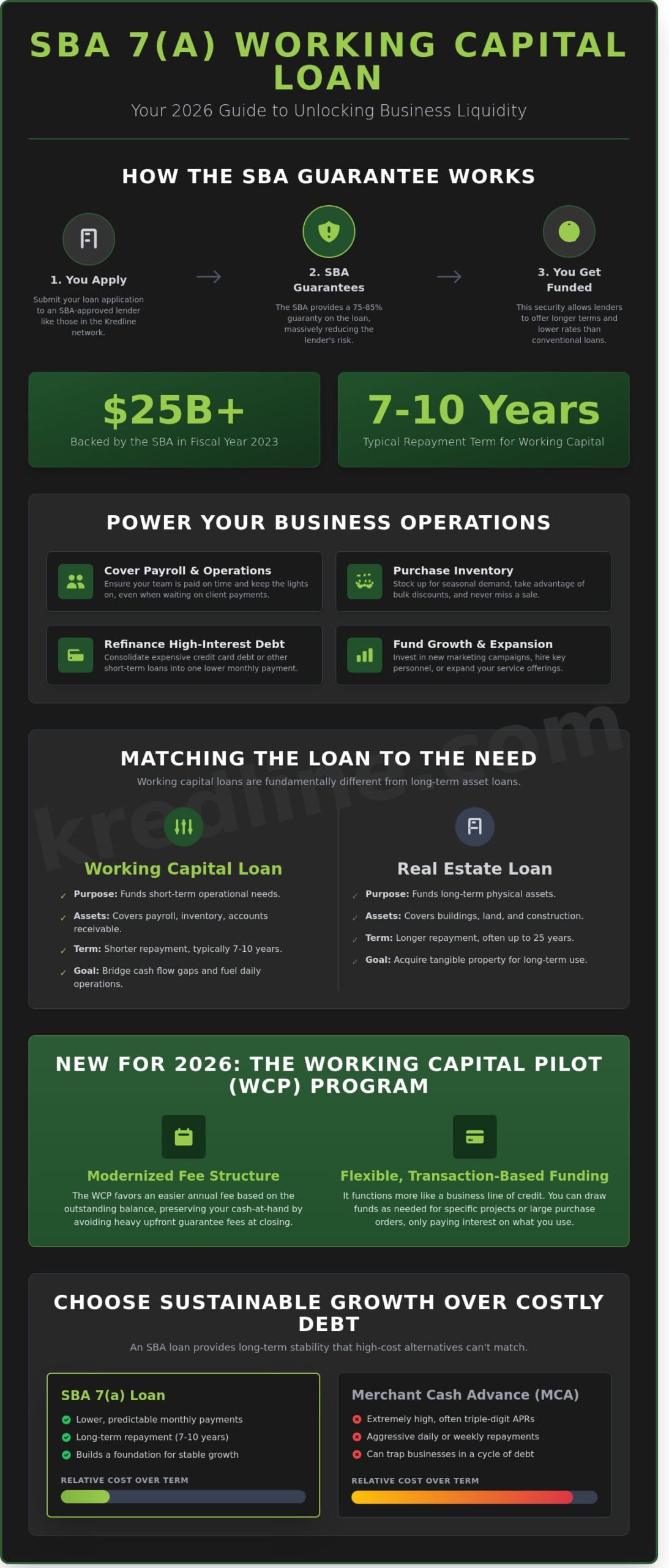
Cash flow is the pulse of every small business. The SBA 7(a) Loan program remains the government’s primary tool for supporting operational liquidity. It isn’t a direct loan from the government; instead, the Small Business Administration provides a “guaranty” to your lender. This promise covers between 75% and 85% of the loan amount if a business can’t repay. This safety net is exactly why banks say yes to a sba 7(a) working capital loan when they might reject a standard commercial application. By reducing the bank’s risk, the program opens doors to longer terms and lower interest rates than almost any other private funding alternative.
In 2026, the focus has shifted toward speed and flexibility. Owners don’t just need money; they need it at the right time. The 7(a) program provides a stable foundation for businesses to manage daily expenses without the stress of high-interest, short-term debt. It’s a professional way to scale without giving up equity or overextending your weekly budget.
The 2026 Working Capital Pilot (WCP) Program
The SBA’s Working Capital Pilot (WCP) has modernized how businesses access cash. One of the biggest changes in 2026 is the move away from heavy upfront guarantee fees. Traditional loans often require a large percentage paid at closing, which can hurt a company’s immediate cash position. The WCP uses an annual fee structure based on the outstanding balance, making it much easier on your monthly books. This program also favors transaction-based lending. If you’ve landed a major contract or a large purchase order, you can draw funds specifically for that project. It functions more like a monitored business line of credit, giving you the power to pull funds when you need them and stop paying interest when you don’t.
Why “Working Capital” is Different from Real Estate Loans
It’s vital to distinguish between asset-heavy loans and operational funding. Real estate loans are designed for buildings and land, often stretching over 25 years. Working capital is different. It focuses on short-term assets like inventory, payroll, and accounts receivable. Because these assets move quickly, the repayment terms are shorter, typically ranging from 7 to 10 years. This timeline ensures you aren’t still paying for last year’s inventory five years after it’s sold. SBA 7(a) working capital acts as a bridge for operational gaps rather than long-term asset acquisition. This distinction helps you match your debt to your revenue cycle, keeping your business lean and responsive to new opportunities.
If you’re trying to figure out if your current cash flow can support a growth spurt, looking into a sba 7(a) working capital loan is a smart first step. It’s about building a sustainable runway for your business, not just putting out fires. At Kredline, we focus on helping you understand these structures so you can make a decision that actually helps your bottom line stay healthy through 2026 and beyond.
Practical Ways to Use SBA 7(a) Funds in Your Business
Getting an sba 7(a) working capital loan gives your business room to breathe. It isn’t just a safety net for emergencies. It’s a strategic tool for managing timing. Most small businesses face a timing problem where bills arrive before customer checks do. This loan fills those gaps so you don’t have to stall your operations while waiting for a wire transfer.
The versatility of these funds allows you to address several areas at once. You might use a portion to cover a seasonal inventory spike while using the rest to refinance a high-interest credit line. This flexibility is why the program remains a staple for growing companies. According to the SBA, the 7(a) program provided over $25 billion to small businesses in the 2023 fiscal year alone, proving its role as a primary source of long-term capital.
Managing Daily Operational Expenses
Payroll is often a business owner’s largest recurring expense. It doesn’t wait for your clients to pay their invoices. If you operate a service-based business with 60-day or 90-day payment cycles, you still have to pay your team every two weeks. An sba 7(a) working capital loan ensures your staff stays paid during these lulls. It also covers fixed costs like rent and utilities when you’re in an expansion phase and your overhead has grown faster than your immediate revenue.
Consider a retail business preparing for the holiday season. In October, they may need $75,000 to stock their shelves for the December rush. Their current cash flow might only cover existing bills. By using SBA funds, they can secure inventory early, capitalize on bulk discounts, and handle the extra staffing costs required for the peak season without stressing their bank account. This is also an ideal time to discover KP Innovations for developing premium private label apparel that maximizes your seasonal revenue.
Debt Consolidation and Cash Flow Optimization
High-interest debt is a silent growth killer. Many owners rely on business credit cards with 22% or 29% APR to handle short-term needs. You can use SBA 7(a) funds to pay off these high-cost balances. This moves your debt into a single monthly payment with a significantly lower interest rate and a longer repayment term. It’s a move that immediately improves your monthly cash flow.
Lenders look closely at your debt-to-income ratio during the application. They want to see that this new loan will actually strengthen your position rather than just shifting debt around. You can review the official SBA 7(a) loan information to see specific rules on what types of debt qualify for refinancing. Often, reducing your monthly interest payments by $1,500 or $2,000 provides the exact amount of capital you need to fund a new marketing project or hire a specialized technician.
Investing in growth is the final piece of the puzzle. Whether it’s a $12,000 piece of specialized software or a $20,000 down payment on a new delivery van, these funds provide the “dry powder” needed to move quickly. If you’re ready to see how these numbers look for your specific situation, you can prequalify for business funding to explore your current options.
Comparing SBA 7(a) to Other Funding Options
Small business owners often feel like they are choosing between a marathon and a sprint. An sba 7(a) working capital loan is the marathon. It offers some of the lowest rates and longest terms available, but it is not the only way to keep your cash flow healthy. If you need seasonal flexibility, a business line of credit might serve you better than a term loan. While a 7(a) loan provides a one-time lump sum, a line of credit lets you draw only what you need, when you need it. This is a practical way to manage the gaps between payroll and client payments without committing to a decade of debt.
Speed vs. Cost: The Ultimate Trade-off
SBA loans typically take 30 to 90 days to fund. This timeline is often too slow for a business facing an immediate inventory shortage or a sudden equipment breakdown. In contrast, Merchant Cash Advances (MCA) can land in your bank account within 24 to 48 hours. However, this speed carries a heavy price tag. SBA interest rates generally hover between 8% and 12%, while MCAs use factor rates that can equate to 20% to 50% or more in annual interest. For those who cannot wait months but want to avoid the extreme costs of an MCA, looking into short-term business loans provides a middle ground that balances speed with more manageable costs.
When an SBA Loan Might Not Be the Best Fit
An sba 7(a) working capital loan isn’t a universal fix for every situation. If your business has a credit score below 650 or you lack physical collateral like real estate, the SBA process can be frustrating. High-growth tech or service companies with few physical assets often find that revenue-based financing fits their model better. This structure bases repayments on your monthly sales, which protects your cash flow during slower months.
Understanding how to get an SBA 7(a) loan helps you realize that the documentation requirements are intense. If you’re in the middle of a 48-hour emergency, the paperwork alone could cost you the opportunity. You should consider other options when:
- Waiting 60 days means losing a time-sensitive contract.
- You don’t want to pledge personal assets as collateral.
- Your business is too young to meet the two-year operational requirement.
Qualifications and Requirements: Are You SBA-Ready?
Securing an sba 7(a) working capital loan isn’t just about filling out forms. It’s about proving your business has the “staying power” to handle debt. One of the most misunderstood hurdles is the Credit Elsewhere test. This rule requires you to demonstrate that you can’t obtain the same loan terms from a non-government guaranteed source. Lenders will look at your personal liquidity and business assets to ensure the SBA’s help is truly necessary for your growth.
Your credit score carries significant weight. For 2026, the SBA continues to use the FICO Small Business Scoring Service (SBSS) to pre-screen applications. You’ll need a minimum score of 155 to pass the initial automated check, though most high-volume lenders prefer seeing a 160 or higher. This score isn’t just your personal credit; it’s a proprietary blend of your personal history and your business’s credit signals. If your score is lower, you might need to focus on smaller loan amounts or alternative structures first.
Collateral is another area where business owners often feel stuck. If you don’t have heavy machinery or commercial real estate, don’t panic. The SBA won’t decline an sba 7(a) working capital loan solely because you lack collateral, provided your cash flow is strong. However, they’ll likely require a lien on available business assets, and for loans over $50,000, they may look at personal real estate if the business doesn’t have enough “skin in the game.”
Financial Documentation Checklist
Preparation is what separates a fast approval from a three-month headache. You’ll need to provide three years of business and personal tax returns to show a history of profitability. Your current year-to-date Profit & Loss (P&L) statement and Balance Sheet must be updated within the last 90 days. Lenders also require a detailed schedule of existing business debts and any active UCC filings to understand your current obligations.
The “Human” Side of the Application
Numbers tell part of the story, but your Statement of Purpose tells the rest. Lenders want to see a clear, growth-oriented plan. Instead of saying you need money for “general expenses,” explain how the capital will bridge a specific 60-day gap between inventory purchase and client payment. If you’ve had credit issues in the past, a brief, honest letter of explanation can go a long way in building trust.
Sometimes, jumping straight into a large SBA loan is a stretch for a young company. In these cases, a business line of credit can be a perfect stepping stone. It helps you build the necessary credit history and operational discipline that SBA lenders look for later on. It’s often easier to manage and provides the flexibility needed for immediate, smaller expenses.
Ready to see if your business meets the current standards? You can prequalify for business funding today to understand your options without the guesswork.
Simplifying the Process: Why the Right Partner Matters
Traditional big banks often feel like a dead end for small business owners. You might have a 700+ credit score and three years of steady revenue, yet still receive a generic rejection letter. This happens because large institutions often prioritize massive corporate deals over the nuanced needs of a growing company. In 2024, big bank approval rates for small business loans hovered around 13% to 14%, leaving many qualified entrepreneurs without the capital they need. Finding a lender that actually wants to issue an sba 7(a) working capital loan requires looking beyond the local branch on the corner.
A financial marketplace changes this dynamic. Instead of you begging a bank for a loan, you’re positioned in front of lenders that are actively seeking to grow their small business portfolios. Kredline bridges this gap by organizing your financial data to meet specific lender expectations. We help ensure your application doesn’t get stuck in a digital “no-man’s land” by matching your profile with the right institution from the start.
The Advantage of a Broker-Led Network
Every industry has its own rhythm. A seasonal retail shop has different cash flow patterns than a medical practice. We connect you with lenders that specialize in your specific field, which eliminates the frustration of explaining your business model multiple times. This approach saves owners an average of 20 to 30 hours of redundant paperwork. Kredline acts as a navigator, specifically identifying which institutions are participating in the 2026 WCP pilot. These lenders are often more flexible with fee structures and collateral requirements compared to traditional SBA paths, making the sba 7(a) working capital loan more accessible than it was just a few years ago.
Taking the First Step Toward Funding
The process doesn’t have to be a gamble with your credit score. We use a soft pull credit check to explore your options, meaning your score won’t drop just because you’re looking for capital. Once you submit your initial details, you can expect a clear response or a request for clarification within the first 48 hours. This speed is vital when you’re trying to cover a surprise expense or seize a time-sensitive growth opportunity. If you’re ready to see where your business stands, you can prequalify for business funding today to view your specific eligibility and potential terms.
- Avoid Redundancy: One application connects you to a network of SBA-friendly lenders.
- Expert Guidance: Get help navigating the 2026 WCP pilot requirements.
- Fast Feedback: Receive initial feedback within two business days.
- Protect Your Score: Explore funding options without a hard credit inquiry.
Moving from research to funding is about choosing a partner that understands the 2026 lending environment. By focusing on data-driven matching rather than cold applications, you can secure the working capital your business needs to thrive in the coming year.
Fueling Your Business Growth in 2026
Success in 2026 requires more than just a good idea; it requires liquid capital to handle payroll, inventory, and unexpected shifts in the market. The sba 7(a) working capital loan remains one of the most reliable tools for small businesses because it offers repayment terms up to 10 years and interest rates capped by the SBA. You’ve seen how these funds can bridge the gap between your invoices and your operating costs, but the application process requires precision and the right documentation to succeed.
Navigating the 2026 lending landscape doesn’t have to be a solo effort. We help you access a national network of SBA-approved lenders while providing a transparent comparison of SBA options versus faster alternative funding. Our team provides expert guidance on documentation to ensure your eligibility is clear from the start. You don’t have to guess which path is right for your cash flow needs. Explore your SBA 7(a) and working capital options with Kredline today. Taking control of your finances is the first step toward a stable, profitable year. We’re here to help you build that future.
Frequently Asked Questions
What is the maximum amount I can borrow through an SBA 7(a) working capital loan?
The maximum amount you can borrow through an sba 7(a) working capital loan is $5 million. This limit applies to the total sum of all SBA-guaranteed loans your business and its affiliates have outstanding. If you need a smaller, faster option, the SBA Express program provides a streamlined path for amounts up to $500,000, though interest rates might be slightly higher for those smaller totals.
How long does it typically take to get funded for an SBA 7(a) loan in 2026?
Funding typically takes between 30 and 90 days after you submit a complete application package. While the SBA introduced digital processing updates in 2024 to speed things up, your specific timeline depends on the lender’s efficiency. Working with a Preferred Lender can often save you 15 to 20 days because they have the authority to make final credit decisions without waiting for a separate SBA review.
Can I use an SBA 7(a) loan to pay off my business credit card debt?
You can use these funds to refinance business credit card debt if the original charges were for eligible business expenses. The SBA requires the new loan to provide a clear financial benefit, such as reducing your monthly debt service payment by at least 10 percent. It’s a smart way to move high-interest revolving debt into a predictable monthly payment plan with a much lower interest rate.
Do I need to provide a personal guarantee for an SBA 7(a) loan?
Yes, any individual who owns 20 percent or more of the business must provide a full, unconditional personal guarantee. This makes you personally responsible for the debt if the business can’t repay it. Even if you own less than 20 percent, the lender might still ask for a guarantee if your role is critical to operations or if the business lacks strong collateral to back the request.
What is the minimum credit score required for an SBA 7(a) working capital loan?
Most lenders require a personal credit score of at least 680, though the SBA’s internal FICO SBSS score requirement for smaller loans is 155. In 2026, banks still use your personal credit history as a primary indicator of how you’ll handle business debt. If your score is below 650, you’ll likely need to show exceptionally strong cash flow or provide additional collateral to secure an approval.
How do SBA 7(a) interest rates compare to traditional bank loans?
Interest rates for an sba 7(a) working capital loan are usually 2 to 4 percent lower than what online alternative lenders charge. The SBA caps the maximum interest rate lenders can charge based on the Prime Rate plus a specific markup. While a conventional bank loan might offer a slightly lower rate for a business with 10 years of history, the SBA program is much more accessible for growing companies.
What happens if my business cannot provide enough collateral for the loan?
The SBA explicitly states that a lender can’t decline your application solely because you lack enough collateral, as long as you meet all other credit and cash flow criteria. The lender will still place a lien on all available business assets like equipment and accounts receivable. For loans over $50,000, they might also require a lien on your personal real estate if the business assets don’t fully cover the loan value.
Is the SBA 7(a) Working Capital Pilot (WCP) program available to all industries?
The WCP program is available to most for-profit small businesses, but it’s specifically designed for companies with international sales or government contracts. This pilot, which began in 2024, offers a more flexible line of credit structure than a standard term loan. You’ll need to confirm with your lender if your specific industry qualifies, as businesses involved in gambling, lending, or passive real estate investing are generally excluded from all SBA programs.

Article by
Billy Wagner Jr
Billy has 15 years of customer service experience and several years of experience in business loans and merchant services. His passion is helping business owners understand their options and assisting them in making confident decisions around funding and payment processing.
