



Last Tuesday, a business owner named Sarah discovered her 22% bulk inventory discount had vanished because her traditional bank loan was stuck in a 30-day review period. It’s a story that repeats far too often. When you’re trying to scale, waiting weeks for a maybe isn’t just frustrating; it’s expensive. Implementing effective Kredline strategies for growth means you don’t have to let those windows of opportunity close. You need capital that moves at the speed of your business, not the speed of a legacy institution’s paperwork.
You likely already know that cash flow isn’t a straight line, especially during those 3-month seasonal dips that can stall your most important projects. This guide will show you how to strategically deploy alternative capital to bridge those gaps and outpace competitors without the usual banking headaches. We’ll walk through a clear roadmap for matching funding types to specific milestones, a method to calculate your exact ROI on growth capital, and how a long-term partnership can lower your rates by 1.5% over the next 18 months.
Key Takeaways
- Identify the hidden cost of traditional banking delays and learn how to define “growth capital” based on its potential return rather than just its cost.
- Discover how to match specific funding products to your business milestones to ensure you’re using the right capital for the right opportunity.
- Master the “ROI Rule” and use Kredline strategies for growth to calculate whether a funding option will actually increase your bottom line.
- Avoid the common “scaling trap” of stacking multiple advances, which can paralyze your cash flow if not managed with a sustainable repayment plan.
- Follow a practical 90-day roadmap to improve your financial health and transition from immediate bridge funding to more competitive prime rates.
Why Traditional Financing Often Stalls Small Business Growth
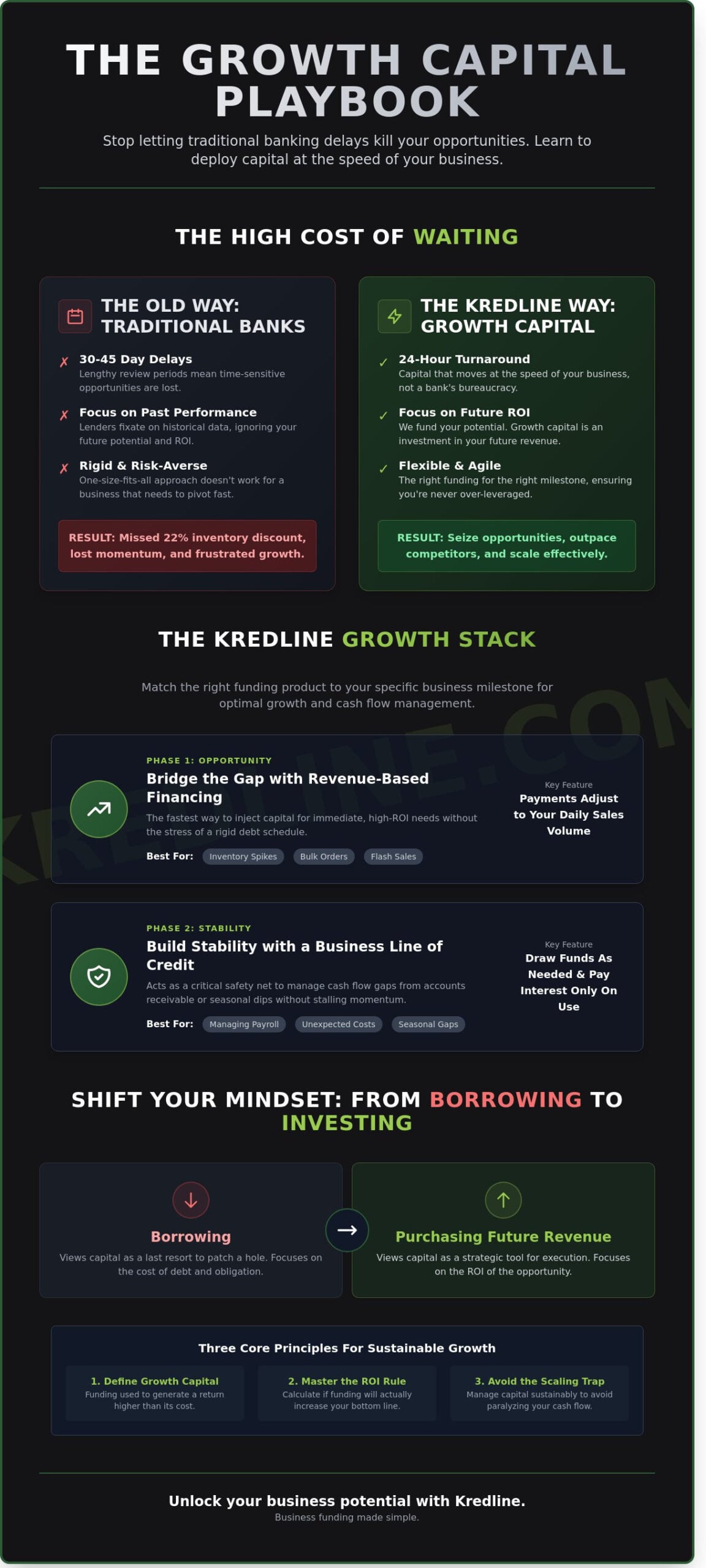
Traditional banks often take 30 to 45 days to process a simple loan application. In the 2026 market, that’s an eternity. If a supplier offers a three-day window for a 20% discount on raw materials, a 30-day bank delay is a direct hit to your profit margins. This hidden cost of waiting is often the difference between a business that scales and one that merely survives. You aren’t just waiting for an approval; you’re losing the chance to outpace your competition. When a time-sensitive expansion opportunity arises, speed is your most valuable asset.
It’s vital to define growth capital correctly. This isn’t money used to patch a hole or cover a mistake. Growth capital is funding used specifically to generate a return that’s higher than the cost of the capital itself. If you spend $25,000 on a new piece of equipment that triples your production output, the interest rate is less important than the immediate increase in revenue. Most traditional lenders focus on risk mitigation and past performance rather than your future ROI. This creates an “Opportunity Gap” where your business’s proven potential exceeds your current liquid cash flow. Implementing effective Kredline strategies for growth means closing that gap before the opportunity disappears.
The 2026 economy requires faster pivots than traditional SBA or bank loans allow. Supply chains shift in weeks, and consumer trends disappear as fast as they arrive. Relying on a lender that requires six months of tax returns and three weeks of manual underwriting doesn’t work for a business that needs to pivot by Friday. You need a partner that understands the urgency of a 24-hour turnaround to keep your momentum high.
The Problem with the “Wait and See” Approach
Hesitation is expensive in a competitive market. A business owner might wait for organic cash flow to buy inventory, missing out on bulk discounts that could have increased margins by 20%. You might also lose top-tier talent to competitors because you couldn’t meet a $5,000 signing bonus requirement on the spot. Beyond the numbers, there’s a psychological toll. Constant stagnation drains the energy of a business owner and their team. When you’re always waiting, you aren’t leading.
Alternative Funding as a Strategic Lever
Successful owners shift their mindset from “borrowing” to “purchasing future revenue.” It’s a tool for execution. Sometimes, paying a slightly higher rate for capital delivered in 24 hours is more profitable than waiting 30 days for a bank’s lower rate. Speed of execution often outweighs the cost of the capital itself. Using a marketplace gives you access to various funding options that a single bank simply cannot offer. This flexibility is a cornerstone of Kredline strategies for growth, turning capital into a competitive advantage rather than a bureaucratic hurdle.
The Kredline Growth Stack: Matching Products to Milestones
Growing a business isn’t a linear path. It’s a series of specific hurdles that require different tools to clear. Using a long-term loan to cover a two-week inventory gap is like using a sledgehammer to hang a picture frame; it’s overkill and unnecessarily expensive. Effective Kredline strategies for growth focus on matching the right financial product to your current business milestone. This ensures you aren’t over-leveraged while keeping your cash flow fluid enough to handle the 15% to 20% increase in overhead that often accompanies a scaling phase. Knowing when to pivot from a quick advance to a structured term loan determines how much of your profit you actually keep.
Phase 1: Bridging the Gap with Revenue-Based Financing
When you’re hit with a sudden bulk order or a 48-hour flash sale opportunity, you don’t have weeks to wait for a bank’s approval. This is where revenue-based financing becomes your best asset. Unlike fixed monthly payments, this model adjusts to your daily sales volume. If your sales dip on a Tuesday, your payment dips too. It’s the fastest way to inject capital for inventory spikes or quick marketing bursts without the stress of a rigid debt schedule. It’s about speed and agility, allowing you to say yes to high-ROI projects that would otherwise pass you by.
Phase 2: Building Stability with a Business Line of Credit
As your operations expand, the gap between finishing a job and getting paid often grows. A 30-day or 60-day lag in accounts receivable can stall your momentum. Having a business line of credit in your back pocket acts as a safety net. You only pay interest on the amount you actually draw. For example, if you have a $50,000 line but only need $10,000 to cover payroll while waiting for a client check, you aren’t charged for the remaining $40,000. It’s a vital tool for operational flexibility, ensuring that a temporary cash crunch doesn’t turn into a permanent growth stall.
Phase 3: Scaling Infrastructure with Equipment Funding
Eventually, scaling requires more than just cash flow; it requires physical capacity. Whether you’re adding a third delivery truck or upgrading to a $150,000 CNC machine, equipment funding is the logical next step. This allows you to preserve your working capital for day-to-day expenses while the equipment itself often serves as collateral. Beyond the immediate production boost, owning your tools offers tax advantages and long-term ROI. Integrating these tools into your broader Kredline strategies for growth ensures you’re building on a foundation of stability. If you’re ready to see which phase your business currently fits into, you can prequalify for funding options in minutes to map out your next move.
Calculating the ROI of Your Growth Strategy
Many business owners hesitate to take on capital because they view the cost of funding in a vacuum. However, effective Kredline strategies for growth require looking at the “ROI Rule” instead. Simply put, capital is only expensive if the profit it generates is lower than its cost. If you’re using funds to capture a 40% margin, a 10% cost of capital is a logical trade that moves your business forward.
When you evaluate a growth opportunity, you shouldn’t just look at the dollar amount you’re paying back. You need to compare the cost against your projected net profit increase. If a $5,000 fee allows you to secure a $30,000 contract you would otherwise lose, that fee is a small price for a $25,000 gain. Focusing on APR alone can be a misleading strategy for short-term growth. APR annualizes costs over 12 months, which doesn’t accurately reflect the reality of a 90-day inventory turn or a quick equipment upgrade.
Imagine a retailer who finds a bulk inventory deal for $50,000. They know this stock will generate $80,000 in sales within 90 days. If the cost of the funding is $7,000, the net profit after paying back the capital and the original investment is $23,000. Without the funding, the profit is $0 because the opportunity would have passed. In this case, the “expensive” capital created $23,000 in wealth that didn’t exist before.
The Growth ROI Formula
To determine if a move makes sense, use this simple three-step calculation. It keeps your focus on the bottom line rather than the sticker shock of interest rates.
- Step 1: Estimate the total net profit from the specific growth initiative. Be conservative with your numbers.
- Step 2: Calculate the total cost of the funding, which includes the principal plus all fees or factor rates.
- Step 3: If your projected profit minus the total cost is a positive number that meets your internal margin goals, the funding is a viable growth strategy.
Factor Rates vs. Traditional Interest
Understanding factor rates is essential for modern business owners. In plain English, a factor rate tells you exactly what you’ll owe upfront. For example, a 1.20 factor rate means you pay $1.20 for every $1.00 borrowed. There’s no compounding math to worry about. This transparency is why a short-term business loan with a factor rate can be safer than a compound interest loan for fast turns. You know your total cost on day one.
It’s easy to fall into the trap of comparing apples to oranges when looking at financial products. A 10-year mortgage and a 6-month bridge loan serve completely different purposes. When you use Kredline strategies for growth, you’re looking for speed and certainty. You want to know that the cost of the capital is fixed so you can protect your margins while you scale.
Avoiding the “Scaling Trap”: Managing Capital Sustainably
Scaling isn’t just about getting bigger; it’s about staying alive while you do it. Many entrepreneurs make the mistake of chasing top-line revenue without watching their cash flow floor. Implementing effective Kredline strategies for growth means knowing when to press the gas and when to check your mirrors. If you aren’t careful, the capital meant to fuel your expansion can quickly become the weight that sinks your operations.
The Golden Rule: Never Stack
Stacking happens when a business takes a second or third capital advance while still paying off the first. It’s a dangerous path that often ends in a “death spiral.” If you have a $2,500 weekly repayment and add another $1,800 position, your profit margins can vanish overnight. This leaves you with zero room for error. Always communicate with your Kredline advisor before taking on additional capital. The smartest move is “paying down to scale up.” By finishing at least 75% of one repayment cycle before starting the next, you prove your business model can support the debt without straining your daily operations.
Cash Flow Management Post-Funding
Once funds hit your account, you need a system that runs on autopilot. Successful owners in 2026 set up automated reserve accounts to handle daily or weekly remittances. They move a fixed percentage of daily sales into a separate bucket so the operating account stays focused on payroll and inventory. You also need to keep a close eye on your Debt-to-Income (DTI) ratio. Write a single sentence defining DTI as the ratio of your monthly debt payments to your gross monthly revenue. If your DTI exceeds 25%, you’re entering a high-risk zone where a single slow week could cause a significant cash crunch.
Your 2026 bank statements are your most important growth asset. Lenders look for a “Clean File,” which means zero non-sufficient funds (NSF) alerts and consistent daily balances. Even if you’re doing $100,000 in monthly revenue, two or three NSF hits can make you look like a high-risk gamble. Maintaining a clean profile and managing repayments are core Kredline strategies for growth that ensure you qualify for lower-cost revenue-based financing in the future.
Finally, recognize when growth is happening too fast for your current setup. If your error rate in order fulfillment has climbed by 12% or your staff turnover has spiked, your infrastructure is likely buckling. Capital can’t fix a broken process; it only makes the cracks wider. Scaling sustainably means ensuring your team and technology can handle the volume before you dump more fuel on the fire.
Your Roadmap to Prime Funding and Long-Term Scaling
Scaling a business isn’t a single event. It’s a series of transitions. Most owners start with bridge funding to cover immediate needs, but the goal is to move toward prime rates. These Kredline strategies for growth focus on shifting from high-cost, short-term capital to long-term, low-interest debt that fuels sustainable expansion. This transition requires a deliberate plan to improve your business’s financial health over time.
The best way to start is with a 90-day sprint. During these three months, focus on cleaning up your financial statements. Underwriters in 2026 prioritize “clean” files. This means eliminating non-sufficient funds (NSF) occurrences and ensuring your tax filings are current. If you can show three consecutive months of increasing revenue, even by a modest 5% or 10%, you become a much more attractive candidate for larger funding amounts. Consistency proves to a lender that you can handle the debt service without straining your daily operations.
Working with a marketplace broker is a strategic move that beats relying on a single lender. A single bank has one set of rules. If you don’t fit their box, you’re denied. A marketplace gives you access to dozens of different programs simultaneously. As your business matures, your advisor can move you from revenue-based financing to more traditional products without you having to start the relationship from scratch each time.
Improving Your Funding Profile
Underwriters today value consistent revenue more than a perfect personal credit score. While a score of 680 is helpful, a business showing $50,000 in steady monthly deposits is often viewed as lower risk than a high-score founder with erratic cash flow. Time-in-business milestones are equally critical. Reaching the 6-month, 1-year, and 2-year marks opens new tiers of capital. Maintaining a healthy average daily balance, ideally at least 10% of your requested loan amount, signals to lenders that your business has the liquidity to manage unexpected hurdles.
The Kredline Advantage
The Kredline marketplace model ensures you don’t outgrow your funding source. Instead of being stuck with one lender’s limitations, you have a dedicated advisor who understands your industry’s specific cycles, whether you’re a seasonal retailer or a high-growth tech firm. These experts help you navigate the path toward the SBA 7(a) loan, which remains the gold standard for small business growth due to its 10-year terms and capped interest rates. By using Kredline strategies for growth, you’re not just getting a loan; you’re building a financial foundation for the next decade.
Ready to see where your business stands? Prequalify for funding in minutes and start your journey toward prime rates today.
Take the Next Step Toward Sustainable Scaling
Growing a business isn’t just about injecting cash into your accounts. It’s about precision. You’ve seen how matching specific funding products to your business milestones prevents the common scaling traps that often sink promising firms. By focusing on ROI and sustainable capital management, you ensure expansion doesn’t outpace your actual cash flow. Implementing effective Kredline strategies for growth means you won’t have to navigate these complex markets alone or risk your personal assets.
You need a financial partner that moves at the speed of your operations. We provide access to 50+ third-party funding providers, and you can receive a funding decision in as little as 24 hours. Since most products don’t require personal collateral, your private assets remain protected while your business moves forward. It’s time to stop waiting for traditional bank approvals and start building a roadmap that works for your specific 2026 goals.
Find the right growth strategy for your business; prequalify with Kredline today
Your business has the potential to reach new heights. Let’s make it happen.
Frequently Asked Questions
How does Kredline help my business grow faster than a traditional bank?
Kredline accelerates growth by providing funding decisions in 24 hours rather than the 30 to 45 days typical of traditional banks. Most banks require three years of tax returns and physical collateral, but our marketplace evaluates your last 6 months of cash flow. This speed lets you grab inventory discounts or hire key staff before your competitors can even finish their bank paperwork.
What is the “ROI Rule” for small business funding?
The ROI Rule suggests you should only take on capital if the projected profit from the investment is at least 2 times the total cost of the funding. If a $20,000 expansion loan costs you $3,000 in interest, the project should realistically generate at least $6,000 in new net profit. Following this 2:1 ratio ensures that Kredline strategies for growth remain sustainable and don’t overextend your monthly cash flow.
Can I get growth capital if I have a low personal credit score?
You can still secure capital with a personal credit score as low as 550 because many modern lenders prioritize your business’s actual revenue over your personal history. Kredline strategies for growth focus on the $15,000 or more in monthly deposits your business generates rather than just a single three digit number. In 2025, approximately 35% of funded businesses on our platform succeeded despite having credit scores under 620.
What is the difference between a merchant cash advance and a business loan?
A merchant cash advance is a purchase of your future sales, while a business loan is a standard debt with a fixed repayment schedule. With an advance, the provider takes a small percentage of your daily sales, so you pay less during slow weeks. A loan requires the same fixed payment every month, which works best for businesses with very predictable, steady income throughout the year.
How long does it take to get funded through the Kredline marketplace?
Most businesses see the capital in their bank account within 24 to 48 hours of completing their application. The marketplace uses secure digital connections to verify your bank data instantly, which eliminates the 7 day manual review process used by older institutions. If you submit your documents on a Tuesday morning, it’s common to have your funds ready for use by Thursday at noon.
Is it possible to outgrow my current funding strategy?
You’ll likely outgrow your strategy once your annual revenue increases by more than 25% or you expand to a second location. A funding plan that worked for a $400,000 business often becomes too expensive or restrictive for a company crossing the $1.5 million mark. It’s time to pivot when your monthly debt service exceeds 12% of your gross monthly income or when you need longer repayment terms.
What documents do I need to prepare for a fast approval in 2026?
To get an approval in under 4 hours, you’ll need your last 4 months of business bank statements and your business tax ID number. Most lenders in 2026 also request a “read-only” link to your accounting software to verify your real time profit and loss statement. Having your 2025 tax returns saved as a PDF will prevent any delays during the final underwriting stage.
What happens if my sales slow down while I have a revenue-based advance?
Your payment amounts will automatically drop because revenue-based funding is tied to a fixed percentage of your daily deposits. If your shop has a slow Monday with only $500 in sales, the withdrawal is much smaller than on a busy Saturday with $5,000 in sales. This flexible structure protects your business during seasonal dips, ensuring you don’t face the same $1,200 weekly bill when traffic is down.

Article by
Billy Wagner Jr
Billy has 15 years of customer service experience and several years of experience in business loans and merchant services. His passion is helping business owners understand their options and assisting them in making confident decisions around funding and payment processing.
