





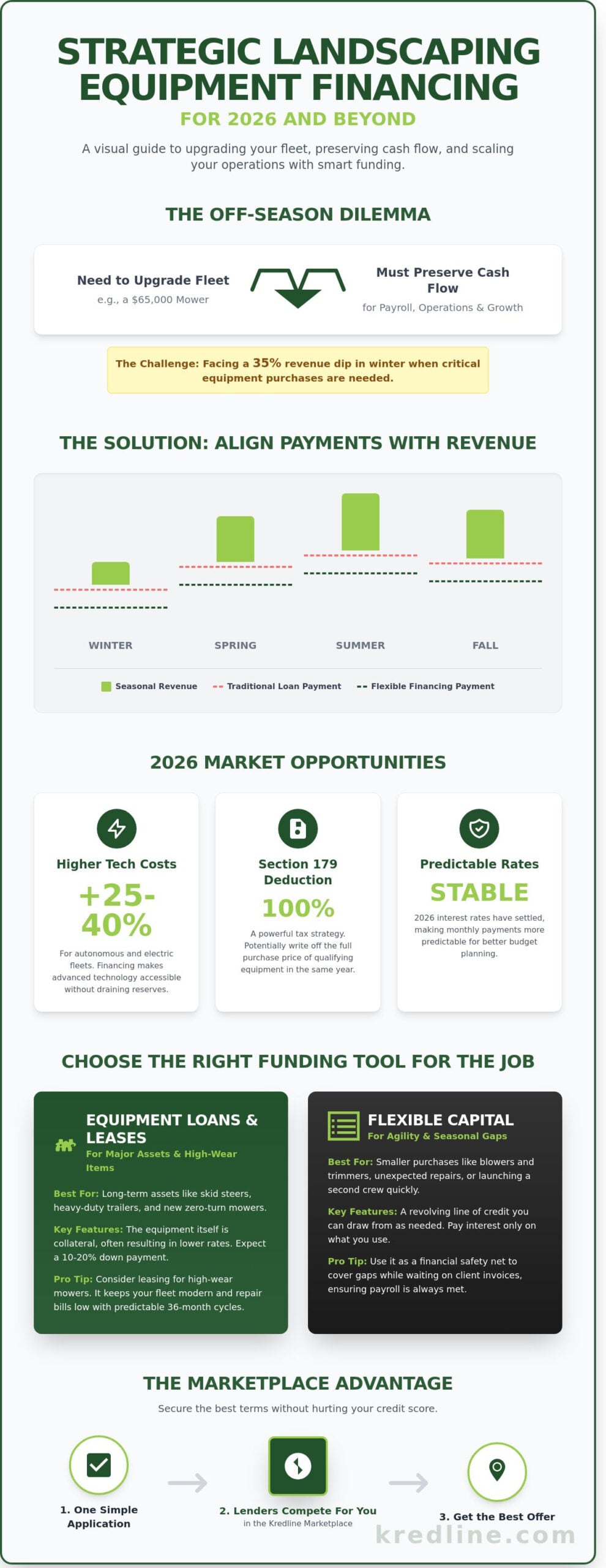
Last November, a fleet manager in Ohio watched his revenue dip by 35% just as his primary commercial mower reached its 2,500-hour limit. He knew that waiting until the spring rush to replace it would mean higher prices and limited inventory, yet the thought of a $65,000 cash outlay during the off-season felt like a massive risk. This is the exact moment where landscaping equipment financing becomes a strategic tool rather than just a debt obligation. It’s about keeping your crews moving with reliable gear without leaving your bank account empty when the ground freezes.
You’ve likely felt that same tension between needing modern machinery and wanting to keep a healthy cash reserve for payroll. It’s a common struggle in an industry where 60% of annual revenue often arrives in just a few short months. We’ll show you how to choose a financing structure that mirrors your seasonal flow, allowing for lower payments in the winter and standard ones when the grass is growing. You’ll also learn how to leverage Section 179 tax deductions to potentially write off the full purchase price this year. We’re breaking down the steps to upgrade your fleet while maintaining the financial flexibility your business needs to thrive in 2026. If you’re ready to see what’s possible, Kredline can help you explore options that fit your specific revenue cycle.
Key Takeaways
- Learn how 2026’s flexible repayment models allow you to align your equipment costs with the natural ebb and flow of seasonal landscaping revenue.
- Compare the long-term benefits of asset-backed loans against flexible capital to determine the best path for high-wear machinery like zero-turn mowers.
- Discover a practical roadmap for scaling your crew and fleet without depleting the cash reserves you need for daily operations and payroll.
- Streamline your approval process with a clear checklist of the essential documents and bank statement trends that modern lenders prioritize.
- Understand why a marketplace approach to landscaping equipment financing helps you secure competitive terms from multiple partners without multiple hard credit pulls.
The Landscape of Equipment Financing in 2026
Landscaping equipment financing is a specialized commercial funding tool designed to help business owners acquire essential assets like zero-turn mowers, trailers, and heavy machinery without paying the full cost upfront. By 2026, the market has moved away from one-size-fits-all loans. Instead, modern financing now focuses on flexible repayment models that align with your actual revenue cycles. This means your payments can be lower during the dormant winter months and higher when the grass is growing and the checks are rolling in. It’s about making sure the money stays where it’s most useful: in your pocket.
Traditional bank loans often fail landscaping businesses because their criteria are too rigid. Most banks require perfect credit scores and years of consistent, year-round profit. This doesn’t account for the seasonal nature of the green industry. Banks don’t always understand why your revenue drops in January, but specialized lenders do. Choosing landscaping equipment financing allows you to maintain a vital cash buffer. Having $20,000 in the bank for an emergency repair or a surprise payroll tax bill is much safer than having that money tied up in a piece of equipment sitting in your shop.
Why Cash is King in Landscaping
Buying equipment outright comes with a high opportunity cost. When you spend $50,000 on a new fleet, that capital is gone. You can’t use it to hire more crew members or bid on a massive commercial contract that requires an upfront deposit. Preserving liquidity lets you respond to seasonal demand spikes, like a sudden rainy spring that doubles your workload. Maintaining a healthy level of working capital ensures you can cover operational gaps when clients are slow to pay their invoices. Cash flow is the lifeblood of your crew; don’t let it get stuck in a depreciating asset.
Current Market Trends for 2026
Interest rates in 2026 have settled into a new normal, making monthly payments more predictable than the volatile swings seen in previous years. We’re also seeing a surge in technology-integrated equipment, such as autonomous mowers and electric fleets, which carry a 25% to 40% higher entry cost than traditional models. This makes financing even more necessary for companies wanting to stay competitive without draining their reserves. Section 179 remains a critical 2026 tax strategy, enabling business owners to deduct the full purchase price of qualifying equipment from their gross income during the same tax year. These trends show that growth in 2026 isn’t just about working harder, but about using smarter financial tools to scale your operations.
Comparing Your Options: Equipment Loans vs. Flexible Capital
Choosing the right way to pay for your gear is just as important as the brand of mower you buy. Most owners find themselves deciding between a loan tied directly to the machine or a flexible pot of cash. Each path serves a different stage of growth. If you are looking at landscaping equipment financing for 2026, you need to match the debt to the asset’s lifespan and your cash flow cycle.
Equipment-Specific Loans
These loans use the machine itself as collateral. Because the lender can reclaim the asset if payments stop, they often offer lower interest rates than unsecured options. You can usually expect a down payment of 10% to 20%, though some lenders offer zero-down deals for established businesses with high credit scores. This is the standard path for equipment funding when you’re buying long-term assets like skid steers or heavy-duty trailers that will stay in your fleet for five years or more.
High-wear items like zero-turn mowers require a different perspective. If a mower only lasts three seasons before maintenance costs skyrocket, leasing might be smarter than owning. Leasing lets you swap for a new model every 36 months, keeping your crew efficient and your repair bills low. Ownership makes more sense for “iron” that holds its value, while leasing protects you from the rapid depreciation of high-hour machines.
Alternative Funding for Seasonal Gaps
Sometimes you don’t need a $50,000 tractor; you just need three new blowers and a set of trimmers to get a second crew on the road. A business line of credit is perfect for these smaller purchases. It gives you a safety net you can draw from and pay back as the season’s invoices roll in. It is about agility rather than long-term debt.
For owners with a credit score in the 550 to 620 range, revenue-based financing offers a way to grow while credit is recovering. These payments fluctuate based on your monthly sales. If a heavy snow season doesn’t hit or winter landscaping slows down, your payment drops accordingly. It is a built-in safety valve for the off-season. Before you sign, always compare the total cost of capital against the revenue a new crew can generate. If a $2,000 monthly payment helps you land a $10,000 monthly maintenance contract, the math works in your favor. You can check your options to see which structure fits your current revenue best and ensures landscaping equipment financing helps rather than hinders your 2026 goals.
Case Study: Scaling a Multi-Crew Operation
In March 2026, GreenScapes LLC reached a crossroads that many successful landscaping businesses eventually face. They had just landed a multi-year contract for a regional corporate park, a deal that promised to increase their annual revenue by $220,000. However, their existing fleet was already at maximum capacity. To fulfill the new contract, they needed to deploy two additional crews immediately, which required a significant investment in new machinery.
The Problem: Growth vs. Liquidity
The equipment list was specific and non-negotiable. They needed three commercial zero-turn mowers at $15,000 each, two custom trailers at $7,500 each, and a versatile skid steer with various attachments priced at $90,000. The total bill came to $150,000. At the time, GreenScapes had $40,000 in cash reserves. The owner, Mark, felt the pressure of a classic growth dilemma. He could use his cash for a down payment, but that would leave the business with no safety net if a mid-summer drought hit or if a major client delayed payment.
Mark’s biggest hesitation was the risk of debt during seasonal fluctuations. He didn’t want to be tied to high monthly payments if the rain stopped and the grass stopped growing. He initially considered a standard bank line of credit, but the variable interest rates in early 2026 made him uneasy about long-term planning for heavy machinery.
The Solution: A Hybrid Financing Approach
Instead of choosing a single, rigid product, Mark opted for a strategy that protected his cash flow. He used dedicated landscaping equipment financing to cover the $150,000 for the mowers, trailers, and skid steer. This allowed him to lock in a fixed rate and spread the cost over a five-year term, ensuring the equipment effectively paid for itself through the new contract’s monthly billings. The specialized nature of this funding meant the equipment itself served as collateral, which often results in more favorable terms for the borrower.
To handle the “soft costs” of expansion, Mark secured a short-term business loan. This $25,000 infusion covered the initial hiring costs for four new operators, branded uniforms, and an aggressive local marketing push to fill the gaps in the new crews’ schedules. By separating the long-term asset debt from the short-term operational costs, he kept his finances organized and transparent.
Twelve months into the new operation, the results were transformative. GreenScapes LLC achieved 40% revenue growth, moving from a $550,000 operation to over $770,000. Most importantly, Mark maintained his $40,000 cash reserve throughout the year. The landscaping equipment financing payments were easily covered by the new revenue, and the business ended the season with higher equity and a significantly larger market share.
Preparation Checklist: Getting Approved in 2026
Approval for landscaping equipment financing in 2026 relies more on your business’s real-time performance than a static credit score. Lenders have shifted toward data-driven models that prioritize cash flow consistency and operational transparency. To stand out, you need to present a clear picture of your company’s health before you ever sign an application. Preparing your data beforehand shows a lender that you’re a low-risk partner who understands their own numbers.
The Paperwork Reality Check
While a 700+ credit score is helpful, your last 4 to 6 months of bank statements carry more weight in the current market. Lenders use digital tools to scan these statements for “NSF” (non-sufficient funds) events and to see if your average daily balance stays above a $2,500 threshold. You’ll also need a formal, itemized equipment quote from your dealer that includes the specific VIN or serial number for the machinery. An accurate Profit and Loss statement for the preceding 12 months remains the primary tool for lenders to verify that your net margin exceeds 15 percent, ensuring you can comfortably service new debt. Keeping these documents organized in a digital folder can cut your approval time from days to hours.
Navigating the Credit Conversation
Don’t let a slow January or February discourage you. Lenders in the green industry understand that revenue might drop by 35 to 50 percent during the off-season. The key is showing that your debt-to-income ratio remains manageable over a full 12-month cycle. If you’ve had past credit hiccups, explain them as “seasonal credit” issues rather than systemic mismanagement. This distinction is vital; brokers are often willing to overlook a dip in your score if your bank statements show a strong recovery every spring.
For those moments when you need to bridge a gap before the peak season begins, a merchant cash advance can provide immediate liquidity for smaller needs like payroll or minor repairs. However, it’s a bridge, not a long-term solution for heavy assets. For large purchases like skid steers or commercial mowers, stick to dedicated equipment loans to keep your interest costs predictable. If you’re ready to see which options fit your current cash flow, you can prequalify for business funding to explore your path to growth without any initial commitment.
Finding the Right Partner for Your Fleet
Choosing a lender isn’t just about finding the lowest interest rate. It’s about finding a structure that actually fits your seasonal cash flow. A single bank usually has one set of rigid rules. If your business doesn’t fit their specific box, you’re often left without options. Using a marketplace like Kredline changes that dynamic. Instead of knocking on ten doors, you access a broad network of lenders through a single point of contact. This approach allows you to compare multiple offers side by side without seeing your credit score drop five points for every inquiry. Most initial steps involve a soft credit pull, protecting your rating while you shop for the best terms.
In the landscaping industry, timing is everything. A skid steer sitting on a dealer lot doesn’t earn a dime. You need that machine on the job site by Monday morning to stay on schedule. Speed is often the difference between winning a new commercial contract and losing it to a competitor with better capacity. The right financing partner understands that a 48 hour turnaround is the standard, not the exception. When you secure landscaping equipment financing quickly, you’re not just buying a machine; you’re buying the ability to say “yes” to more work.
It is also vital to match the financing term to the “money-making” life of the asset. If a zero-turn mower typically requires heavy maintenance after 1,500 hours, a five year loan might leave you paying for a machine that is no longer reliable. We help you align your payments with the period when the equipment is at its peak productivity. This ensures the machine pays for itself long before it becomes a liability on your balance sheet.
The Broker Advantage
Kredline acts as a navigator through a complex network of third party providers. We don’t just look at a credit score; we look at the specific challenges of the landscaping world. We understand that your revenue in July looks very different from your revenue in January. Our team works to find lenders who offer flexible structures, such as seasonal payment adjustments. By positioning ourselves as a partner in your long term growth, we focus on how a new piece of equipment will increase your daily output. We handle the heavy lifting of the application process so you can stay focused on your crews and your clients.
Next Steps for Your Business
As you plan for 2026, take a hard look at your current fleet. If more than 25 percent of your primary machines are reaching their hour limits, it’s time to act. Modern equipment is more than a line item; it is a powerful recruitment and retention tool. In a tight labor market, the best crews want to work with reliable, ergonomic gear that doesn’t break down in the heat of the day. Providing top tier tools shows your team that you value their time and safety.
You can prequalify for business funding today to see exactly what your buying power looks like. There is no obligation, and it provides the clarity you need to negotiate with dealers from a position of strength. Get your landscaping equipment financing in place now so your fleet is ready the moment the ground thaws and the spring rush begins.
Equipping Your Business for the 2026 Season
Growing a landscaping business in 2026 requires more than just hard work; it demands a strategic approach to your fleet. We’ve explored how balancing equipment loans with flexible capital ensures you aren’t overextended during slow months. By following a 2026-ready approval checklist, you’ll be prepared to secure the tools your crew needs before the spring rush hits. Finding a partner who understands that your revenue fluctuates with the weather is the final piece of the puzzle.
At Kredline, we don’t believe in a one-size-fits-all approach. We provide access to a network of over 75 third-party lenders to find the specific terms that fit your operation. Our human-first advisory team focuses on transparent conversations, not automated rejection letters. We specialize in funding solutions tailored for seasonal businesses, ensuring your cash flow stays healthy year-round. Navigating landscaping equipment financing shouldn’t be a source of stress.
Prequalify for landscaping equipment funding today
You’ve got the vision for your fleet’s growth, and the right resources are ready when you are.
Frequently Asked Questions
Can I get landscaping equipment financing with a low credit score?
You can get landscaping equipment financing with a credit score as low as 600. While a 700 score unlocks the best terms, lenders in 2026 prioritize your business’s monthly revenue and time in operation over just a single number. If your cash flow is steady and you’ve been in business for 2 years, a lower score won’t stop you from getting the gear you need to grow.
How much of a down payment is typically required for commercial mowers?
Expect to put down between 10% and 20% of the mower’s total price. For a $15,000 zero-turn mower, this means an upfront cost of $1,500 to $3,000. Some programs offer zero down for businesses with over 2 years of history, but a larger down payment reduces your monthly burden. It’s a smart way to lower your total interest and keep more cash in your pocket later.
Is it better to lease or finance landscaping equipment in 2026?
Financing is generally better if you plan to keep the equipment for over 5 years. Leasing works well for high-wear items like mowers that you might replace every 3 years. In 2026, many owners prefer financing to take full advantage of Section 179 tax deductions. This allows you to deduct the full purchase price in the first year, which significantly helps your company’s bottom line.
What is the typical interest rate for landscaping equipment loans?
Interest rates for landscaping equipment financing currently range from 6% to 15% based on your credit profile. A business with 3 years of history and a 720 credit score can often secure a rate around 7.5%. These rates are fixed for the life of the loan. This means your monthly payment stays the same, which helps you plan your budget through the entire 2026 season.
How fast can I get funding for a new trailer or skid steer?
You’ll typically receive funding within 24 to 48 hours after your application is approved. The approval process itself often takes less than 4 hours if you have your bank statements and equipment quotes ready. This speed is vital when you need a new skid steer or trailer to start a project that begins in a few days. We focus on getting you back to work quickly.
Can I finance used landscaping equipment through Kredline?
You can finance used equipment through Kredline, as long as the machinery is less than 10 years old. Buying used is a practical way to save 30% compared to new prices. We help you verify the equipment’s value to ensure the loan amount matches the market price. This approach keeps your debt lower while still giving you reliable tools for your daily operations.
Does equipment financing cover attachments and smaller handheld tools?
Financing covers attachments like blowers, trimmers, and augers when you bundle them into a larger equipment purchase. Most lenders require a minimum loan amount of $5,000 to $10,000 for these packages. Including these smaller tools in your primary loan keeps your monthly payments consolidated. It’s an efficient way to ensure your crew has every piece of gear needed to finish a job without multiple bills.
What happens to my payments during the winter off-season?
Many contracts include seasonal payment structures where you pay as little as $50 per month during the winter. This flexibility protects your cash flow during the months when grass stops growing and revenue drops. Once the spring season starts in March, your payments return to the standard amount. This setup allows you to manage your budget without the stress of high costs during your slow period.

Article by
Billy Wagner Jr
Billy has 15 years of customer service experience and several years of experience in business loans and merchant services. His passion is helping business owners understand their options and assisting them in making confident decisions around funding and payment processing.
