



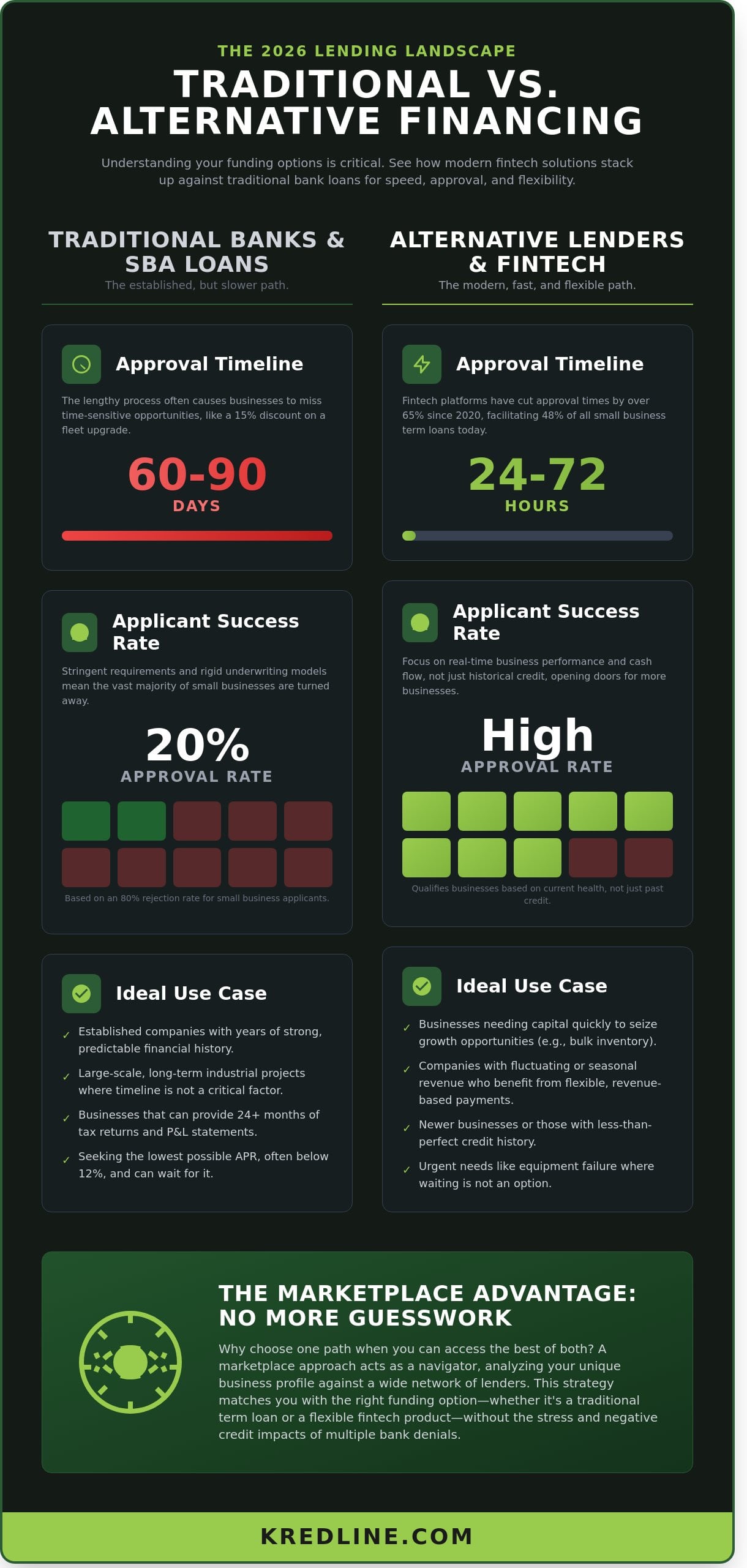
On October 14, 2025, a mid-sized logistics company lost a 15% discount on a fleet upgrade because their traditional bank approval process dragged into its seventh week. It’s a story we hear often, where the rigid structure of legacy finance fails to keep pace with real-world opportunities. Understanding the nuances of term business lending isn’t just about getting a loan anymore; it’s about timing your capital injection to match your specific growth cycle before the window of opportunity closes.
You’ve likely felt the pressure of choosing between a fixed payment you can plan for and a variable option that might fluctuate with your monthly sales. It’s stressful to worry about hidden fees or wonder if you’ll have the funds in time to meet a seasonal surge. We’ll help you clear up that confusion and show you how to secure a lump sum with transparent terms and fast approval times. This guide provides a clear roadmap to the 2026 lending environment, helping you choose the right path for your revenue model without the typical bank headaches or endless red tape.
Key Takeaways
- Discover how the shift toward alternative providers offers more flexibility than traditional banks for your 2026 growth plans.
- Compare SBA loans against revenue-based financing to identify which structure aligns best with your business’s cash flow patterns.
- Learn to assess the ROI of term business lending so you can confidently invest in opportunities that generate more revenue than the cost of the capital.
- Get a step-by-step framework for organizing your financial data and understanding the metrics lenders use to evaluate your business’s health.
- Understand how a marketplace approach acts as a navigator, matching your specific profile to the right funding options without the stress of multiple bank denials.
What is Term Business Lending in 2026?
Term business lending is the foundational “lump sum” financing model where you receive a specific amount of capital upfront and repay it over a predetermined schedule. In 2026, this landscape has evolved far beyond the local bank branch. While traditional institutions still handle large-scale industrial loans, private lenders and fintech platforms now facilitate approximately 48% of all small business term loans. This shift means you can often secure funding in 72 hours rather than the 60 day waiting period common in previous decades.
The structure is straightforward. You receive your principal, and you agree to pay it back plus the cost of capital. This cost is usually expressed as an Annual Percentage Rate (APR) or a factor rate. For example, if you take a $100,000 loan with a 1.15 factor rate, you’ll repay $115,000. It’s a predictable, “one and done” arrangement. Business owners choose term business lending when they have a specific destination for every dollar, such as a major renovation or a bulk inventory purchase that will drive revenue for the next three years.
The Core Mechanics of a Term Loan
A term loan delivers the entire balance to your business checking account at once. This differs from a business line of credit, which functions more like a safety net you draw from as needed. In the 2026 economy, 74% of small businesses opt for fixed interest rates over variable ones to protect their margins against fluctuating federal rates. Your amortization schedule determines how much of each payment goes toward interest versus the principal. This predictability helps you manage monthly cash flow without the “payment shock” often associated with revolving debt products.
Why Term Lending is Essential for Growth
Growth requires significant, immediate investment that daily cash flow can’t always cover. If you’re looking to acquire a competitor or invest in a $200,000 equipment upgrade, a short-term business loan provides the necessary leverage. Beyond the capital, there’s a psychological advantage: a fixed end date. You know exactly when the debt will be off your books. Additionally, successfully retiring a term loan is one of the fastest ways to build your business credit score. It demonstrates to future creditors that your company can handle six-figure responsibilities, clearing the path for even larger expansion projects down the road.
- Predictability: Fixed monthly or weekly payments make budgeting simple.
- Speed: Modern alternative providers have cut approval times by 65% compared to 2020 standards.
- Purpose: Best suited for long-term ROI projects rather than daily operational gaps.
Traditional Term Loans vs. Alternative Financing Structures
Choosing the right capital source depends on your timeline and your cash flow patterns. Traditional SBA 7(a) loans remain a popular choice for their low rates, but the 60 to 90 day approval process often stalls time-sensitive growth opportunities. Modern private lenders have filled this gap by cutting the wait down to 24 or 48 hours. This shift in term business lending means you no longer have to choose between growth and speed, though the cost of capital varies significantly between these paths.
The main trade-off centers on the ease of approval versus the total interest paid. While a bank might offer the lowest APR, they often reject 80% of small business applicants. Alternative structures prioritize your business’s current performance and real-time data, making them accessible even if your credit history isn’t perfect. For a retail shop or a restaurant facing a sudden equipment failure, a merchant cash advance serves as a quick bridge. It’s funded fast, often within a single business day, by purchasing a portion of your future sales.
Fixed Payment Term Loans
These loans are the bedrock of term business lending for established companies. They work best if your bank account shows steady, predictable growth month over month. Lenders typically require 24 months of tax returns and clear P&L statements to verify your stability. The primary advantage here is the lower APR, which often stays below 12% for businesses with strong financial profiles. You’ll know exactly what’s leaving your account every month, which makes long-term budgeting much simpler.
Flexible Revenue-Based Options
If your sales aren’t a flat line, a fixed payment can feel like a burden during a slow month. For businesses with peaks and valleys, revenue-based financing offers a built-in safety net. Your payments fluctuate based on your daily or weekly sales volume. If you have a quiet week in January, your payment drops automatically. Qualification focuses on your last 6 months of bank data rather than just a static credit score. This structure protects your cash flow during seasonal dips, ensuring you don’t overextend when revenue is lean.
Every business reaches a point where they need to decide if waiting for a traditional bank is worth the missed opportunity. If you’re ready to see what’s available for your specific situation, you can prequalify for business funding in just a few minutes without any obligation. We’re here to help you navigate these choices so you can focus on running your business.
Matching the Loan to Your Business Need
Choosing the wrong timeframe for your capital can lead to unnecessary interest or unexpected cash flow bottlenecks. You wouldn’t finance a three-month inventory purchase with a five-year term; that is a recipe for paying interest long after the goods are sold. Successful term business lending relies on aligning the repayment schedule with the life of the investment. If the capital is meant to fuel a project that concludes in six months, your debt should ideally be retired shortly after that project pays out.
Before you sign a contract, focus on the Return on Investment (ROI). If a $40,000 loan costs you $6,000 in total interest but allows you to fulfill a contract worth $95,000 in gross profit, the math is clear. You also need to monitor your debt-to-income ratio. Most healthy businesses aim for a debt service coverage ratio (DSCR) of at least 1.25. This means that for every dollar of debt payment, your business generates $1.25 in net operating income. Keeping this buffer ensures you can handle a slow week without stress.
It’s common to feel uneasy about daily or weekly payment schedules. However, most modern lenders utilize automated ACH withdrawals for a specific reason. This system mirrors the natural rhythm of your sales cycle. Instead of a massive lump sum disappearing from your account on the 1st of the month, smaller amounts are processed automatically. This keeps your bank balance more predictable and prevents the “end-of-month shock” that often catches small business owners off guard.
Financing Long-Term Assets
When you are investing in machinery, vehicles, or specialized technology, equipment funding is usually the smartest route. By using the equipment itself as collateral, you can often secure more competitive rates than you would with unsecured debt. To find your break-even point, divide the monthly loan payment by the additional revenue the asset generates. If a new $3,000-a-month oven allows a bakery to produce 40% more bread, the asset pays for itself within the first few hours of operation each week.
This same principle applies to commercial real estate. If your growth plan includes purchasing a new office, warehouse, or retail space, it’s often best to work with a firm that focuses on property financing. For example, financial services companies like Icon Capital LLC specialize in a wide range of real estate loan programs designed for these types of long-term investments.
Short-Term Working Capital Needs
There are moments when speed is your most valuable asset. A short-term business loan is designed for these sprints, such as bridging a 30-day gap between an invoice and a payment. These funds can often be deposited in 24 to 48 hours. Whether you need to cover a $12,000 payroll during a seasonal dip or grab a 20% bulk discount from a supplier, the agility of term business lending ensures you don’t miss opportunities while waiting for traditional bank approvals.
The Application Framework: Getting Approval-Ready
Securing term business lending in 2026 requires more than just a decent credit score. Lenders have moved toward a more holistic view of business health. Preparation is the difference between a fast approval and a frustrating rejection. Follow these five steps to ensure your business is ready for the underwriting process.
- Step 1: Organize your financial data. Focus on your last 4 to 6 months of bank statements. Lenders use these to verify your average daily balance and monthly revenue consistency.
- Step 2: Calculate your Debt Service Coverage Ratio (DSCR). This number shows if you can afford new debt. Divide your net operating income by your total annual debt payments. Aiming for a ratio of 1.25 or higher signals to lenders that you have a 25% cushion to handle repayments.
- Step 3: Review your credit landscape. Check both your personal FICO and your business credit scores. A personal score below 670 or a business score with recent late payments can limit your options or increase your interest rates.
- Step 4: Create a “use of proceeds” statement. Don’t just ask for capital. Show exactly how the funds will drive growth. For example, explain how a $75,000 loan will fund a new inventory management system that reduces waste by 15%.
- Step 5: Compare multiple offers. Look beyond the monthly payment. Evaluate the total cost of capital and check for hidden fees like origination costs or early repayment penalties.
What Lenders Look for in 2026
The lending environment has shifted toward cash flow underwriting. Traditional collateral matters less than it used to. Modern lenders prioritize your bank balance consistency over a single high-revenue month. If your account drops to a near-zero balance multiple times a month, it’s a major red flag. They also look for “clean” statements. More than two Non-Sufficient Funds (NSF) occurrences in a 90-day period or existing tax liens will often lead to an automatic denial.
Navigating the Documentation Process
Speed is essential when you’re ready to grow. You’ll need your Tax ID, basic ownership information, and recent tax returns. Many modern platforms now allow you to create digital connections to your accounting software like QuickBooks or Xero. This transparency speeds up the verification of your term business lending application, often cutting approval times from five business days down to 24 hours. Always be upfront about existing business debt. Lenders will see your current positions during a soft credit pull, and honesty builds the trust needed for a long-term partnership.
If you’re ready to see where your business stands, you can prequalify for business funding in minutes without affecting your credit score.
The Broker Advantage: Why a Marketplace Approach Wins
Walking into your local bank branch feels like the logical first step, but it’s often the most limiting one. If that single institution rejects your application, you’re back at zero with a fresh inquiry on your credit report. Data from 2024 shows that big banks approve fewer than 15% of small business loan requests. Kredline changes this dynamic by acting as a navigator. Instead of pitching one product, we match your specific profile to a network of third-party providers. This allows you to compare different funding options like a Merchant Cash Advance against traditional term business lending side-by-side. You see the cost, the speed, and the long-term impact before signing anything.
A marketplace approach gives you the power of choice. You aren’t forced into a specific box. If your business has high credit but low monthly volume, or high volume but a shorter time in business, we find the lender that values your specific strengths. Choosing the right structure for term business lending depends entirely on your 2026 growth targets. We’re here to ensure you don’t outgrow your debt before you’ve even had a chance to invest it.
Saving Time and Reducing Stress
Business owners often spend over 20 hours on a single bank loan application. That’s time taken away from operations, staff management, or sales. Our “one application, many offers” model cuts that time down to minutes. You don’t have to listen to a biased sales pitch from a direct lender who only wants to sell their own product. We stay objective. When multiple lenders see your file in a marketplace, they compete for your business. This competition often leads to lower rates or more flexible repayment schedules that wouldn’t be available if you approached them individually. It’s a more efficient way to protect your time and your sanity.
Next Steps for Your Business
Start by looking at your cash flow for the last 90 days. This helps you decide if you need a quick bridge for a seasonal gap or a long-term investment for equipment. You can prequalify for business funding through our platform without a hard credit pull. It’s a low-risk way to see where you stand in the current market. Having a financial resource on standby means you can jump on a bulk inventory discount or a new location the moment it becomes available. We’re here to help you scale, providing the clarity you need to make confident decisions for your company’s future.
Taking the Next Step in Your Growth Strategy
Navigating the financial landscape in 2026 requires more than just a good credit score; it’s about strategic alignment. You’ve seen how matching a 5-year loan to equipment or securing a 12-month facility for working capital stabilizes cash flow. Preparing your documentation now, including 6 months of bank statements, puts you ahead of the curve. Choosing term business lending isn’t just about debt; it’s fuel for your next 24 months of operations.
Finding the right fit shouldn’t be a full-time job. Kredline connects you to over 75 alternative and traditional lenders through one transparent portal. There’s no corporate jargon here. Whether you need $25,000 for inventory or $500,000 for a new location, we offer tailored solutions for working capital and equipment. The process is fast, moving at the speed of your business without the stress of traditional bank queues.
See your funding options and prequalify with Kredline today
Your business has the potential to lead the market this year, and the right partner makes that journey much smoother.
Frequently Asked Questions
What is the typical interest rate for a business term loan in 2026?
In 2026, interest rates for business term loans generally range from 6.5% to 15% for most qualified small businesses. If your credit score is above 720, you can likely secure a rate at the lower end of that scale. These figures follow the market stabilization seen in late 2025. Rates from online lenders might be slightly higher than traditional banks, but they offer faster access to capital when you need to move quickly on an opportunity.
How long does it take to get approved for term business lending?
Approval times for term business lending currently range from 48 hours to about 22 days depending on the lender’s structure. Online fintech platforms have streamlined their systems to provide a decision within 2 business days if you have digital records ready. Traditional banks still take longer, often requiring 3 weeks to process manual paperwork and appraisals. Having your 2024 and 2025 tax returns digitized will help you move through the queue much faster.
Can I get a business term loan if I have bad credit?
You can still qualify for a loan with a credit score as low as 580, though the terms will reflect the higher risk. Lenders will look closely at your annual revenue, usually requiring at least $150,000 in yearly sales to approve the application. You might face interest rates closer to 18% or be asked to provide specific equipment as collateral. It’s a practical way to fund growth while you focus on improving your credit profile over the next 12 months.
What is the difference between a term loan and a merchant cash advance?
A term loan provides a lump sum with a fixed monthly payment, while a merchant cash advance is an advance against your future credit card sales. Term loans are almost always more affordable, with annual percentage rates often 40% lower than the costs associated with an advance. Because a merchant cash advance takes a daily cut of your sales, it can create a cash flow squeeze during slow weeks. Term loans offer the predictability you need for long term budgeting.
Do business term loans require a personal guarantee?
Most lenders require a personal guarantee for small business loans, particularly for amounts under $500,000. This means you’re personally responsible for the debt if the business can’t make its payments. Roughly 92% of non-bank lenders include this requirement to keep interest rates competitive without requiring physical collateral like real estate. It’s a standard industry practice that builds trust between you and the lender by showing your commitment to the project.
Can I pay off my business term loan early to save on interest?
You can usually pay off your balance early, but you should check your specific contract for a prepayment penalty. Some lenders charge a fee, often 2% of the remaining principal, to cover their lost interest revenue. Other modern lenders offer “no-penalty” terms that allow you to clear the debt whenever your cash flow allows. If you plan to pay early, it’s worth calculating if the interest savings are greater than any potential exit fees.
What is the maximum amount I can borrow with a term business loan?
Maximum loan amounts can reach $5 million, but most small businesses find their limit is tied to 10% or 15% of their annual gross revenue. If your company generates $1 million in yearly sales, a lender might approve you for a loan between $100,000 and $150,000. Lenders also look at your debt-to-income ratio to ensure you aren’t overextended. Your industry and the length of time you’ve been in business also play a role in determining that final number.
What happens if my business revenue drops during the repayment period?
If your revenue drops, your fixed monthly payment for term business lending stays the same, which can put pressure on your working capital. Unlike flexible lines of credit, these loans require consistent installments regardless of your monthly sales performance. If you see a 25% dip in revenue coming, it’s smart to reach out to a resource like Kredline to discuss your options. Communicating with an advisor before a payment is missed is the best way to protect your business credit score.

Article by
Billy Wagner Jr
Billy has 15 years of customer service experience and several years of experience in business loans and merchant services. His passion is helping business owners understand their options and assisting them in making confident decisions around funding and payment processing.
