



Imagine it’s a Tuesday morning and you’re staring at a $250,000 quote for new equipment you need by Q1 2026. You know an SBA 7(a) loan is likely your best path to growth, but the moment you try to figure out the actual monthly drain on your cash flow, the numbers start to blur. Between the 3% spread over the prime rate and those upfront guarantee fees, guessing isn’t a strategy. Using a precise sba loan calculator is the only way to ensure your expansion doesn’t accidentally squeeze your operating capital before that new revenue arrives.
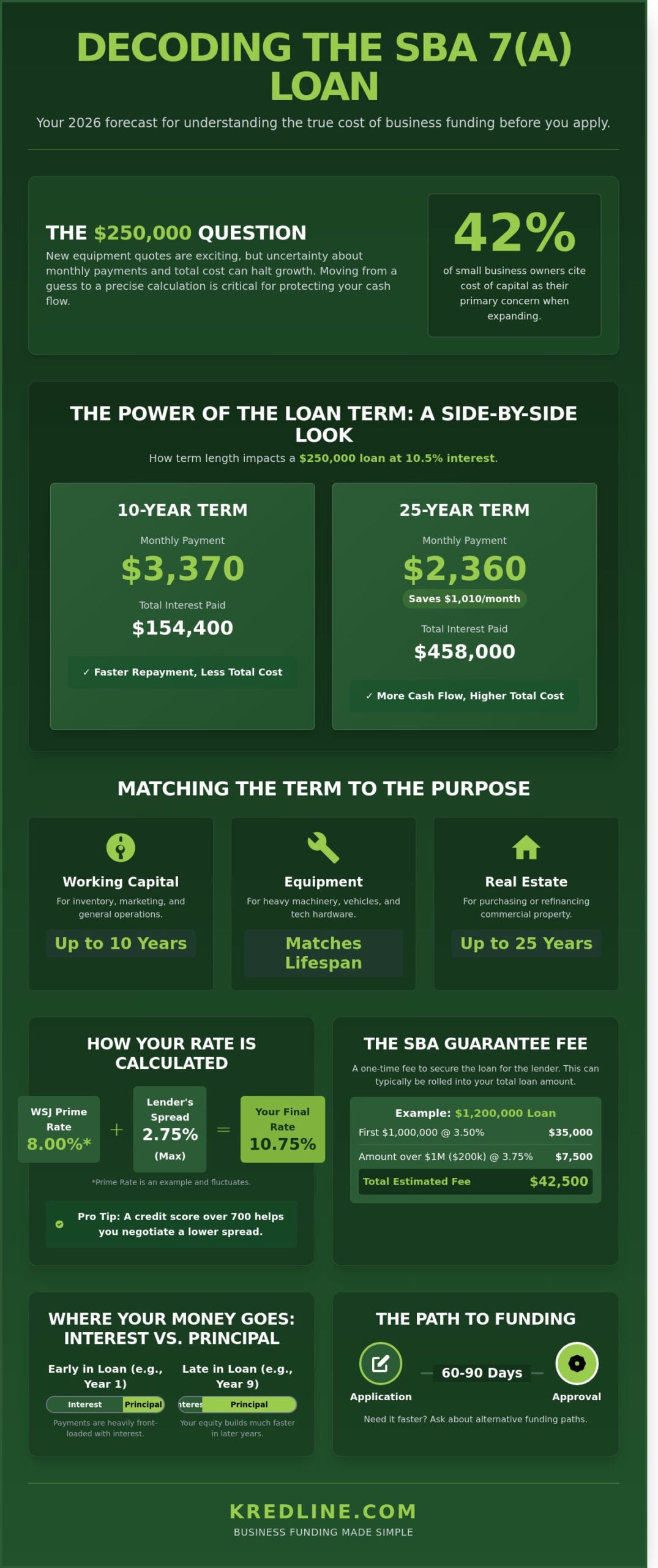
We know the 60 to 90 day wait for SBA approval is stressful enough without wondering if you can actually afford the debt. About 42% of small business owners cite cost of capital as their primary concern when expanding, especially with variable rates in the mix. In this guide, you’ll learn how to accurately forecast your 2026 funding costs and see exactly how much interest you’ll pay over a 10 or 25 year term. At Kredline, we’re here to translate these complex bank processes into clear steps. We’ll break down the fee structures so you can know your numbers before you spend 40 hours on paperwork.
Key Takeaways
- Use an sba loan calculator to project your monthly payments and see how term lengths-ranging from 10 to 25 years-impact your business cash flow.
- Learn how interest front-loading and amortization schedules affect your debt repayment strategy over the life of the loan.
- Discover why real-world lender fees often differ from online estimates and how to account for these variables in your budget.
- Master the documentation process by identifying the specific tax returns and financial reports needed to speed up your application.
- Explore alternative funding paths for situations where your business needs capital faster than the typical 60-90 day SBA timeline allows.
Understanding SBA 7(a) Loan Costs and Monthly Payments
The SBA 7(a) loan is the gold standard for working capital, providing small business owners with the long-term stability needed to scale operations without the aggressive repayment schedules of traditional bank products. When you use an sba loan calculator, you’re doing more than just looking at a monthly number. You’re mapping out the future of your cash flow by estimating how principal and interest will interact over the life of your debt. These loans are government-backed, which allows lenders to offer more favorable terms to businesses that might not qualify for conventional financing elsewhere.
The SBA 7(a) Loan Program typically offers repayment terms that align with the specific use of the funds. If you’re using the capital for inventory, marketing, or general working capital, you’ll usually see a 10-year term. For those purchasing heavy machinery or commercial vehicles, the term often matches the equipment’s expected lifespan. If your goal is purchasing or refinancing commercial real estate, terms can extend up to 25 years, which significantly lowers the monthly burden on your business bank account.
An sba loan calculator helps you visualize these different scenarios before you ever sign a term sheet. By plugging in different loan amounts and durations, you can see exactly how a $100,000 infusion of capital fits into your existing budget. This clarity is vital for avoiding the common trap of over-leveraging your business during a growth phase.
How Interest Rates Work in 2026
In 2026, SBA interest rates continue to be pegged to the Wall Street Journal Prime Rate. Lenders are permitted to add a negotiated “spread” on top of this base rate. For loans exceeding $50,000, the SBA limits this spread to a maximum of 2.75% for most variable-rate structures. If the Prime Rate sits at 8.00%, your interest rate would likely land between 10.25% and 10.75%. Your personal credit profile and business debt-service coverage ratio determine where you fall in that range. Higher credit scores, typically those above 700, give you the leverage to negotiate a lower spread with your lender.
The Impact of Loan Terms on Cash Flow
The length of your loan term is the most significant lever you have for managing monthly affordability. Consider a $250,000 loan at a 10.5% interest rate. On a 10-year term, your monthly payment would be approximately $3,370. If you move that same loan to a 25-year term, the payment drops to about $2,360. While the 25-year option saves you $1,010 every month, you’ll end up paying far more in total interest over the decades. It’s a trade-off between immediate breathing room and long-term cost. To find the right balance for your specific situation, you can prequalify for business funding to see what terms your business currently supports.
The Math Behind the Numbers: Amortization and Fees
Using an sba loan calculator gives you a clear monthly figure, but it doesn’t show the internal mechanics of your debt. Amortization is the math that ensures your loan balance hits zero at the end of the term. It’s a structured descent. However, SBA loans are heavily front-loaded with interest. This means your initial payments do very little to reduce the actual principal. During the first 36 months of a typical 10-year loan, more than 50% of your monthly payment might go toward interest rather than principal. It’s only later in the term that you’ll see your equity in the business or property start to climb rapidly.
Breaking Down the SBA Guarantee Fee
The SBA charges a guarantee fee to protect the lender if you can’t pay back the loan. It’s not insurance for you; it’s security for the bank. This fee varies based on the loan size and the percentage of the loan the government guarantees. For example, loans over $1,000,000 often carry a fee of 3.5% for the amount up to $1,000,000 and 3.75% for any amount above that. You can find the latest SBA 7(a) loan details regarding these percentages on the official government site. Most borrowers choose to roll this fee into the total loan amount. While this saves you from a large upfront cash outlay, it means you’re paying interest on that fee for the life of the loan.
Understanding the Amortization Schedule
Your amortization schedule is a month-by-month breakdown of every payment. It’s a vital tool for tracking how much of your business you actually own. In a standard 25-year real estate SBA loan, the tipping point where principal payments exceed interest often doesn’t happen for over a decade. If you have a windfall or a high-revenue quarter, making extra principal payments can drastically reduce your total interest cost. Many owners don’t wait for the full term. Data shows that 60% of small business borrowers refinance or pay off their loans within the first 7 years as they scale or seek more flexible terms.
Beyond the interest and guarantee fees, you’ll need to budget for closing costs. These include appraisals, environmental reports, and packaging fees. These can easily add $3,500 or more to your startup costs. If you’re still weighing your options, it’s a good idea to prequalify for business funding to see how an SBA loan compares to other available capital sources. Knowing these numbers and checking them against an sba loan calculator early in the process prevents surprises when you finally sit down at the closing table.
Why Your Calculated Payment Might Differ from Reality
An sba loan calculator provides a solid baseline for your monthly budget, but it rarely accounts for the granular details of a bank’s final offer. Most online tools operate in a vacuum, assuming a static interest rate and zero closing costs. In reality, the figure you see on your screen is often the best-case scenario before a lender applies their specific risk adjustments and fee structures.
Lenders often charge service fees that aren’t reflected in a standard interest rate calculation. These can range from 0.5% to 2% of the total loan amount. Additionally, the Prime Rate is a moving target. If the Federal Reserve adjusts rates during your 60 to 90 day underwriting period, your final interest rate at closing will reflect those changes. You should also budget for collateral-related expenses. Appraisals for commercial real estate can cost between $2,000 and $5,000, while legal fees for complex loan structures can add several thousand dollars to your upfront costs. To get a clearer picture of what you actually qualify for, you can prequalify for business funding through platforms that look at your actual data rather than just hypothetical numbers.
The Role of the Debt Service Coverage Ratio (DSCR)
Lenders use the DSCR to determine if your business generates enough cash to cover its debts. While an sba loan calculator tells you what you owe, the DSCR tells the bank if you can afford it. Most SBA loan programs require a minimum ratio between 1.15x and 1.25x. To find yours, divide your annual Net Operating Income by your total annual debt payments. If your business earns $125,000 in profit and has $100,000 in annual debt, your ratio is 1.25x; this meets the standard threshold for most banks and indicates a healthy cushion for repayment.
Variable Rates and Market Volatility
The majority of SBA 7(a) loans feature variable interest rates that adjust quarterly. This means your payment isn’t set in stone for the next 10 or 25 years. On a $500,000 loan with a 10-year term, a 1% rate hike increases your monthly payment by approximately $250. Over the life of the loan, that 1% shift costs you an extra $30,000 in interest payments.
To mitigate this risk, you can consider these strategies:
- Negotiate a “rate cap” with your lender to limit how high the interest can climb.
- Explore the SBA 504 program, which offers fixed-rate options for long-term equipment or real estate.
- Refinance into a fixed-rate product once your business credit profile strengthens.
Understanding these fluctuations helps you build a more resilient cash flow plan. It ensures that a shift in the economy doesn’t catch your business off guard or jeopardize your working capital.
Preparing Your Business for a Successful SBA Application
Using an sba loan calculator gives you a target, but your documentation proves you can actually hit it. Lenders don’t just want to see that you’re profitable today. They want to see a history of responsibility. You’ll need to gather three years of federal tax returns for the business and every owner holding at least 20% of the company. These documents serve as the foundation for your debt service coverage ratio calculation, which determines if your cash flow can handle the new debt.
Accuracy is your best friend during this process. Update your Balance Sheet and Profit and Loss (P&L) statement so they’re current within the last 90 days. You should also draft a specific “Use of Proceeds” list. Instead of asking for a lump sum, show exactly where the money goes. For example, allocating $50,000 for a specific piece of machinery and $25,000 for seasonal payroll shows the lender you have a concrete plan for growth. Don’t forget to check your personal and business credit scores. A 2021 study by the Wall Street Journal noted that credit errors are common; finding and fixing a mistake before the underwriter sees it is vital for your approval odds.
The Importance of a Clean P&L Statement
Your P&L tells the story of your daily operations. Lenders want to see that your revenue is growing or staying steady while your expenses remain controlled. If you had a rough patch, be ready to explain it. This is where “add-backs” become essential. If you paid a one-time $10,000 fee for a rebranding project, that expense shouldn’t count against your long term ability to pay back a loan. By identifying these one-time costs, you show a higher “true” profit. This makes the monthly payments you found on the sba loan calculator look much more affordable to the bank.
Collateral and Personal Guarantees
SBA loans often require collateral, which can include business real estate, heavy equipment, or even inventory. If your business lacks enough physical assets to fully secure the loan, the SBA won’t automatically decline your application, but they may require a lien on personal assets like your primary residence. It’s also a standard rule that anyone owning 20% or more of the business must sign a personal guarantee. This ensures that the owners are fully committed to the loan’s success. If these requirements feel too rigid for your current situation, you can explore revenue-based financing to see if a more flexible structure fits your needs better.
Exploring Funding Alternatives When SBA Timelines Don’t Align
While using an sba loan calculator gives you a clear picture of your ideal financial future, the present often demands more speed. SBA loans are famous for their low rates, but they’re equally famous for their 60 to 90 day processing times. If your business faces an immediate opportunity or an urgent bill, waiting three months isn’t a strategy. It’s a risk. In 2023, many small businesses reported that the ability to act within a 48-hour window was the difference between winning a contract and losing it to a competitor.
Alternative funding options exist to fill this specific void. These products carry higher interest rates than a standard 7(a) loan, but the friction is significantly lower. You’re paying for speed and certainty. Think of it as a bridge. You can secure a short-term business loan to handle immediate inventory needs or equipment repairs in as little as 24 to 48 hours. This keeps your operations running smoothly while your long-term SBA application processes in the background. Kredline acts as your navigator here, helping you secure that vital capital without the typical banking red tape.
When to Consider a Business Line of Credit
An SBA loan provides a lump sum, which is great for major expansions. However, many business owners find that a business line of credit offers the type of flexibility a fixed loan cannot match. Instead of taking $200,000 at once and paying interest on the full amount, you draw only what you need. This is a “draw as you go” model. It’s especially helpful for managing seasonal gaps where cash flow dips for a specific 30-day period. You might use the sba loan calculator to plan for a new building, but use a line of credit to ensure your team gets paid during a slow month.
Revenue-Based Financing and Merchant Cash Advances
If your business generates high sales volume but lacks the “hard” collateral like real estate that the SBA usually requires, revenue-based financing might be the right path. These structures bypass strict asset requirements by focusing on your actual bank deposits and credit card processing history. It’s a performance-based approach. Since the approval is tied to your daily or weekly cash flow, the paperwork is minimal compared to federal programs.
The goal is to keep your business moving forward, not stuck in a filing cabinet. You can use Kredline to prequalify for business funding across a variety of providers. This allows you to compare real offers in hours rather than waiting months for a government-backed response. Whether you’re bridging a gap or fueling a sudden growth spurt, having a partner who understands the urgency of small business is your greatest asset.
Moving From Estimates to Business Growth
Using an sba loan calculator gives you a solid baseline for your 2026 planning, but numbers on a screen are just the beginning. Real-world factors like lender-specific credit overlays or fluctuations in the prime rate will inevitably shift your final monthly payment. Success in securing these funds often comes down to early preparation. You’ll need to have your financial statements and business plan ready to prove you can meet the SBA’s requirements. If the timeline for a traditional SBA loan doesn’t match your immediate needs, you don’t have to navigate the market alone.
At Kredline, we focus strictly on business capital, meaning we don’t handle personal loans or distractions. We provide direct access to a network of 50+ lenders, giving you a wider range of options than a single bank ever could. Whether you’re looking for a long-term SBA 7(a) loan or a faster bridge for equipment, our team offers the expert guidance needed to simplify the process. Explore your funding options and prequalify with Kredline today. Your business deserves a partner that speaks your language and understands your goals.
Frequently Asked Questions
What is the current interest rate for an SBA 7(a) loan in 2026?
SBA 7(a) loan interest rates in 2026 typically range from 10.25% to 10.75% for most standard business loans. These rates are tied to the daily Prime Rate, which currently sits at 8.00%, plus a negotiated spread between 2.25% and 2.75%. If you’re using an sba loan calculator to plan your monthly budget, remember that your specific rate depends on your credit profile and the total loan amount.
How much of a down payment is required for an SBA loan?
You’ll typically need a down payment of at least 10% for most SBA 7(a) loans, especially for startups or real estate purchases. If you’re buying an existing business, some lenders might ask for 15% or even 20% depending on the industry risk and the health of the company you’re acquiring. Having this cash ready shows lenders you’ve got skin in the game and helps lower your total monthly obligation.
Can I use an SBA loan to pay off existing high-interest business debt?
Yes, you can use an SBA 7(a) loan to refinance existing high-interest business debt if the new loan improves your cash flow by at least 10%. This is a smart move for businesses stuck with expensive daily-draw merchant cash advances or short-term bridge loans. Kredline can help you look at your current debt structure to see if refinancing makes sense for your specific bottom line.
What is the minimum credit score needed to qualify for an SBA 7(a) loan?
Most lenders look for a personal credit score of 680 or higher to qualify for an SBA 7(a) loan. While the SBA doesn’t set a strict minimum, a score below 640 often leads to an automatic rejection from traditional banks. Lenders also check your FICO Small Business Scoring Service (SBSS) score, where a 155 is usually the floor for approval.
How long does the SBA loan approval process actually take?
The SBA loan process usually takes between 30 and 90 days from the moment you submit your application to the day funds hit your account. Standard 7(a) loans take the longest because of the extensive documentation required by both the lender and the government. If you need capital faster, SBA Express loans can cut that time down to about 30 days, though they offer lower maximum loan amounts.
Are there prepayment penalties for SBA 7(a) loans?
Prepayment penalties only apply to SBA 7(a) loans with terms of 15 years or longer, such as commercial real estate. If you pay off the loan in the first three years, you’ll face a fee: 5% in the first year, 3% in the second, and 1% in the third. For shorter working capital loans, you can usually pay the balance early without any extra costs or hidden fees.
What happens if I can’t provide collateral for an SBA loan?
The SBA won’t decline your loan solely because you lack collateral, but they’ll require a lien on any available business assets. For loans over $50,000, lenders must follow specific collateral requirements, which might include a mortgage on your personal residence if business assets don’t cover the loan amount. Using an sba loan calculator helps you see if the monthly payment is manageable even without a massive asset pool.
Can a startup business qualify for an SBA 7(a) loan?
Startups can definitely qualify for SBA 7(a) loans, provided the owners have a 10% equity injection and relevant industry experience. You’ll need a detailed business plan with three years of financial projections to prove the business can handle the debt. It’s a rigorous process, but it’s often the most affordable way to get a new venture off the ground without giving up equity.

Article by
Billy Wagner Jr
Billy has 15 years of customer service experience and several years of experience in business loans and merchant services. His passion is helping business owners understand their options and assisting them in making confident decisions around funding and payment processing.
