





Data from the 2025 Small Business Credit Survey shows that 82% of small businesses fail because of poor cash flow management, yet traditional lenders still take an average of 20 to 30 days to approve a simple line of credit. When your walk-in cooler breaks or a seasonal dip hits your revenue, you don’t have a month to wait for a committee’s decision. You’ve likely felt the frustration of a low credit score or a lack of collateral blocking your path to a merchant cash advance or other flexible funding. It’s exhausting to manage fixed monthly payments when your sales fluctuate from week to week.
We agree that your business shouldn’t be held hostage by slow bank bureaucracies. That’s why we’ve built this guide to help you master your 2026 financial strategy. In the following sections, we’ll show you exactly how these advances work, how to calculate the true costs without the confusion, and how to determine if this fast funding option fits your specific cash flow needs. We’ll look at how you can access capital in as little as 24 hours with a repayment structure that actually breathes with your sales volume. By the time you’re done reading, you’ll have a clear roadmap to decide if Kredline can help you bridge your next funding gap without the typical banking stress.
Key Takeaways
- Learn why selling a portion of your future sales for immediate capital is a strategic alternative to traditional debt.
- Demystify factor rates to understand the total, fixed cost of a merchant cash advance before you commit to a contract.
- Compare the 24-hour funding speed and revenue-based requirements of an MCA against the lengthy approval cycles of bank loans.
- Apply the “ROI Rule” to ensure the capital you receive generates more revenue for your business than the cost of the funding itself.
- Discover why using a marketplace or advisor is the safest way to prequalify for competitive terms without the pressure of aggressive lenders.
What is a Merchant Cash Advance and How Does it Work in 2026?
Forget the rigid structure of a traditional bank loan. A merchant cash advance (MCA) isn’t actually a loan; it’s a purchase of your future sales. You’re essentially selling a piece of tomorrow’s revenue to get the cash you need right now. In the fast-paced 2026 economy, where 72% of small businesses prioritize funding speed over long-term interest rates, this model has become a staple for managing immediate cash flow needs.
The shift is fundamental. You aren’t borrowing money and promising to pay it back with interest over years. Instead, you’re entering a contract where a provider buys a specific dollar amount of your future receivables at a discount. This distinction is crucial because it means the cost is a fixed factor, not an interest rate that compounds over time. For businesses that don’t want to tie up personal assets, the no-collateral requirement is a major advantage. If you run a consulting firm or a boutique retail shop, you don’t have to worry about pledging your home or equipment to secure the funds.
The Core Mechanics: Lump Sums and Sales Percentages
The advance amount is typically based on a deep dive into your historical merchant processing data. Providers usually look for at least $10,000 in monthly revenue to qualify. Once the lump sum hits your account, the retrieval process begins. This is known as the “holdback” percentage. Every day, a small portion of your sales, usually between 8% and 15%, is automatically routed to the provider. Because this is a percentage of sales, the repayment is flexible. If you have a rainy day with zero customers, you pay nothing. It’s a self-correcting system that prevents the cash flow crunch often caused by fixed monthly bank payments.
MCA vs. Revenue-Based Financing: Are They the Same?
It’s easy to confuse these terms, but the difference matters for your bottom line. A traditional merchant cash advance typically tracks only your credit card swipes. If your business has shifted toward B2B contracts or ACH payments, revenue-based financing offers more breathing room by looking at your total bank deposits. This ensures your funding capacity grows alongside your entire business, not just one payment channel.
A merchant cash advance is a purchase of future receivables where a business sells a portion of its upcoming sales at a discount to receive immediate working capital.
At Kredline, we see this as a tool for agility. It’s about bridging the gap between an opportunity and the cash required to seize it without the 60-day wait time of a traditional lender. Whether you’re dealing with a seasonal slowdown or a sudden equipment failure, the process is designed to be as fast as your business moves.
Decoding the Cost: Factor Rates vs. Interest Rates
Most business owners are used to Annual Percentage Rates (APR). When you look at a merchant cash advance, that logic changes. Instead of a percentage that fluctuates based on how long the money is outstanding, you’ll see a factor rate. This is usually expressed as a decimal, like 1.2 or 1.4. It represents the total amount you’ll pay back, regardless of the time it takes.
To find your total cost, you multiply the advance amount by this factor. A 1.2 factor on a $10,000 advance means you owe $12,000. That $2,000 fee is locked in from day one. Because this is a purchase of future sales rather than a loan, the cost is fixed. If your sales spike and you finish the repayment in four months instead of six, the total cost remains exactly the same. This Forbes Advisor guide to MCAs explains how this structure differs from traditional amortizing debt. It’s vital to calculate the “effective APR” before signing to see how it stacks up against other funding options.
A Practical Math Example
Let’s look at a $50,000 advance with a 1.3 factor rate. Your total repayment is $65,000. The $15,000 fee is a flat cost. If your business averages $2,000 in daily credit card sales and the provider takes a 15% holdback, they’ll collect $300 that day. On a slower day with only $500 in sales, they only take $75. This flexibility helps during seasonal dips, but remember that the total $65,000 balance doesn’t change.
Common Fees to Watch For
You need to look beyond the factor rate to see the true cost of a merchant cash advance. Many providers add an origination fee, which can range from 2% to 5% of the total amount. You might also see a UCC filing fee, typically between $50 and $200, for public record documentation. Reputable providers are transparent about these costs. If you see daily “administrative” or “maintenance” charges buried in the fine print, it’s a red flag. Transparency is the hallmark of a partner who wants your business to succeed. If you’re weighing these costs against your current cash flow, you can prequalify for funding to see what rates your specific revenue supports.
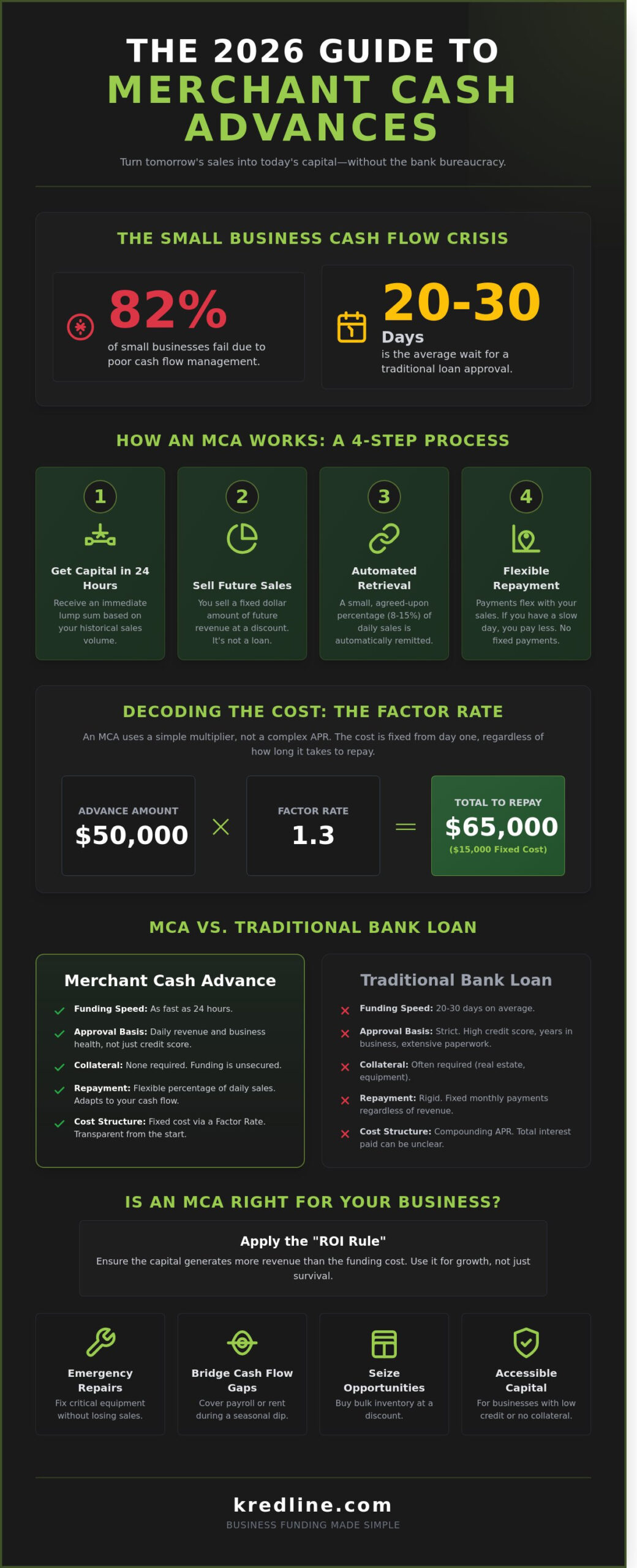
Merchant Cash Advance vs. Traditional Business Loans
Choosing between these options depends on how fast you need the money and what your financial history looks like. Traditional bank loans are built for long-term stability, but they come with a slow approval process. It’s common for a bank to take 4 to 8 weeks to finalize a loan, requiring stacks of paperwork and tax returns. In contrast, a merchant cash advance can be approved and funded in as little as 24 hours. This speed is a lifesaver when you’re facing an unexpected equipment failure or a sudden inventory opportunity that won’t wait for a loan committee.
The qualification process also differs significantly. Banks prioritize high credit scores and collateral. If your score is below 680, you might face an immediate rejection. An advance focuses on your revenue consistency instead. Most providers look at your last three to six months of bank statements to see if your cash flow can support the repayment. Because this is technically a purchase of future sales rather than a loan, many providers only perform a soft credit pull. This means applying won’t damage your credit score, which is a detail often highlighted by the Consumer Financial Protection Bureau when explaining how these products function in the marketplace.
Repayment structures offer the most noticeable daily difference. Bank loans require a fixed monthly check. This stays the same even if you have a slow month. A merchant cash advance uses a variable daily percentage. If your sales drop on a Tuesday, the amount taken out drops too. This flexibility protects your cash flow during seasonal dips, ensuring you aren’t squeezed when customers are sparse.
When a Business Line of Credit is Better
Sometimes a one-time lump sum isn’t what you need. A business line of credit provides revolving access to funds. You only pay interest on the amount you actually draw. This is ideal for recurring needs like monthly payroll or seasonal inventory spikes. Even if a business qualifies for a line of credit, they might choose an advance if they need a larger amount of capital immediately without the strict annual reviews and covenant requirements that banks usually impose.
The Role of Short-Term Loans
A short-term business loan acts as a middle ground. It offers a fixed injection of cash like an advance, but with set, predictable payments over a period of 6 to 18 months. This is a safer route for businesses with very steady revenue that doesn’t fluctuate much. If your P&L shows consistent monthly profits, a term loan can be more cost-effective. You’ll know exactly when the debt will be paid off, making it easier to plan your long-term budget and growth strategy.
Is an MCA Right for Your Business? Strategic Use Cases
A merchant cash advance isn’t a permanent fix for a broken business model. It’s a tactical tool meant for specific, high-impact situations. The most successful owners follow the “ROI Rule.” You only take an advance if the capital generates more revenue than the total cost of the funding. If an advance costs you $3,000 in fees, but that money allows you to secure a contract worth $15,000, the math works. It’s about using speed to capture value that would otherwise disappear.
Seasonal businesses also use this to handle “quiet months” without the pressure of a fixed monthly payment. Since the repayment is a percentage of sales, the amount you pay back shrinks during your slow weeks. This flexibility prevents the cash flow crunch that often leads to defaults on traditional debt. In 2024, data from small business lenders indicated that nearly 35% of retail advances were used specifically to manage these seasonal dips.
Inventory and Equipment Gaps
Speed is the primary reason to choose a merchant cash advance when equipment fails. Imagine a restaurant owner on a Thursday afternoon whose walk-in freezer stops working. If they can’t fix it by Friday morning, they lose $7,500 in weekend inventory and revenue. Waiting three weeks for a traditional bank loan is a non-starter. An advance can often be funded in 24 hours to get the kitchen back online.
Retailers face similar pressures with inventory. A shop owner might see a 12% price hike coming from a supplier in September. By using an advance to buy holiday stock in August, they lock in lower prices and ensure they aren’t hit by supply chain delays. While this works for quick turnarounds, if you’re looking for long-term financing for heavy machinery, equipment funding might offer a more specialized structure with different tax benefits.
Bridging the Gap Between Invoices
Service-based companies often get stuck in the “net-60” trap. You’ve completed a project, but the client won’t pay the $25,000 invoice for two months. Meanwhile, your 10 employees need their paychecks this Friday. Using an advance to bridge this gap keeps your operations running smoothly while you wait for your receivables to land.
However, you must be careful about “stacking” advances. This happens when a business takes a second or third advance before the first is paid off. It’s a dangerous cycle that can quickly consume 40% of your daily sales. Revenue-based thinking is the best way to avoid this. By focusing on your actual daily intake rather than projected growth, you keep yourself from over-leveraging. If you’re ready to see what your numbers allow for, you can prequalify for business funding to explore your real-world options without any commitment.
How to Prequalify and Secure the Best Terms
Securing a merchant cash advance often feels like a race against time, but rushing into the first offer you receive is a common mistake. Going directly to a single, aggressive lender limits your leverage; they know you’re only looking at their numbers. Using a marketplace or a broker acts as a buffer. It forces lenders to compete for your business, which naturally drives down the factor rate. This competition is the most effective tool you have to keep your costs manageable.
Lenders primarily care about your recent performance rather than your distant credit history. To get started, you’ll need your government ID, the last 4 to 6 months of business bank statements, and your merchant processing history if your sales are primarily credit card-based. They aren’t looking for a perfect credit score; they’re looking for revenue consistency. If your monthly deposits fluctuate by more than 25% or 30%, lenders see higher risk. They want to see that your “slowest” month can still cover the daily or weekly payments comfortably. Consistency is king in this industry.
The Prequalification Process
The best way to start is with a soft credit pull. This allows you to see real numbers without a single point dropping from your credit score. You can prequalify for business funding in under 5 minutes by providing basic revenue data through an encrypted portal. When that first offer letter arrives, look past the total funding amount. Focus on the total payback amount. If the document doesn’t clearly state the total cost of the capital, ask for a revised version before moving forward.
Vetting Your Funding Partner
Watch out for predatory “stacking” or hidden fees that can unexpectedly double the cost of capital. A transparent offer clearly states the total repayment amount and the factor rate without burying “administrative fees” in the fine print. Kredline functions as a navigator here, filtering out lenders who use aggressive tactics or opaque contracts. We help you compare multiple offers side-by-side to ensure you’re getting the lowest factor rate available for your specific industry and revenue tier.
Before you sign, run a final stress test on your bank account. Calculate your average daily net income over the last 90 days. If the daily holdback for the merchant cash advance exceeds 15% of that figure, the pace might be too aggressive for your cash flow. You need to ensure you can afford these payments for the next 6 to 9 months without stalling your ability to meet payroll or pay your own suppliers. A funding partner should help you grow, not create a new bottleneck.
Securing Your Business Future in 2026
Choosing the right funding path determines how quickly you can seize a market opportunity or fix a sudden cash flow gap. A merchant cash advance provides the agility that 2026’s fast-paced economy demands, especially when traditional bank timelines don’t align with your immediate payroll or equipment needs. Success hinges on understanding your specific factor rate and ensuring your projected sales comfortably cover the repayments. You don’t have to navigate these complex options alone or settle for the first offer that comes your way.
Kredline connects you to a network of 50+ third-party providers, offering funding ranging from $5,000 to $900,000. You can see your initial offers without a hard credit pull, keeping your credit score protected while you weigh your decisions. It’s about finding a partner that understands the day-to-day realities of running a small business. Explore your funding options and prequalify in minutes with Kredline. Your business has the potential to scale; getting the right capital in place is simply the next logical step to ensure you’re ready for whatever the quarter brings.
Frequently Asked Questions
How does a merchant cash advance affect my credit score?
Applying for a merchant cash advance typically starts with a soft credit pull that doesn’t impact your score, though 15% of high-volume lenders might perform a hard inquiry during final underwriting. Since these aren’t traditional loans, providers don’t usually report your daily payments to consumer credit bureaus like Equifax or Experian. This means your repayment history won’t help or hurt your personal credit rating, making it a neutral option for your credit profile.
Can I get a merchant cash advance with bad credit (under 600)?
You can qualify for a merchant cash advance with a credit score below 600 because lenders prioritize your consistent sales volume over your personal financial history. Most providers look for at least $10,000 in monthly revenue and 6 months of active business operations rather than a high FICO score. This structure makes it an accessible tool for businesses that have hit temporary setbacks but maintain strong daily cash flow. For those looking to improve their credit profile for better long-term financing options, professional credit education services like Allen & Allen, Inc. can provide expert guidance.
What is the average factor rate for an MCA in 2026?
In 2026, the average factor rate for a merchant cash advance ranges between 1.12 and 1.48 depending on your business’s risk profile and industry. If you receive $50,000 with a factor rate of 1.25, you’ll pay back a total of $62,500 through a percentage of your daily sales. These rates have remained stable over the last 24 months, reflecting a competitive market for alternative business funding options.
Is a merchant cash advance considered a loan under federal law?
A merchant cash advance isn’t legally a loan; it’s a commercial purchase of future receivables. Because you’re selling a portion of your future sales at a discount, these transactions aren’t subject to the same usury laws or interest rate caps that govern traditional bank products. This distinction is what allows for the flexible repayment structure that adjusts based on your actual daily revenue.
What happens if my business has a day with zero sales?
If your business has a day with zero sales, the provider doesn’t collect a payment for that specific day. Since the repayment is a fixed percentage of your daily credit card receipts, the amount fluctuates naturally with your business volume. If you’re running a seasonal business like a coastal cafe and your doors are closed for a Tuesday, your payment for that day is $0.
Can I have more than one merchant cash advance at the same time?
You can have more than one merchant cash advance at a time, a practice often called stacking, but it’s generally limited to 2 or 3 active positions. Most lenders require that your total daily payments don’t exceed 25% of your average daily sales to ensure you maintain enough cash flow for operations. At Kredline, we suggest reviewing your total debt service coverage before taking on a second position to avoid squeezing your profit margins.
How fast can I actually get the funds in my bank account?
You can typically see funds in your bank account within 24 to 48 hours of submitting your full application. Many fintech-driven providers have streamlined this to same-day funding if you provide digital bank connections before 11:00 AM. This speed is a primary reason why business owners choose this route when they need to cover an immediate expense like an emergency equipment repair or a sudden inventory opportunity.
Do I need to provide a personal guarantee for an MCA?
Most merchant cash advance agreements require a personal guarantee, which means you’re personally responsible if the business intentionally diverts funds or commits fraud. While the advance is unsecured and doesn’t require physical collateral like your home or vehicles, this guarantee ensures you fulfill the contract’s terms. It’s a standard industry practice that applies to roughly 90% of contracts in the current market.

Article by
Billy Wagner Jr
Billy has 15 years of customer service experience and several years of experience in business loans and merchant services. His passion is helping business owners understand their options and assisting them in making confident decisions around funding and payment processing.
